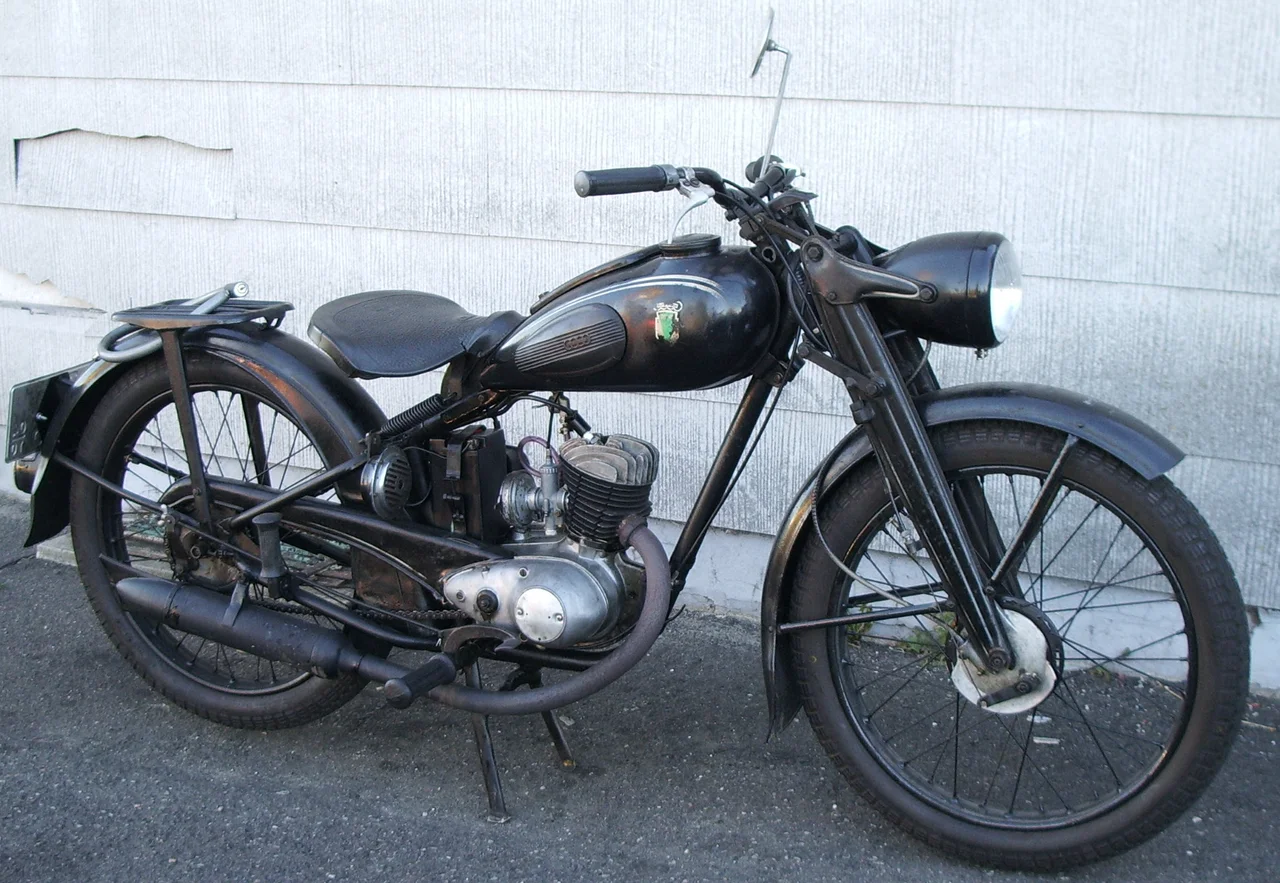

DKW
The initials meant three different things before the company settled down. Jørgen Skafte Rasmussen, a Danish engineer who set up a factory at Zschopau in Saxony in 1916 to make steam fittings, tried that same year to build a steam-driven car and called it the DKW — Dampfkraftwagen. The steam car was a failure. In 1919 he reused the initials for a small two-stroke engine sold as a toy: Des Knaben Wunsch, the boy's wish. Then he put a slightly modified version of that toy engine into a motorcycle frame and had to name it a third time. Das Kleine Wunder — the little wonder. That one stuck, and the little wonder went on to become one of the most widely copied engine designs in the history of the motorcycle.
Sixty Thousand Machines a Year
Zschopau sits in a river valley about 14 kilometres southeast of Chemnitz, at 350 metres, under the twelfth-century Schloss Wildeck. It is not a large place. Motorcycles have been built there since 1922, the world's first motorcycle assembly line ran there from 1926, and by 1928 the Zschopauer Motorenwerke were turning out around 60,000 machines a year — the largest motorcycle factory on earth. DKW's engineers earned the volume. From 1931 Arnold Zoller developed split-single two-strokes for the company, and DKW dominated the Lightweight and Junior racing classes between the wars, along with supercharged racers whose light weight suited them to punishing endurance events like the International Six Days Trial. The company's range ran from that down to the absurd: the smallest engine DKW ever made displaced 6.3 cc, was built for model aircraft, and was shown at the Berlin motor show in 1938.
Four Rings
In 1932 DKW merged with Audi, Horch and Wanderer to form Auto Union, and the four interlocked rings on every Audi built since stand for those four companies. Rasmussen had already become majority owner of Audi Werke AG in 1928, acquiring a plant at Zwickau, and it was there that DKW built the cars that mattered most. The F series — F1 through F8, made from 1931 to 1942 — were the first volume-production front-wheel-drive cars in Europe, powered by transversely mounted two-cylinder two-strokes of 584 or 692 cc, with a combined generator and starter mounted directly on the crankshaft that DKW called the Dynastart. About 218,000 were built at Zwickau. Alongside them ran a stranger line, the rear-drive Schwebeklasse and Sonderklasse of 1929 to 1940, with two-stroke V4 engines whose front pair of cylinders acted as air compressors for forced induction. They looked like V6s from outside. The front cylinders had no spark plugs.
The Design That Got Away
The RT 125, a 125 cc two-stroke built at Zschopau in the 1930s, used loop scavenging and a transfer-port layout that made a small engine unusually efficient. After the Second World War the factory fell inside the Soviet zone and the drawings were taken as reparations — and then the design went everywhere. In Britain it became the BSA Bantam. Harley-Davidson built derivatives from 1948 to 1966. In the Soviet Union it appeared as the Moskva M1A and the Kovrov K-125. Poland produced modified versions as the Sokół 125 and the SHL. And in Japan, once the Allies had voided the copyright, Yamaha reverse-engineered it into the YA-1 of 1955-1958 — the first motorcycle the company ever made. Saab, meanwhile, used a DKW two-stroke as the model for the engine in its first production car, the 92. A small engine designed in an Ore Mountain river town ended up as the common ancestor of a great deal of the postwar motorcycle world.
One Marque, Two Germanys
Auto Union's factories were in Saxony, which became East Germany, and the company had to rebuild itself from nothing in the West. It re-registered as Auto Union GmbH in 1949, first selling spare parts, then producing the RT 125 and the Schnellaster delivery van from Düsseldorf. A three-cylinder prototype that DKW had built in 1939 — 900 cc, 30 hp, streamlined, good for 115 km/h — went into production twice over, on both sides of the new border. In Zwickau it became the IFA F9 and later the Wartburg. In Düsseldorf it became the DKW 3=6, the F91. Production later moved to Ingolstadt, where Audi still builds cars today. Back at Zschopau, the old plant kept building two-strokes for decades afterwards under a new name, MZ.
Last of the Two-Strokes
The postwar DKWs were modest cars with unexpected sporting reserves. The F91 gave way to the F93 in 1956 and then to the Auto Union 1000, whose 1,000 cc three-cylinder two-stroke made 44 or 50 hp; from 1957 buyers could specify the saxomat automatic clutch, unavailable on any other small car, and later versions offered disc brakes when that was still a novelty. In December 1956 the glassfibre-bodied DKW Monza — around 75 were built, on a standard F93 frame — went to the Autodromo Nazionale Monza and took FIA class G records, including 48 hours at an average of 140.961 km/h and 10,000 km at 139.453 km/h. The Junior and F12 series sold well from 1959 to 1965. Then it ended: the F102 was the last DKW car, and production stopped in 1966. Rasmussen's other sideline outlasted the cars in spirit if not in name — the refrigerator business he started in 1928 with three workers, licensed from the American manufacturer Norge, employed 1,200 people by 1938 under the name DKK.
From the Air
The DKW story is anchored at Zschopau, 50.739°N, 13.065°E, in the valley of the River Zschopau about 14 km southeast of Chemnitz at an elevation of 350 m. From the air the town reads as a tight cluster in a wooded valley with Schloss Wildeck on the high ground above it and the long roofs of the motorcycle works strung along the river — the same site that produced DKW machines, then MZ. Terrain rises steadily south into the Erzgebirge toward the Czech border, reaching 1,215 m at the Fichtelberg roughly 35 km southwest, so southbound legs need altitude. Dresden (EDDC) is about 65 km northeast and Leipzig/Halle (EDDP) about 100 km northwest; Prague (LKPR) lies roughly 130 km southeast. The related Auto Union sites are within easy reach on the same flight: Zwickau about 40 km west, Chemnitz 14 km northwest. Valley fog is common in the Zschopau on autumn mornings and can persist well after the ridges clear.
Nearby Stories
- German Hygiene Museum 7.9 km away
- Horch 13 km away
- A. Lange & Söhne 16 km away
- Polabian Language 25 km away
- Battle of Leipzig 41 km away
- The Defenestration of Prague: The Thrown Men Who Started a Thirty Years' War 63 km away
- The Anschluss: When Austria Vanished Overnight 261 km away
- Zwingenberg Castle 283 km away