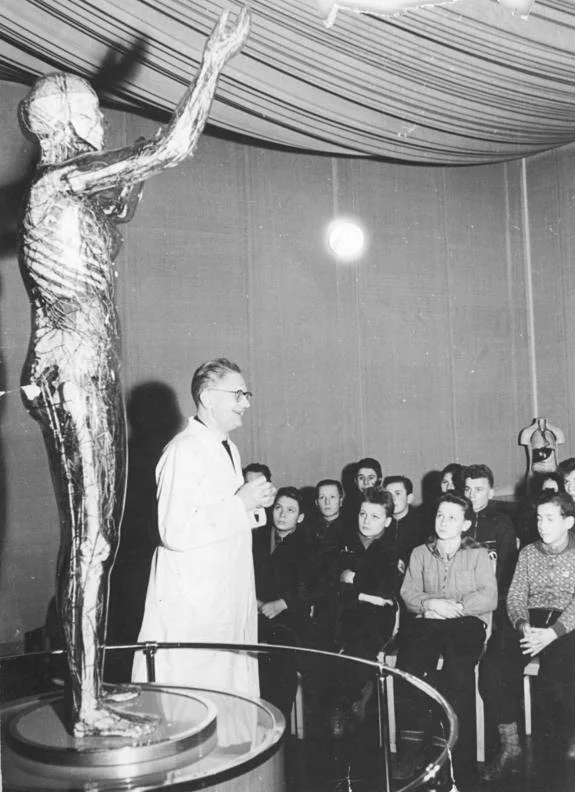

German Hygiene Museum
Stand in front of the Glaserne Mensch and you can see your own anatomy mapped onto a life-sized human figure made of cellulose acetate, internal organs glowing through the transparent skin. The model debuted at the second International Hygiene Exhibition in Dresden in 1930 and became the most famous medical educational object of the 20th century. Copies traveled the world. The original sat in a building designed by Wilhelm Kreis, monumental and modernist, paid for by a Dresden businessman who had made his fortune selling mouthwash. Within three years of the model's debut, the museum was being used by the Nazi regime to argue that some humans were less worth keeping than others. The museum today does not look away from that. It is part of the exhibition.
Karl August Lingner
Karl August Lingner was a Dresden manufacturer who patented a popular antiseptic mouthwash called Odol in 1893 and built one of Germany's most successful early consumer brands on it. He used a portion of his profits to underwrite the first International Hygiene Exhibition in Dresden in 1911, which drew over five million visitors with displays on healthcare, sanitation, and the science of the human body. Lingner founded the German Hygiene Museum the next year, in 1912, as a permanent center for public health education. He was, by the standards of his time, a progressive philanthropist, convinced that ordinary people should understand how their bodies worked and how to keep them healthy. He died in 1916 of cancer of the tongue, before he could see the second International Hygiene Exhibition of 1930-31, for which Wilhelm Kreis designed the museum's permanent home.
The Transparent Man
The 1930 exhibition's centerpiece was the Glaserne Mensch, the Transparent Man, designed by museum staff under chief technician Franz Tschackert. It was the first life-sized anatomical model that allowed viewers to see all the internal organs at once. The skin was made of cellulose acetate, internally lit. The figure stood with its arms outstretched, presented as a kind of secular icon of human biology. The museum produced multiple copies in the following years; they ended up in museums in Chicago, Tokyo, Cleveland, and elsewhere. A Transparent Woman followed in 1936. The model was a triumph of progressive science education in 1930. Within a decade, the same museum was producing materials that argued some humans should be sterilized or killed because of their genes. The Glaserne Mensch did not change; the political use of human biology did.
Under the Third Reich
After 1933, the museum came under Nazi control and was repurposed for the regime's racial ideology. It produced exhibits and printed materials promoting eugenics, sterilization of the disabled, and the so-called racial science that justified the persecution of Jews, Roma, and other groups the Nazis classified as inferior. The museum was used as a venue for events of the German Labour Front, including its 1944 Reichsberufswettkampf vocational competition. Various Nazi government offices moved into the building between 1933 and 1941. Large portions of the collection and the Wilhelm Kreis building were destroyed in the firebombing of Dresden in February 1945. The museum survived the war as a damaged institution under East German rule, slowly rebuilt over the postwar decades. The exhibition today is unusually direct about this period; it does not present the Nazi years as an aberration imposed from outside but as something the museum itself participated in.
Two Films from East Germany
Under East Germany, the museum was an important institution of the GDR's socialist health education system. In 1988, in cooperation with East German gay and lesbian activists, the museum commissioned the DEFA studios to produce Die andere Liebe, the first East German film to deal openly with homosexuality. A year later, just months before the Berlin Wall fell, it commissioned Liebe ohne Angst, the only HIV/AIDS prevention documentary made in East Germany. Both films had small audiences but mattered to the people they reached, in a society where homosexuality had been decriminalized only in 1968 and HIV was only beginning to be discussed publicly. The museum was reconceived after reunification in 1991. Architect Peter Kulka renovated the Kreis building between 2001 and 2005, restoring the monumental classicism while modernizing the interior. The German government included the museum in its 2001 Blue Book of Cultural Lighthouses, twenty institutions of national importance located in the former East Germany.
What the Museum Does Now
The permanent exhibition is called Abenteuer Mensch, the Human Adventure. Across seven thematic rooms, it covers the body, sex, eating, work, memory, beauty, and death; it includes a children's museum of the senses. The collection holds about 45,000 objects documenting the history of public health education. Around 280,000 visitors come each year, making it one of Dresden's most-visited museums. Temporary exhibitions tackle subjects like racism, climate change, AI, and the history of medical experimentation. The current Transparent Woman, a 1990s rebuild, still presides at the center of the permanent show. The Wilhelm Kreis building, restored, holds an institution that has spent the past three decades publicly examining its own twentieth-century history. That is uncommon. Most museums prefer to present themselves as neutral observers. This one knows what it was used for, and says so.
From the Air
Located at 51.04 degrees N, 13.75 degrees E in Dresden's Burgerwiese district, immediately west of the Grosser Garten park. Dresden Airport (EDDC) lies 9 km north. From altitude, the museum is recognizable as a long, low rectangular building between the central Altstadt with its Frauenkirche dome and the green expanse of the Grosser Garten. The Hauptbahnhof (main railway station) is about 600 meters southwest.
Nearby Stories
- Bautzen II 13 km away
- Battle of Mühlberg 15 km away
- Freiberg Cathedral 16 km away
- Ústí Massacre 19 km away
- DKW 22 km away
- 2001 American Memorial 23 km away
- Kromlau Azalea and Rhododendron Park 28 km away
- Ještěd Tower 41 km away