
Dessau-Wörlitz Garden Realm
The prince built a volcano. Not a folly shaped like one - a functioning machine for producing an eruption. On an island in a Wörlitz lake, between 1788 and 1794, Leopold III of Anhalt-Dessau had his architect raise a brick core nearly five storeys high, face it in local boulders, and hollow out a cone at the top containing a chamber with three fireplaces and a crater that could be filled with water. He dug the lake around it, invited his guests, and set the thing off. Only contemporary descriptions record what an eighteenth-century eruption looked like from the far shore. The eruptions were revived in the mid-2000s using sound, light and water effects, and the island still smokes on summer evenings. It is the most theatrical object in a landscape that runs for twenty-five kilometres along the Elbe, and it is not the strangest.
A Prince Who Came Back From England
Leopold III Friedrich Franz ruled a small, poor state on the middle Elbe and had ideas about what a ruler was for. He travelled with his architect and friend Friedrich Wilhelm von Erdmannsdorff to England and Italy, and the two came back convinced that the Baroque garden - clipped, symmetrical, an argument for absolute order - was finished. They had seen Stourhead in Wiltshire and Ermenonville in France, where the landscape was allowed to look like landscape and the visitor walked through a sequence of moods rather than down an axis. From 1765 Leopold began reshaping his country accordingly. Schloss Wörlitz, built between 1769 and 1773, is generally reckoned the first neoclassical building in Germany. The park around it grew to 112 hectares. The Garden Realm as a whole - parks, palaces, villages, dykes, farmland and river meadow - covers 142 square kilometres, and the point was never the garden alone. The point was that a whole territory could be designed and improved together.
Borrowed Buildings
Walk the paths and you walk through a catalogue of the eighteenth century's enthusiasms, each one built properly rather than as scenery. The Gothic House, begun by Erdmannsdorff in 1773 and worked on until 1813, took its model from Horace Walpole's villa at Strawberry Hill and was among the first Neo-Gothic buildings on the continent; one facade is Venetian, the other Tudor. There is a Pantheon of 1795. In 1791 an iron bridge went up here - cast iron, the first on the European mainland, an industrial technology imported as a garden ornament barely a decade after the Iron Bridge opened at Coalbrookdale. Later the taste spread into the villages: Neo-Gothic churches at Riesigk in 1800 and Vockerode in 1811. At Oranienbaum, a Dutch Baroque palace of 1683, Leopold rebuilt the park from 1780 in the Chinese manner set out by Sir William Chambers, with arched bridges, a tea house and a pagoda, and added an orangery in 1811 that runs 175 metres and still shelters citrus trees.
The Synagogue by the Lake
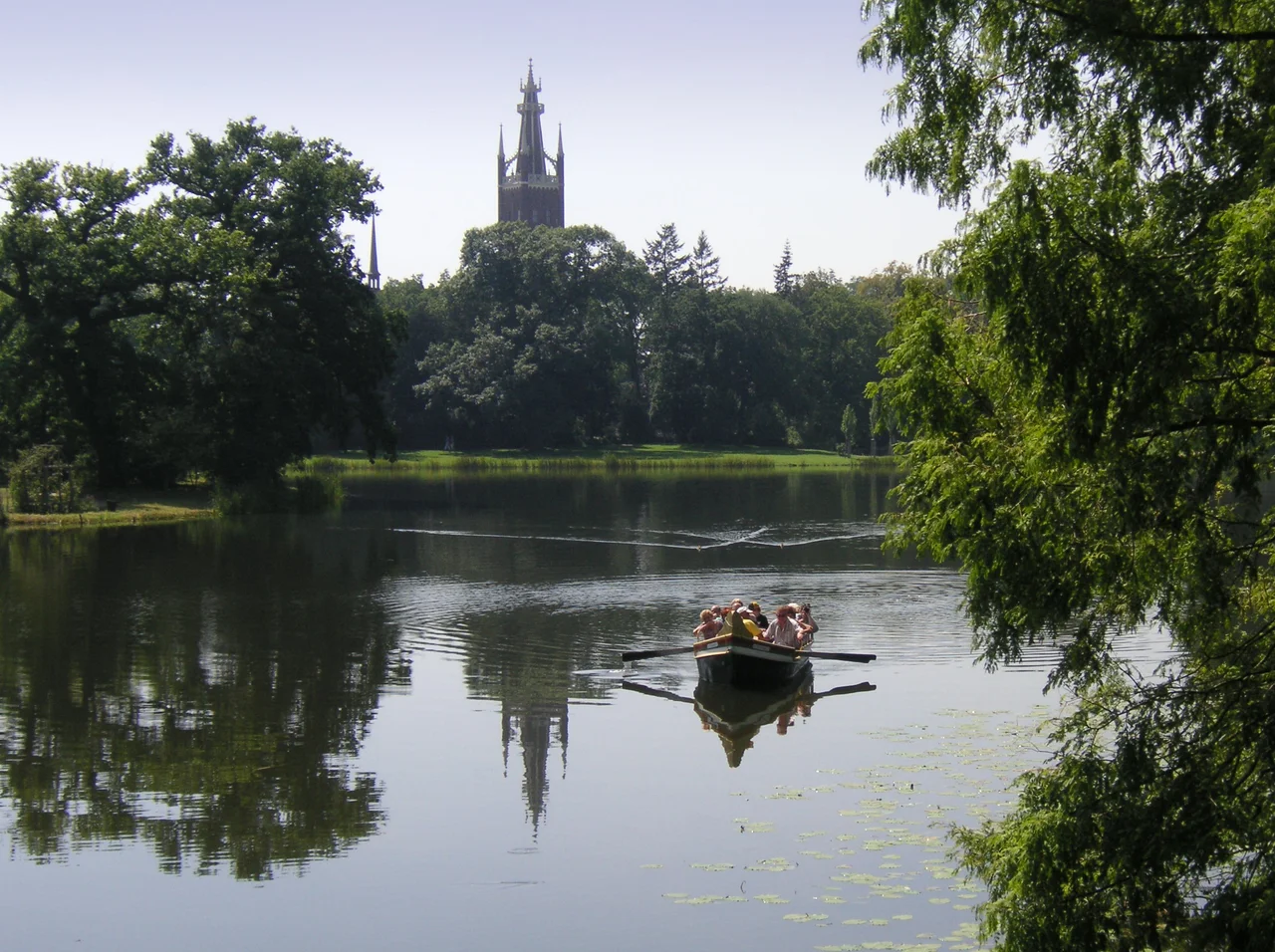
In 1789-90 Leopold built a synagogue in Wörlitz, modelled on the Temple of Hercules Victor in Rome, and placed it where it could be seen across the water from the church. That siting was the argument: the Jewish community of a small German town given a building of the same architectural dignity as everyone else's, in the same view, paid for by the sovereign. It was one of the clearest statements of Enlightenment tolerance any German ruler made in stone. In November 1938 the interior was destroyed in the pogrom. The building itself survived only because the director of the Wörlitz gardens, Hans Hallervorden, intervened to stop it being burned - an argument, presumably, about heritage rather than about the people the building belonged to, and it saved the walls if nothing else. It stands today, restored, still visible from the church, still making Leopold's point.
Open to Anyone Who Walked In
Leopold's other radicalism was the simplest. In his own lifetime the park was open to visitors - all the buildings, the palace included - at a time when a prince's garden was ordinarily a private stage for a private court. Anyone could come and see how the ideas worked. His brothers and family built outward from the same principle: the Georgium north of Dessau from 1780, whose Anhalt collection holds Dürer's Melencolia I and work by Cranach the Elder; the Luisium of 1774-78, a plain neoclassical country house he gave his wife Louise, with a Neo-Gothic Snake House and an orangery borrowing from Kew; Großkühnau of 1780 at the western end, now the seat of the trust that runs the whole realm. Leopold died at the Luisium on 9 August 1817, of the consequences of a riding accident.
What the Twentieth Century Did
A designed landscape twenty-five kilometres long is vulnerable in ways a building is not. In the 1930s a railway line and the Bundesautobahn 9 were driven through, cutting the realm into four pieces, and the Elbe still floods the meadows the design was built to accommodate. UNESCO inscribed the Dessau-Wörlitz Garden Realm as a World Heritage Site in November 2000, and ICOMOS noted at the time, drily and accurately, that "the overall structure of the landscape has undergone a good deal of deterioration." What survives is still coherent enough to walk. It sits inside the Middle Elbe Biosphere Reserve, so the river meadows and old oak stands that Leopold treated as part of the composition are now protected as habitat, which is roughly what he thought they were.
From the Air
The Garden Realm centres on 51.864°N, 12.281°E, spread along the north bank of the Elbe between Dessau and Wörlitz in Saxony-Anhalt. From 2,000 to 4,000 feet the composition is legible as a chain: the Elbe's meander belt running west to east, the Mulde joining it at Dessau, and a string of open parkland, lakes and woodland strung along the north side for some 25 km. Wörlitz is the clearest single target - a lake system with an island in it, the palace on the south-west shore. The A9 motorway crosses the realm north to south and makes a hard visual divider. EDAD (Flugplatz Dessau, named for Hugo Junkers, elevation 187 ft, single 1,000-metre asphalt runway 09/27) lies about 15 km west at Kleinkühnau and is general aviation only; the site holds Europe's first concrete runway, laid in 1927, and the Junkers technical museum. EDDP (Leipzig/Halle) is roughly 55 km south, elevation 470 ft, parallel 3,600-metre runways 08L/26R and 08R/26L. River fog forms readily over the Elbe meadows on autumn mornings; low sun in late afternoon best reveals the designed sightlines between buildings.
Nearby Stories
- Lehnin Abbey 14 km away
- Eisleben 19 km away
- Lichtenburg Concentration Camp 19 km away
- Genthin Rail Disaster 22 km away
- Treuenbrietzen 23 km away
- German National Academy of Sciences Leopoldina 24 km away
- Helmstedt–Marienborn border crossing 36 km away
- Quedlinburg 36 km away