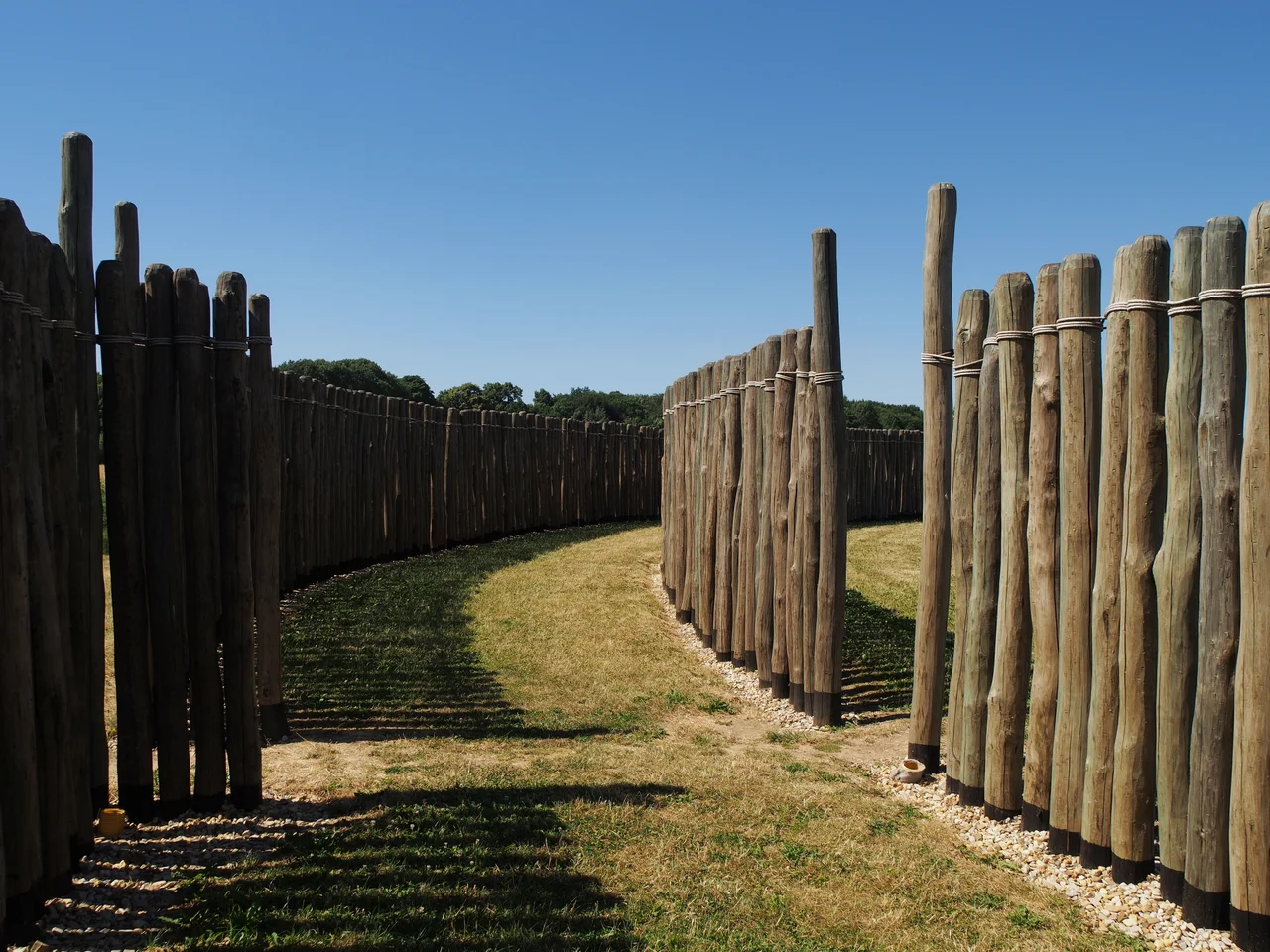

Goseck Circle
From the air, in a dry summer, a buried ditch gives itself away. Wheat rooted in loosened soil stays green a few days longer than the crop beside it, and the difference draws the outline of whatever lies underneath. In 1991 the aerial archaeologist Otto Braasch was flying over farmland near Goseck in Saxony-Anhalt when the drought-stressed crop showed him a set of concentric rings pressed into a field. It took another decade of digging to establish what he had photographed: a timber enclosure raised around 4900 BC, some two thousand years before the first stones were set at Stonehenge, with gates that open onto the midwinter sun.
Reading the Rings
The remains were vulnerable to the plough, so the state heritage office for Saxony-Anhalt decided on excavation and brought in the Institute for Prehistoric Archaeology at the University of Halle-Wittenberg. François Bertemes and Peter Biehl opened a major dig in 2002 and kept returning for a few weeks each year; a team from the University of California, Berkeley joined them in 2004. The site's existence was made public in August 2003.
What they mapped was a concentric ditch 75 metres across enclosing two rings of palisade. The rings are broken by gates. Two of them, on the southern side, line up with sunrise and sunset on the winter solstice; smaller openings face the summer solstice. It was the combination of excavation and GPS survey that made the alignments unmistakable - the geometry only resolves once you know precisely where each post hole sat.
The Trouble with the Word Observatory
Goseck is signposted in German as the Sonnenobservatorium, and promotional material has called it one of the oldest solar observatories in the world. The state archaeologists and the local association that looks after the site are more careful: they present it as a ritual or cult structure.
The distinction is worth holding onto. Solstice sunrise and sunset are the only clear astronomical alignments in the remains. There are no lunar sightlines, nothing tracking a planet, no apparatus for measuring anything across a year. A gate pointed at the midwinter sunrise tells you the builders cared, deeply, about midwinter - which is a real and remarkable thing to learn about people seven thousand years ago. It does not make the enclosure an instrument. Calling it an observatory imports a laboratory into a place that looks far more like a sanctuary, and quietly flatters the builders by making them resemble us.
What the Ground Held
Radiocarbon dates put construction close to 4900 BC. Pottery sherds in the stroke-ornamented ware style belong to around 4700 BC, which suggests the enclosure stayed in use for two or three centuries - long enough for great-grandchildren to walk through the same gates.
The excavators found traces of what may have been ritual fires, scattered animal and human bone, and, near the southeastern gate, a headless skeleton. That last find can be read as evidence of a particular burial rite or as evidence of human sacrifice, and a single body will not settle the question. What can be said plainly is that someone died, that their body was placed at that gate without its head, and that the people who put it there had reasons they never wrote down.
Rebuilt in Oak
After the excavation ended, archaeologists and state officials put the palisade back up: 1,675 oak poles, each two and a half metres tall. The woodworkers used hand tools so the surfaces would carry the right marks rather than the smoothness of a modern mill. The reconstructed enclosure opened to the public on 21 December 2005 - the winter solstice, the day the whole structure appears to have been built around.
An information point at nearby Schloss Goseck carries an exhibition on the excavations, and the Verein Gosecker Sonnenobservatorium maintains the site. Goseck is also a stop on the Himmelswege, the "sky paths" route that strings together the prehistoric monuments of Saxony-Anhalt - a landscape unusually rich in them.
The Ground It Chose
The circle sits on open farmland between Naumburg and Weißenfels, on a slope that rises gently to the south, not far from where the Unstrut empties into the Saale at the edge of the region called the Leipzig Bay. It is good soil and it has been farmed continuously for a very long time, which is exactly why the enclosure survived only as a stain in the subsoil until a low-flying aircraft caught it in a dry year. Of the many circular enclosures built across central Europe in the Neolithic, Goseck may be the oldest, and it is certainly the best known. Stand inside the palisade on a clear midwinter afternoon and the sun comes down the line of the southwestern gate, as it has every year since before anyone here had learned to work metal.
From the Air
The Goseck Circle lies at 51.198 N, 11.865 E on farmland between Naumburg and Weißenfels, close to the Unstrut-Saale confluence. From 2,000 to 3,500 feet the reconstructed palisade shows as a distinct pale ring in open cropland - one of the few prehistoric sites in Germany that is genuinely easier to read from the air than from the ground, which is how it was found. The Saale valley and Schloss Goseck sit immediately east; the Nebra sky disc find site on the Mittelberg is about 26 km west-northwest, and the two are linked by the Himmelswege route. Nearest airports are Leipzig/Halle (EDDP), roughly 36 km northeast, and Erfurt-Weimar (EDDE), about 68 km west-southwest. Late-summer drought sharpens cropmarks across this whole basin; winter inversions can trap haze in the Saale valley for days.
Nearby Stories
- Leipzig Meuten 8.3 km away
- Jena 15 km away
- Eisleben 16 km away
- Battle of Frankenhausen 17 km away
- Horch 30 km away
- Teufelsmauer 31 km away
- All Saints' Church, Wittenberg 46 km away
- Dejudaization Institute Memorial 65 km away