
Rammelsberg
The last ore came out of the Rammelsberg on 30 June 1988. Miners had been cutting into this hillside above Goslar since the late seventh century — the proof is unsmelted ore and slag excavated at Düna in the South Harz, and Anglo-Saxon grave goods in England made from Harz metal. When it stopped, it had been the only mine still working continuously after more than a thousand years, and some thirty million tonnes of ore had come out of the mountain. That metal paid for most of the history of this corner of Germany.
Ore from a Devonian Seabed
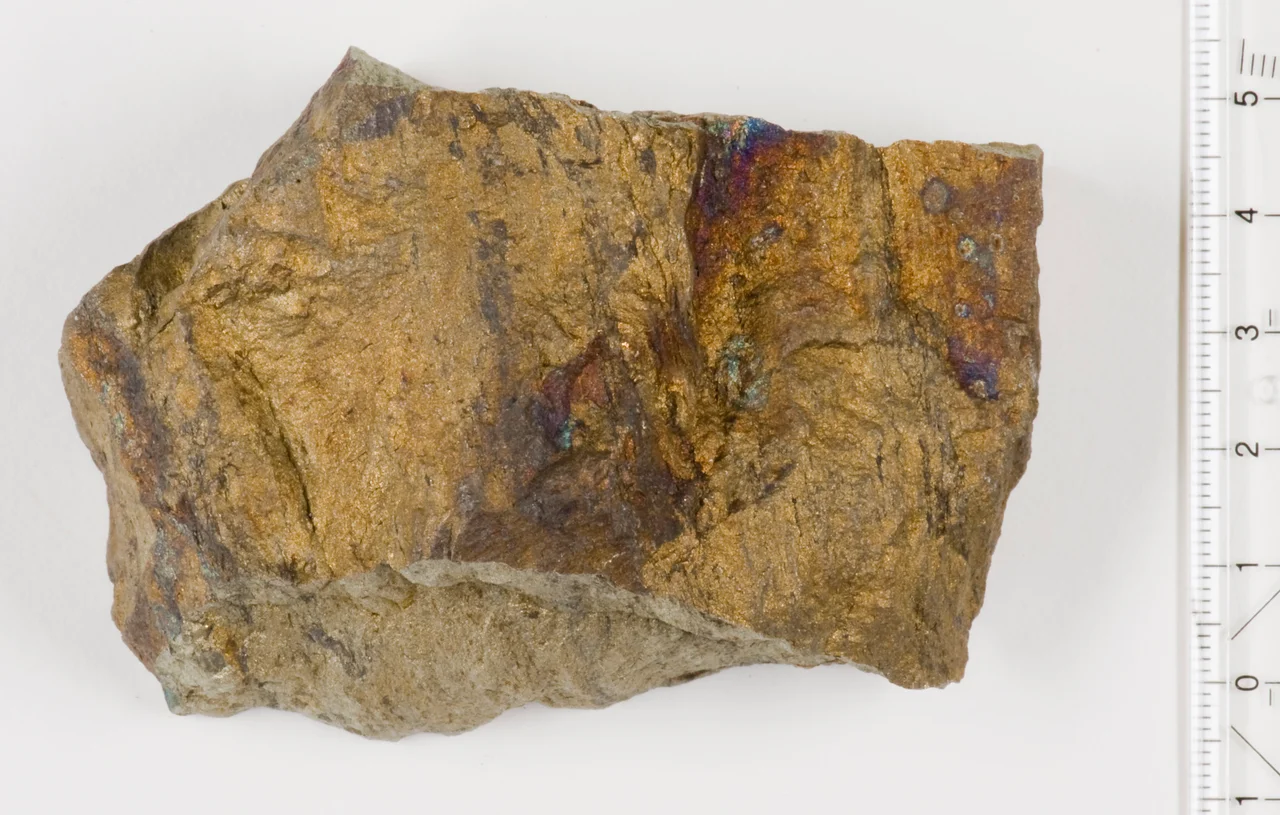
The Rammelsberg is a 635-metre hill on the northern rim of the Harz, and its wealth was laid down on a seabed. In the Devonian, hot metal-bearing water vented from springs on the seabed and precipitated two enormous lenses of massive sulphide — a sedimentary exhalative deposit, quite unlike the vein systems worked elsewhere in the Upper Harz. The Carboniferous folding that built these mountains caught the lenses up and turned them over, so they lie tilted and inverted inside the hill.
The grades stayed extraordinary for a millennium: on average 14 percent zinc, 6 percent lead, 2 percent copper, a gram of gold and 140 grams of silver to the tonne. A second body, the Neues Lager, was found only in the nineteenth century. Copper came first, then much later lead, and with the lead came silver.
The Mountain That Made an Emperor's Town
The Saxon chronicler Widukind of Corvey put the mine in writing around 968, recording that Emperor Otto the Great had the silver deposits opened. Goslar itself does not appear until 979: the mine came first, and the town grew because of it.
Silver of that quality made the place imperial. In 1005 Henry II built the Kaiserpfalz at the foot of the Rammelsberg and held his first Imperial Assembly there in 1009. The mines were Reichsgut, belonging directly to the emperor, which made them worth fighting over. When Frederick Barbarossa asked Henry the Lion for support against the Lombard League in 1175, the duke's price was enfeoffment with the Goslar mines. Frederick refused. Henry besieged the town and demolished the workings; they were restored only after his deposition in 1180.
Goslar's council bought the mining rights outright in 1359, and the wealth carried the town into the Hanseatic League. It carried a cost too. A collapse documented in 1376 buried and killed more than a hundred miners.
Water, Wood and the Master Malter
A medieval mine is a water problem. Drainage, hoisting and ore dressing all depended on getting water onto wheels and keeping it there, which is why the Herzberg Pond was dug in 1561 as a reserve against drought. The Roeder Gallery still carries its wheels and the flatrod linkages that pushed their power through the rock — a system the Deutsches Museum in Munich thought worth replicating.
The surviving fabric goes back a long way: slag heaps from the tenth century, ore-hauling tracks from the twelfth, and in the Feuergezäher Vault the oldest bricked-out underground space in Central Europe. The Rathstiefste, a medieval drainage adit, has walls encrusted in coloured vitriols. Above ground the Maltermeisterturm was raised around 1500 on a slag heap, probably the oldest surviving mine building in Germany. It oversaw the pits, served as a bell tower from 1578, and later housed the master malter, who managed the mine's timber, measured in malters.
1936, and Who Dug It
The Nazi state wanted the Rammelsberg's non-ferrous metals for rearmament, and froth flotation had just made it possible to process ore earlier generations would have discarded. The Rammelsbergprojekt of 1936 and 1937 rebuilt the whole surface plant. Fritz Schupp and Martin Kremmer, the architects of the Zollverein colliery in the Ruhr, designed the terraced processing works and the shaft buildings that still define the hillside — assured industrial architecture, built to arm a war.
From 1941 the mine ran substantially on people who had no choice. About 350 forced labourers worked at the Rammelsberg between 1941 and 1945, around twenty of them women, making up roughly 40 percent of the workforce and drawn from sixteen European countries. The first twenty-two, deported Soviet civilians, arrived in October 1941; twenty-four more young men came in a transport from Kharkiv in May 1942, forty French workers in 1943, and around 140 Italian military internees in early 1944, transferred from the prisoner-of-war camp Stalag XI B at Fallingbostel. Research by the Goslar association Spurensuche in the late 1990s recovered their names and circumstances, and the museum now carries a permanent exhibition on what it meant to live and work here under duress.
The Last Shift
After the war the mine found one more life. Lead and zinc prices climbed in 1950, and low-grade banding ore left in the ground suddenly repaid processing, at around 25 percent recoverable metal. A new dressing plant went up on the Bollrich above Oker in 1953, Schupp planning it once again, linked underground to the mine by pit railway and out to the smelters by standard-gauge line.
The deposit was exhausted by the 1980s, and Preussag closed the mine on 30 June 1988. Demolition was the obvious next step; a citizens' association fought it off. What survived became a museum and visitor mine, listed by UNESCO in 1992 with the old town of Goslar and expanded in 2010 to take in the Upper Harz Water Regale and the Samson Pit. A thousand years of work, and the machinery is still standing where it stopped.
From the Air
The Rammelsberg lies at 51.8875°N, 10.4317°E, a 635 m spur on the abrupt northern edge of the Harz immediately south of Goslar, so the whole scene reads at one glance from 2,000–4,000 ft: the compact red-roofed old town on the flat, the wooded escarpment rising behind it, and on the slope the grey terraced processing plant and headframe stepping down the hillside with pale slag heaps below. The Herzberg Pond sits just west of the workings. The Brocken stands 16 km south-east and makes the easiest large-scale reference in the region. Nearest airfields: Braunschweig-Wolfsburg (EDVE) about 50 km north, Ballenstedt (EDCB) about 58 km east-south-east, Magdeburg-Cochstedt (EDBC) about 68 km east, Hannover (EDDV) about 80 km north-west, Kassel-Calden (EDVK) about 90 km south-west. The Harz front generates rotor and wave in southerly flow, and orographic cloud frequently caps the escarpment while the plain to the north stays clear.
Nearby Stories
- Ströbeck 4.6 km away
- GEO600 5 km away
- Fagus Factory 5 km away
- Unicorn Cave 5.5 km away
- Physikalisch-Technische Bundesanstalt 12 km away
- Helmstedt–Marienborn border crossing 13 km away
- Sababurg 26 km away
- Kyffhäuser Monument 33 km away