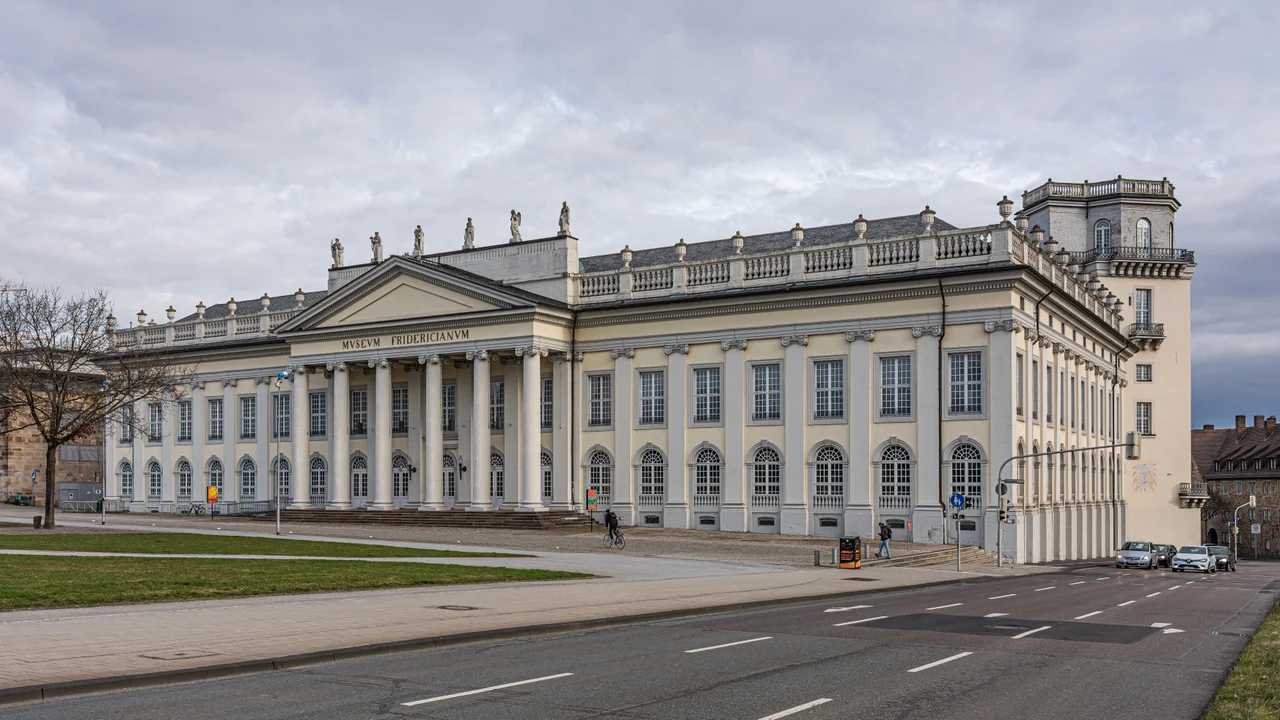

Fridericianum
Landgrave Frederick II of Hesse-Kassel had a problem common to eighteenth-century German princes: an enormous collection and nowhere respectable to put it. His solution was unusual. Rather than build another gallery inside a palace, where a visitor needed an introduction and a reason, he commissioned a free-standing building on the public square and let people in. The Huguenot architect Simon Louis du Ry drew it, and the Fridericianum opened in 1779 as one of the first public museums in Europe. The funding is the part nobody puts on the plaque. Frederick paid for it substantially out of what Britain paid him for Hessian troops - soldiers hired out to fight the American Revolution, converted into a neoclassical facade in northern Hesse.
Everything, Under One Roof
What went inside was encyclopedic in the literal sense: an attempt to hold the whole world in a set of rooms. The state library of Hesse. The landgraves' art collections, including a Modern Statue Gallery. A room for medals, machines and clocks. A print room, a manuscripts room, a map gallery, scientific instruments. Cork models of Roman architecture, painstakingly built for people who would never see Rome. Wax figures of the historic landgraves themselves, watching visitors inspect their possessions. The library was designed to hold a hundred thousand volumes. By the end of the nineteenth century the clock and watch collection was among the largest in the world - a fitting speciality for a town whose name became bound up with licensed clockmaking. Attached to the museum stood the medieval Zwehrenturm, a surviving tower of the old city wall, converted into an observatory. The building looked outward as well as in.
The First Parliament in Germany
In 1807 Napoleon carved a Kingdom of Westphalia out of conquered German territory and installed his youngest brother Jerome as its king, with Kassel as the capital. The Fridericianum stopped being a museum and became a parliament building - the first in Germany - which is a strange fate for a collection of clocks and cork models, and a stranger one for a building financed by a prince Napoleon had just deposed. The court needed librarians, and it hired two brothers who had grown up in the region: Jacob and Wilhelm Grimm. When Jerome was driven out in 1813 the building reverted to its original purpose, its brief parliamentary career over almost before it began.
Emptied Out
Prussia annexed Hesse in 1866, and what followed was quieter than a fire and just as thorough. The collections were gradually transferred to Berlin, where the power now sat, and the building was hollowed out object by object. By 1913 it had ceased to function as a museum at all, retaining only its status as a state library. Then came the bombing. Kassel was a centre of tank and aircraft production, and Allied raids in 1941 and 1943 gutted the Fridericianum; when it was over, the enclosing walls and the Zwehrenturm were essentially all that was left. A building conceived to show a prince's version of the world had been stripped of its contents by one government and burnt out under another, within eighty years.
A Shell Turns Out to Be Useful
The ruin became the opportunity. In 1955 the Kassel artist and curator Arnold Bode filled the patched-up interior with the modern art the Nazi state had condemned and removed from German museums, and called the exhibition documenta. It has returned every five years since, and the Fridericianum has been its centre ever since - a building whose lack of fixed collections, an accident of Prussian removals and RAF incendiaries, turned out to be exactly what a recurring contemporary exhibition needs. Between documentas it runs as an art gallery in its own right, with more than two thousand square metres of exhibition space. Susanne Pfeffer directed it from 2013, mounting the trilogy Speculations on Anonymous Materials, nature after nature and Inhuman, a retrospective for the American experimental filmmaker Paul Sharits, and, for documenta's sixtieth anniversary, a full survey of the Belgian artist Marcel Broodthaers. Moritz Wesseler has led the institution since November 2018, with a programme built around artists who have had no institutional platform in Germany. Two and a half centuries on, the building is still doing what Frederick built it for: putting things in front of people who were not invited.
From the Air
The Fridericianum stands on the north side of Friedrichsplatz at 51.3136N, 9.4975E, in the centre of Kassel in northern Hesse. From 2,000-4,000 ft the identification is easy: Friedrichsplatz is one of the largest open squares in Germany, a big clear rectangle in a dense rebuilt city centre, with the long neoclassical museum block along one edge and the stubby medieval Zwehrenturm at its eastern end. The Fulda river runs along the east side of the old city and the baroque Karlsaue park extends southeast from the square toward the water. The regional navigation feature is the Bergpark on the wooded hill west of town: the Hercules monument sits at the top of a cascade whose axis points directly at the city centre, so tracking it east delivers you to Friedrichsplatz. Kassel-Calden (EDVK) lies just northwest of the city, with Paderborn Lippstadt (EDLP) northwest and Frankfurt (EDDF) south. The surrounding hills generate low cloud and ridge obscuration in poor weather; the square photographs best in low winter sun, which rakes across the colonnade.
Nearby Stories
- Wartburg 7.9 km away
- Edersee Dam 8.5 km away
- Sababurg 10 km away
- 1st German Bratwurst Museum 15 km away
- Fulda Gap 15 km away
- Stadtallendorf 18 km away
- Unicorn Cave 21 km away
- Niederhagen concentration camp 35 km away