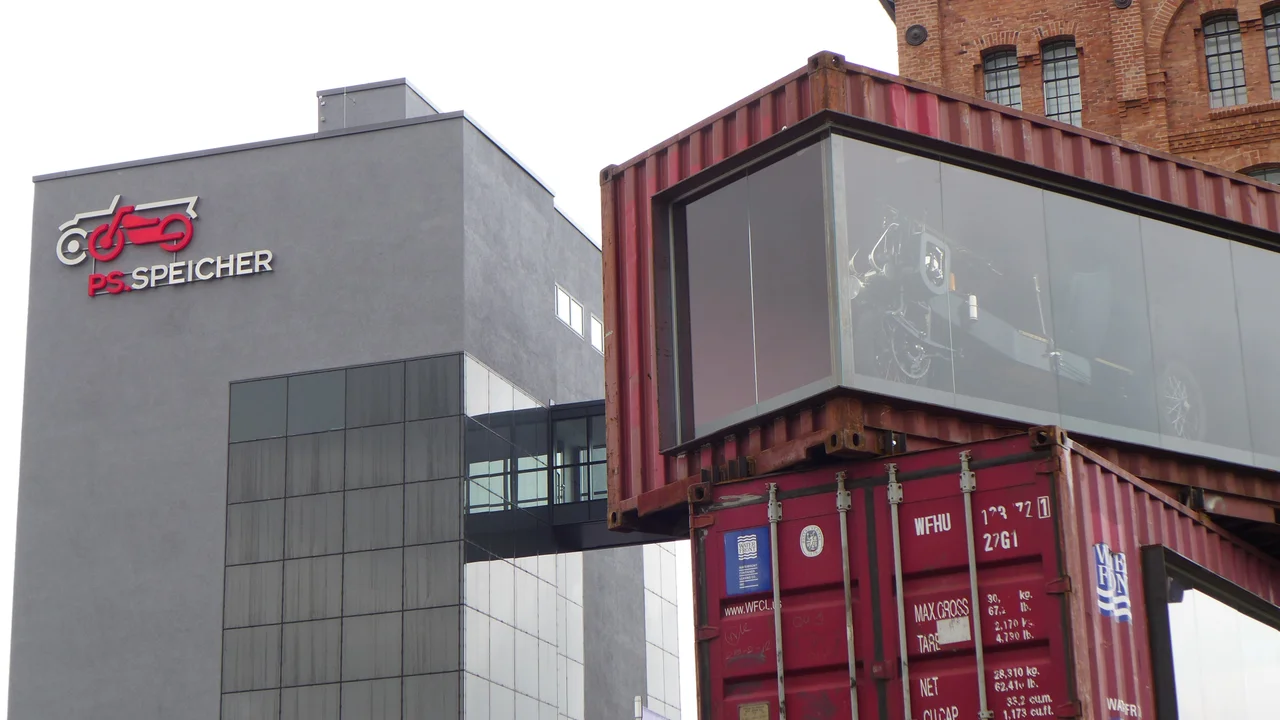

PS Speicher
Einbeck's contribution to civilisation was beer. Written evidence of Einbecker beer being exported dates to 1351, the town joined the Hanseatic League in 1368, and when Munich brewers copied the style they mangled the name — Einbeck came out as oan bock, a billy goat, and the goat stuck. That is why a strong dark lager is called bock. A short walk from the half-timbered old town stands a brick granary from 1898, and inside it, on six floors, are several hundred motorcycles and cars. The building has gone from storing the raw material of one German obsession to housing another.
A Town Rebuilt in Fifteen Years
Einbeck sits in southern Lower Saxony with a population of a little under thirty thousand, and it looks the way it does because of a catastrophe. In July 1540 an arsonist set a fire that destroyed almost the entire town. The rebuilding took about fifteen years, which is why the old town reads as a single coherent statement rather than a jumble of centuries — a nearly complete late-medieval townscape in half-timbering, carved and painted and leaning slightly, street after street of it.
Brewing paid for that. At its height Einbecker beer travelled from Antwerp to Riga and from Stockholm to Munich, carried on the Hanseatic trade routes that made a small inland town briefly famous across northern Europe. The trade eventually contracted, as trades do. The buildings stayed, and so did the name that Munich had garbled.
Grain Out, Machines In
The granary went up in brick in 1898, on the scale that late nineteenth-century agriculture demanded — a working silo, not an ornament. In the second half of the twentieth century more modern facilities were built in the region and it went out of use, drifting through a series of other purposes without ever quite finding one.
A major restoration began in 2012 on what is now a protected heritage building, and the museum opened on 23 July 2014. The exhibition occupies roughly 4,000 square metres inside the granary; the wider site runs to about 25,000. Six floors were given over to the history of getting about under your own power — an unusual shape for a museum, because a silo is tall rather than wide, and the collection had to be organised vertically or not at all.
One Man's Garage, Enlarged
The collection was assembled privately by Karl-Heinz Rehkopf, who then handed it to a foundation — the Kulturstiftung Kornhaus, established in 2009 and renamed the Stiftung PS.Speicher in December 2020. It runs to more than four hundred historic vehicles spanning about 130 years, and is billed as the world's largest collection of German motorcycles. Not everything is out at once; the display rotates.
Stephan Weil, the Minister-President of Lower Saxony, opened the building in 2014, and the museum now draws in the order of a hundred thousand visitors a year to a town most travellers pass without stopping. There is a driving simulator on a Porsche chassis, a playground, a restaurant, and a shop selling reproduction posters — the usual apparatus. The reason to come is upstairs.
Down Is Forward
The decision to run the chronology downward is the cleverest thing about the place, and it changes how the collection reads. You take the lift to the top and start in the 1880s and 1890s, where the machines are experiments — spindly, improvised, obviously uncertain about what they are for. Then you walk down, and each floor is a decade or two later, and the objects get more confident and less strange.
By the lower levels the vehicles have stopped being inventions and become products: mass-produced, marketed, ordinary. The last floor deals with current research and where personal transport goes next, which puts the visitor at the bottom of a hundred-and-thirty-year descent looking at a question rather than an answer. Vehicles are staged in full-size dioramas throughout, set inside the streets and events they belonged to rather than lined up on plinths, so the effect is less showroom and more archaeology.
1894 and Everything After
The oldest headline exhibit is a Hildebrand & Wolfmüller, the first series-production motorcycle and the machine that gave the German language the word Motorrad. Its connecting rods drove the rear wheel directly, the way rods drive a locomotive, with none of the transmission logic later riders take for granted. A Benz Patent-Motorwagen Victoria of the same year sits nearby, along with a replica of Daimler's Reitwagen — the very beginning of the idea, before anyone knew which shape would win.
Further down, the collection catches the more revealing decades. First-generation scooters. The tiny superminis of the Wirtschaftswunder, when a divided, rebuilding country wanted anything with a roof. An IFA F9, built in East Germany from a pre-war DKW design left behind in Zwickau when Auto Union re-established itself in the West — one drawing, two states, two very different production runs. Postwar German history turns out to be legible in bodywork.
From the Air
PS Speicher stands at 51.8195°N, 9.8601°E on the edge of Einbeck's old town, southern Lower Saxony, in the broad Leine basin west of the Harz. From 1,500–3,000 ft the town reads clearly: a compact red-roofed medieval core with a tall church tower, ringed by modern development, with the large rectangular brick granary block standing apart on the northern side. The Ilme and Leine valleys run either side, the Solling forest fills the ground to the south-west, and the Harz uplands rise 30 km to the east. Northeim lies 16 km south-east, Bad Gandersheim 13 km north-east. Nearest airfields: Hildesheim (EDVM) about 41 km north, Kassel-Calden (EDVK) about 57 km south-west, Hannover (EDDV) about 72 km north, Braunschweig-Wolfsburg (EDVE) about 73 km north-east. Terrain is easy — under 200 m in the valley — but autumn and winter bring persistent low stratus and valley fog to the Leine basin.
Nearby Stories
- Royal Palace of Werla 0.9 km away
- Princely Abbey of Corvey 5.8 km away
- Brocken 5.9 km away
- Reich Harvest Thanksgiving Festival 6.7 km away
- Hildesheim Cathedral 14 km away
- Bergpark Wilhelmshöhe 22 km away
- Kyffhäuser Monument 40 km away
- Kassel 42 km away