
Waldsiedlung
The signs on the outer fence said wildlife research area. Five kilometres of wire mesh through the Brandenburg pines, and behind it, in theory, biologists counting deer. What was actually inside was the government of the German Democratic Republic — every member of the Politburo, their families, and the Stasi officers who guarded them, in a compound of about two square kilometres that a stranger could drive past without noticing. Waldsiedlung means forest settlement, which is exactly as much as the name gives away. East Germans called it Wandlitz, after the village down the road, and by the 1980s they had a better name for it: Volvograd.
After Budapest
Until the late 1950s the SED leadership lived in villas on the Majakowskiring in Pankow, well inside East Berlin and close enough to the city that a crowd could reach them. The Hungarian uprising of 1956 changed the calculation. In Budapest, party officials had been dragged into the street; in Berlin the leadership decided it wanted somewhere further out.
Construction began in 1958, two years after the party resolution, in woodland belonging to the town of Bernau bei Berlin some 30 km north of the capital. The building agency was subordinate to the Ministry for State Security, so the Stasi did not merely guard the place — it built it. Waldsiedlung was finished in 1960. Moving in was not a perk offered to Politburo members. It was compulsory.
Volvograd
The nickname came from the Volvos. The leadership had started out in Soviet Chaika limousines and moved on to Swedish cars, and the joke welded that to Volgograd: Volvograd, the city of the Volvo. It is a sharper piece of mockery than it looks, because the fleet was the point. Almost everything inside the fence was about access to things nobody else could get.
The houses themselves were unremarkable — two dozen semi-detached family homes, seven rooms in most, fifteen in the larger ones. Erich and Margot Honecker had House 11. Walter Ulbricht had House 7, Erich Mielke House 14. There was a clubhouse with a cinema and a restaurant, a swimming pool and sauna, a shooting range, tennis courts, a nursery, a polyclinic, a market garden, and a shop selling subsidised Western goods for East German marks. In 1983 a nuclear bunker for 400 people was completed.
Two Rings and Thirty-One Towers
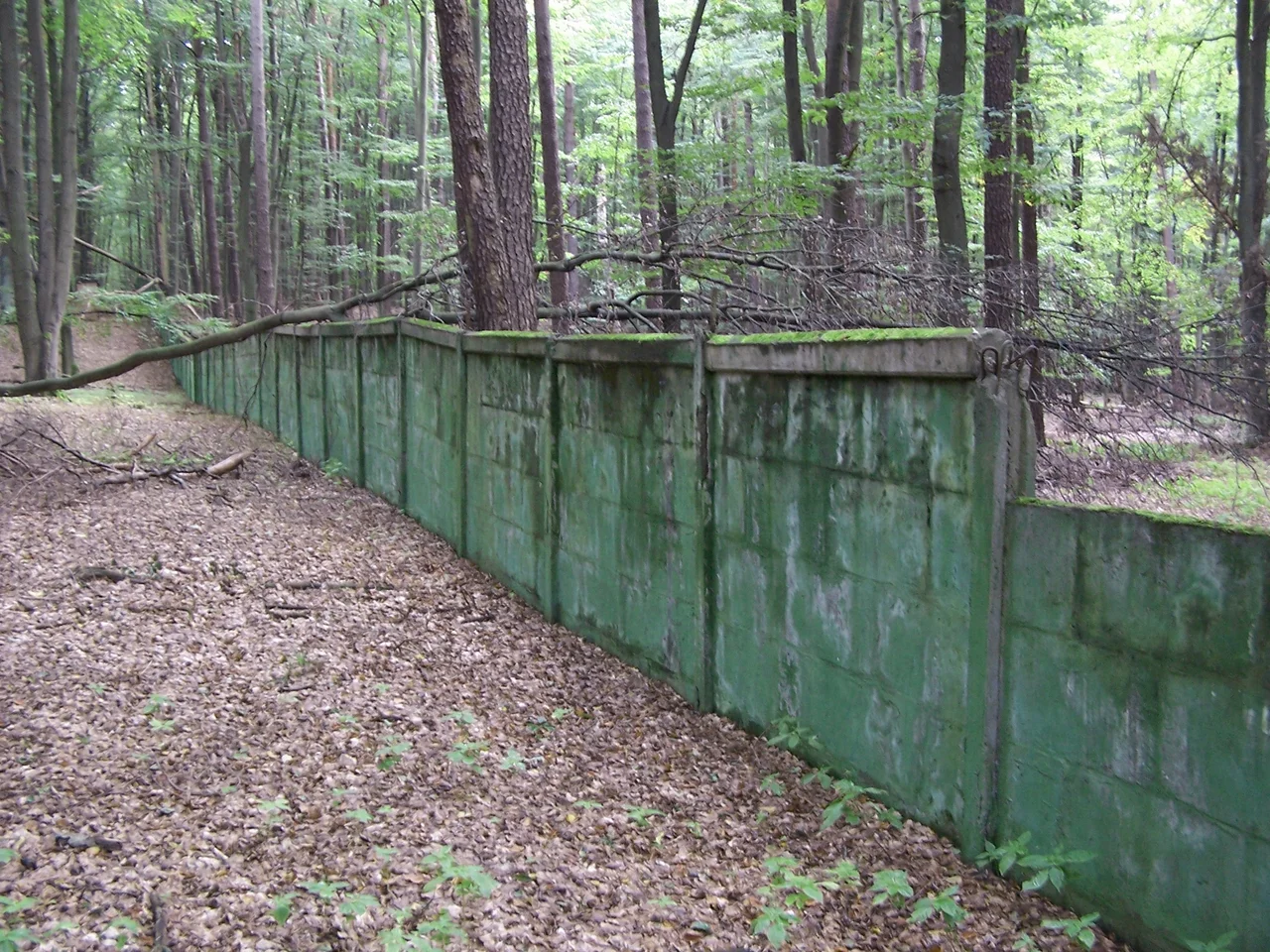
The security was arranged in layers so that the outer one looked like nothing. The five-kilometre outer ring was ordinary wire mesh carrying its wildlife research signs; thirty-one watchtowers stood inside it. The inner ring was a two-metre concrete wall painted green, and getting through it required a special pass at one of four gates, each held by the Felix Dzerzhinsky Guards Regiment — the Stasi's paramilitary arm. Roughly 140 personnel ran the site.
In the 1970s a four-lane autobahn was built to connect Waldsiedlung directly to East Berlin. That is the detail that gives the arrangement its proportions: a national road project, built to serve roughly two dozen households on their commute.
Two Standards of Comparison
Photographs of Wandlitz tend to disappoint people who expect a palace. The houses are plain, the furniture is 1960s functional, and next to the home of a Western head of government the whole compound looks distinctly ordinary. That is one measurement, and it is the one the residents themselves reached for.
The other measurement is the country on the far side of the fence, where the shop was not stocked with Western goods, the clinic was not on the doorstep and the motorway had not been built for you. Waldsiedlung was not extravagant. It was separate — and being separate, in a state whose founding claim was that privilege had been abolished, is what made it the shorthand it became. Ask a German today what Wandlitz means and you will not get a description of the houses.
A Thousand Beds
In late 1989 the residents were told to leave, and they left. The compound they vacated turned out to be the most legible thing the collapsing state had produced: not a policy or a speech, but a fence with an explanation on it.
What happened next is almost anticlimactic. The buildings were converted for medicine. The site now holds a large rehabilitation complex, the Brandenburgklinik and associated facilities including children's rehabilitation, running to around a thousand beds — a place people go to recover from strokes and surgery, in houses built for men who were driven past everyone else. The site was placed under monument protection in 2017, and since 2021 anyone who wants to walk around and look at it can.
From the Air
Located at 52.7306 N, 13.4917 E, in forest north of Bernau bei Berlin, Brandenburg, roughly 30 km north of central Berlin and about 3 km southeast of the village of Wandlitz. From the air it reads as a distinct clearing pattern rather than a set of buildings: a roughly 2 km-square block of managed pine broken by a loose scatter of low houses and larger flat-roofed clinic blocks, with the old perimeter track still traceable as a pale ring through the trees. The Liepnitzsee and Wandlitzsee lie 3-5 km northwest and are the easiest visual fix in this otherwise uniform forest; the A11 autobahn runs 6 km east. Recommended viewing altitude 1,500-2,500 ft AGL; the site sits outside Berlin's inner controlled airspace but the TMA boundary is close to the south, so brief it. Eberswalde-Finow (EDAV) is about 18 km northeast, Strausberg (EDAY) about 33 km southeast, Berlin Brandenburg (EDDB) about 41 km south. Best seen with leaves down or under low winter sun, when the clearings and the ring track separate from the canopy; in summer the pine closes over most of it.
Nearby Stories
- Berlin Brandenburg Airport 3.3 km away
- Caputh 4.1 km away
- Nauen Transmitter Station 6.6 km away
- Carinhall 13 km away
- Neuruppin 14 km away
- Oderbruch 14 km away
- St. Mary's Church, Chojna 25 km away
- Frankfurt (Oder) 34 km away