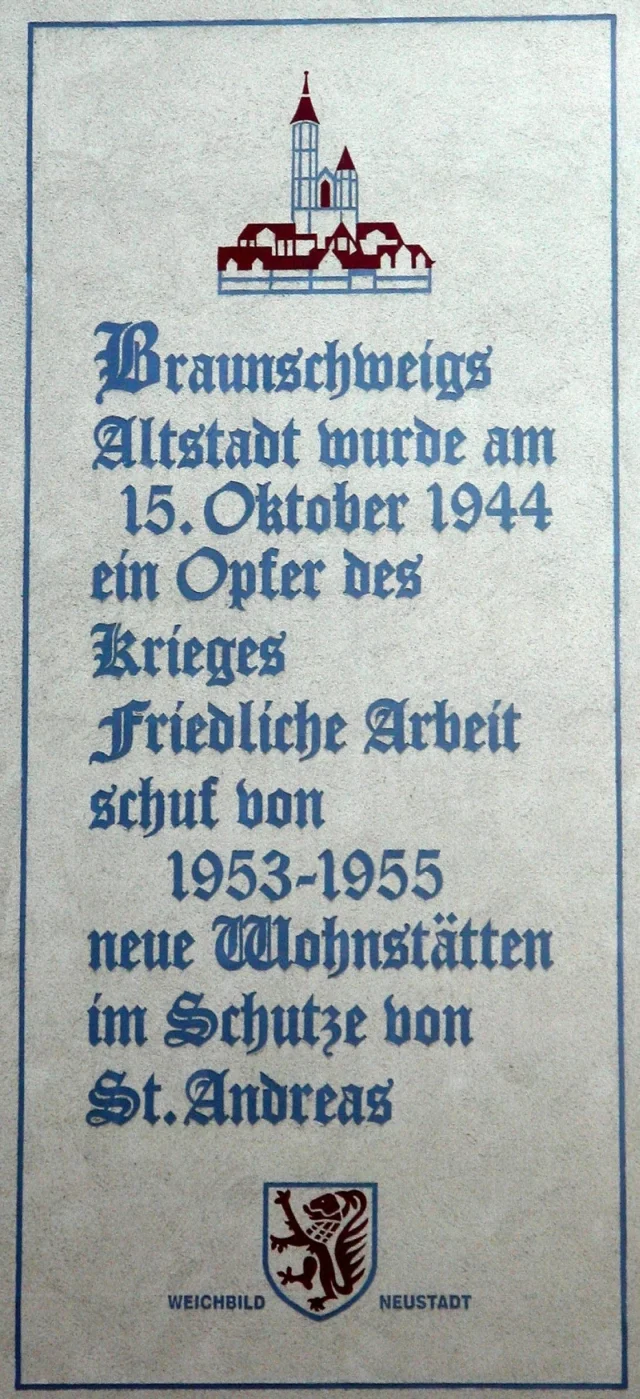

Bombing of Braunschweig (15 October 1944)
Around five in the morning on 15 October 1944, with the centre of Braunschweig burning and some 23,000 people sealed into bunkers beneath it, a fire brigade lieutenant named Rudolf Prescher proposed making it rain. The idea was a long hose punched full of holes and laid through the fire, kept under constant spray so that the jets from each hole overlapped into an unbroken corridor of artificial rain — a Wassergasse, a water alley. The people in the shelters had two ways to die: suffocate as the fires above burned the oxygen out of the air, or walk into a firestorm. Prescher's crews took the hose in. By seven o'clock they had reached the bunkers. All 23,000 walked out.
A Green Flare Over the Cathedral
The aircraft of No. 5 Group lifted off around eleven the previous night: 233 Lancasters, each carrying about six tonnes, with seven Mosquitos alongside. They ran south of the Ruhr, turned north near Paderborn and crossed Hanover. Behind them, an elaborate lie was being told to the German defences — 141 training aircraft feinting at Heligoland, twenty Mosquitos to Hamburg, sixteen to Berlin, eight to Mannheim, two to Düsseldorf, and 140 electronic-warfare aircraft of 100 Group scattering Window to blind the radar. The Germans expected Mannheim. Braunschweig's sirens went at about 1:50 a.m., and nothing rose to meet the bombers.
No. 5 Group had its own marking method. A Mosquito dropped a green blind marker over the Dom-Insel, the island of ground carrying Braunschweig Cathedral, then laid about sixty flares from a thousand metres, each burning three to seven minutes. The whole force then flew in over the green marker from every direction in a fan and dropped on the run. The cathedral was the aiming point. The cathedral survived.
A Firestorm Is a Design
The raid was part of Operation Hurricane, ordered on 13 October to demonstrate to Germany the overwhelming superiority of the Allied air forces. Duisburg took the RAF's main effort of roughly a thousand bombers, Cologne the USAAF's twelve hundred. Braunschweig — around 150,000 people — got 233.
The firestorm was not an accident of the weather. Darmstadt had been burned on 11 September using a fan formation and a deliberate sequence of explosive and incendiary loads, and about 11,500 people had died there. Braunschweig's centre was roughly 800 tightly packed timber-framed houses, many of them medieval. So the first wave was about 12,000 high-explosive blockbusters, dropped to tear roofs away, blow out windows, split walls and open the wooden buildings up like kindling. Then came about 200,000 phosphorus and incendiary bombs into the wreckage. Roughly 847 tonnes in forty minutes; by 3:10 a.m. it was over.
Ninety-Five of a Hundred and Four
By half past six the fire had organised itself. Superheated air rose off the burning quarter, cool air rushed in beneath it from every side, and the resulting winds were strong enough to pick up furniture and knock people down. About 150 hectares of the old town were alight. The steeples of St Andrew's, some hundred metres tall, burned like torches visible far out into the countryside and rained embers back across the city.
Help came from everywhere: around 4,500 firefighters from up to ninety kilometres away — Hanover, Celle, Helmstedt, Hildesheim, Peine, Salzgitter, Wolfenbüttel, Blankenburg, Wernigerode, Quedlinburg — along with volunteers and works brigades from the surrounding factories. The water alley reached six bunkers and two shelters in time. It did not reach the shelter on Schöppenstedter Straße. When firefighters got there, ninety-five of the 104 people inside had suffocated; the fire in that street had used up nearly all the air. Nine came out.
Who Was Not Let In
Braunschweig had unusually good shelters. The Braunschweig Armour, a bunker construction standard developed at the city's technical university, became a reference across the Reich, and the city was thick with reinforced Hochbunker. Its people were also practised: between 1939 and 1945 there were 2,040 warnings and 620 full alarms, most of them for bombers passing over on their way to Magdeburg and Berlin.
That preparation is why the toll on 15 October was counted in hundreds rather than thousands. Contemporary estimates ran from 484 to 640 dead; historians now put it above a thousand. Eighty thousand people lost their homes in a night. But the shelters were not for everyone. Of the roughly 2,905 people who died in Braunschweig from the effects of the war, 1,286 — more than four in ten — were foreigners: prisoners of war, forced labourers and concentration camp prisoners brought in to work the armament industry, who were forbidden access to the air raid bunkers. They heard the same sirens as everyone else and had nowhere to go.
The Second Destruction
More than ninety percent of the medieval core inside the Oker ring was gone; across the city as a whole, forty-two percent. Some 3,670,500 cubic metres of rubble had to be moved. Clearing began officially on 17 June 1946, and the city did not declare the job finished until 1963.
What replaced it caused its own grief. Planners looked at a cleared centre and saw a chance to build a modern, car-friendly city, and in many places the old street plan was simply overwritten. Ruins that could have been restored came down in a hurry. The war-damaged Brunswick Palace was demolished in 1960 and reconstructed only in 2007. Locals have a name for all this: the second destruction. Every 14 and 15 October the city marks the raid, and the graves of many of the dead lie together at the Main Cemetery. On the sixtieth anniversary in 2004, Britten's War Requiem was performed in the cathedral that had served as the aiming point.
From the Air
Braunschweig's historic centre sits at 52.2643°N, 10.5242°E, wrapped by the Oker river, which loops around the old town as a ring of water and green — the clearest navigational feature in the city and the boundary within which ninety percent of the fabric burned in 1944. From 2,000-3,500 ft the cathedral and the Burgplatz complex are visible at the centre with the reconstructed Brunswick Palace east of them, and the contrast between the 1950s road grid and the surviving medieval quarters at Magniviertel and Michaelis is obvious from above. Braunschweig-Wolfsburg (EDVE) lies about 5 km southeast of the centre and controls the airspace here; Wolfenbüttel and the Herzog August Library are 12 km south, Hannover (EDDV) about 55 km west, and the Harz rises on the southern horizon. Summer afternoons bring convective build-ups off the Harz; autumn and winter bring low stratus over the flat country north of the city.
Nearby Stories
- Expo 2000 3.7 km away
- Fagus Factory 5.7 km away
- Ströbeck 13 km away
- Goslar 15 km away
- Helmstedt–Marienborn border crossing 15 km away
- Celle 21 km away
- Sieben Steinhäuser 27 km away
- Stones Fan Museum 49 km away