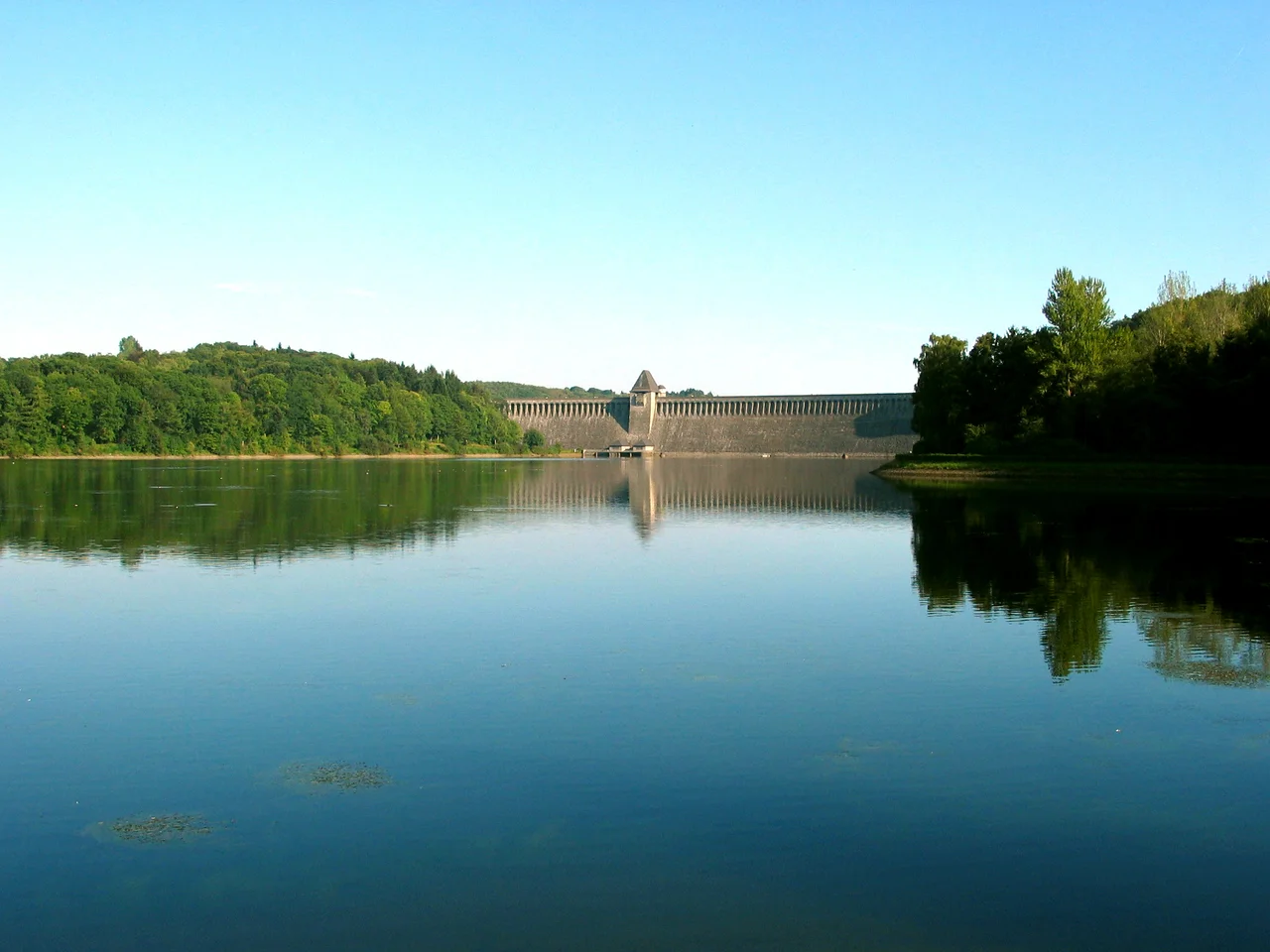

Möhne Reservoir
Just after midnight on 17 May 1943, a 22-meter section of the Möhne Dam disappeared. A bouncing bomb dropped by an Avro Lancaster of No. 617 Squadron had skipped across the reservoir, sunk against the masonry wall, and detonated. The breach was 77 meters wide. The water that had spent thirty years filling Europe's largest reservoir behind that wall went down the Möhne valley at killing speed. By morning at least 1,579 people were dead. More than a thousand of them had been brought to the Ruhr against their will. About 526 of them were Soviet women held in a forced labor camp at Neheim, and they made up the single largest group of victims of the most famous bombing raid of the war.
The Dam Before the Story
By 1904 the growing Ruhr industrial belt was using more water than the existing reservoirs of the Ruhr river system could supply. The Ruhrtalsperreverein, the association of dam-builders, decided that storage volume needed to triple. Between 1908 and 1912 they built the Möhnetalsperre at a cost of 23.5 million marks, damming both the Möhne and the Heve rivers and creating a four-basin lake holding up to 135 million cubic meters of water. To make space for it, 140 homesteads and seven hundred residents were moved out of the valley. When it opened, the Möhne Dam was the largest in Europe. For three decades it did exactly what it had been built to do: regulate the Ruhr downstream, generate hydropower, and provide industrial water to one of the most concentrated manufacturing regions in the world.
Operation Chastise
The British engineer Barnes Wallis had spent years arguing that the German war economy could be crippled by destroying the dams that supplied it with water. The technical problem was that the dams were protected by torpedo nets and could not be hit at depth by ordinary bombs. Wallis's solution was a cylindrical bomb spun backward and released low and fast, skipping across the water like a stone, hopping the nets, and sinking against the dam wall before exploding at depth. On the night of 16 to 17 May 1943, nineteen modified Lancasters of No. 617 Squadron flew into the Ruhr at treetop height to put the theory into practice. The lead aircraft, piloted by Wing Commander Guy Gibson, attacked the Möhne. Mick Martin attacked it. So did Dinghy Young, Henry Maudslay, and David Maltby. Maltby's bomb finished the job.
The Flood
What followed has to be told from the ground. The wave that came down the Möhne valley reached the small town of Neheim, downstream from the dam, in the early hours of the morning. On the eastern edge of Neheim was a camp holding Soviet women who had been deported to the Ruhr to work as forced laborers, the Ostarbeiterinnen, conscripted from occupied territories and confined in wooden barracks. At least 526 of them died there, the largest single group lost in the flood. Across the broader inundation, more than a thousand of the roughly 1,600 dead were foreign forced laborers, held in camps that had been placed in valleys precisely because the land was cheap and the local population had been displaced for the dam decades earlier. German civilians died too, and so did their livestock and their houses. But the heaviest cost of Operation Chastise was paid by people who had not chosen to be in Germany at all, and who could not run when the sirens went.
Rebuilt by Forced Hands
The dam itself was not allowed to stay broken for long. Albert Speer, who toured the site, described the powerhouse below the wall as if it had been erased along with its turbines. Industry in the Ruhr stopped while electrical installations dried out. Within days, the Organisation Todt had pulled some 7,000 men from work on the Atlantic Wall in France and put them onto the Möhne. By 23 September 1943, just over four months after the breach, the dam was sealed again, in time to collect the next year's water. The British did not return to bomb the repair effort. Much of the labor on the reconstruction was, like the labor that had died below it, performed by men who were not there by choice.
The Lake That Remains
Today the Möhnesee is a tourist lake. People sail it, fish it, walk its shoreline. It is a Natura 2000 European bird sanctuary, home to one of the largest great crested grebe breeding populations in Westphalia and a stopover for four to six thousand waterfowl on migration. The 1955 British film The Dam Busters made the raid a cinematic legend and named, then mostly omitted, the people who paid for it. Standing on the rebuilt wall on a quiet afternoon, looking down at the powerhouse and out at the calm water, the engineering still impresses. The memory of what came down the valley below it on a May morning eighty years ago is harder, and more necessary, to hold.
From the Air
Coordinates 51.4833°N, 8.0667°E, in the Sauerland east of Dortmund and just north of Arnsberg. The reservoir is a clear elongated water feature roughly 10 km long with four connected basins, sitting between the Haarstrang ridge to the north and the Arnsberg Forest to the south. The masonry dam at the western end and the Kanzelbrücke road bridge are easy visual checkpoints. Best viewed from 2,500-5,000 ft AGL for the full shape of the lake. Nearest airfields: Arnsberg-Menden (EDKA) about 15 km southwest, Meschede-Schüren (EDKM) about 20 km southeast, Paderborn-Lippstadt (EDLP) about 35 km northeast. Dortmund (EDLW) is roughly 45 km west.
Nearby Stories
- Atta Cave 3.1 km away
- Ruhr University Bochum 9 km away
- Burg Castle (Solingen) 16 km away
- Heinz Nixdorf MuseumsForum 21 km away
- Liesborn Abbey 24 km away
- Wewelsburg 26 km away
- Lembeck Castle 27 km away
- Marburg 44 km away