_b.jpg)
Wewelsburg
The number that matters at Wewelsburg is not twelve. Twelve columns, twelve niches, twelve spokes in the ornament set into the floor, twelve SS department heads - that is the number visitors arrive already knowing, taught to them by decades of paperback occultism. The number that matters is 1,285: the recorded deaths among the roughly 3,900 people the SS imprisoned in a camp at the edge of this village, whose forced labour cut the stone and laid the floors that tourists now come to look at. Almost everything strange about this castle was built by people being worked to death. Almost everything said to be mysterious about it was invented after they were gone.
Six Centuries Before the SS
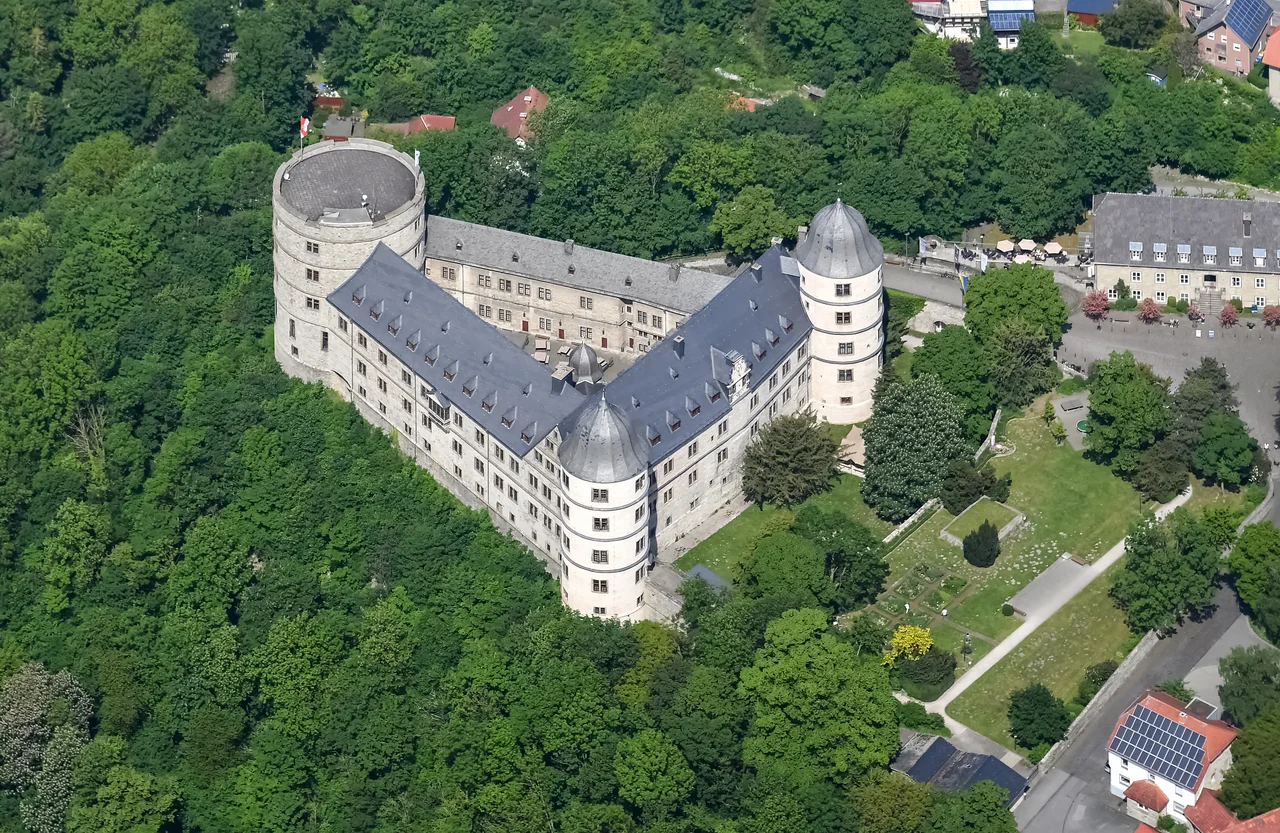
The Wewelsburg is a Renaissance castle with an unusual triangular plan - three round towers joined by heavy walls - standing above a village that is now part of Büren in Westphalia. Fortifications had held the hill long before. One predecessor was pulled down in 1123 or 1124 by peasants a local count had oppressed, once he was safely dead. In 1301 the Count of Waldeck sold the site to the Prince-Bishop of Paderborn; Swedish troops razed it during the Thirty Years' War in 1646. Above the north tower entrance a Latin inscription survives from the prince-episcopal chapel: Domus mea domus orationis vocabitur - my house shall be called a house of prayer.
A Hundred-Year Lease for One Reichsmark
Himmler came to look on 3 November 1933 and decided on the spot to acquire the place. In the first half of 1934, over the district administrator's objections, a hundred-year lease was signed at a symbolic rent of one Reichsmark a year. That August Manfred von Knobelsdorff moved in as castle commandant; on 22 September 1934 Himmler took possession in a large public ceremony. From 1935 the site was formally the SS-Schule Haus Wewelsburg. Its stated purpose - ideological training for the SS leadership - narrowed almost at once into pseudo-scientific work on Germanic prehistory, folklore and genealogy, produced to furnish underpinnings for the racial doctrines of the SS. The architect Hermann Bartels drew no lecture halls, only small cell-like study rooms. The exterior plaster was stripped off to make the building look more like a castle.
Niederhagen
From 1939 the SS put concentration camp prisoners to work on the site, and in September 1941 the camp at the edge of the village became an independent concentration camp: Niederhagen. It opened with 480 men transferred from Sachsenhausen and held as many as 1,200 at a time. Around 3,900 people passed through it - Soviet prisoners of war, labourers seized in Poland, the Soviet Union, Czechoslovakia, France, the Netherlands and Belgium, political prisoners, Sinti and Roma, homosexual men, Jewish men, and, unusually, a large core of Jehovah's Witnesses imprisoned for refusing conscription and the Hitler salute. Niederhagen may be the only camp where they made up the bulk of the prisoner population. Almost a third of those held there did not survive. The deaths of 1,285 are recorded, many from typhus; 56 men were formally executed. A crematorium was built for the camp in 1942. When Niederhagen was dissolved in 1943 most survivors went to Buchenwald, while about forty were kept at Wewelsburg to keep working. American troops found them there in early April 1945.
The Hall, and the Stories Told About It
From 1938 the SS worked on two rooms inside the north tower and finished neither. On the ground floor is the Obergruppenführersaal - twelve columns under a groined vault, a dark green sun wheel set into the pale marbled floor with a disc of gold at its axis. Beneath it, cut into rock where a cistern had been, is the Gruft: floor lowered by 4.8 metres, twelve pedestals around the perimeter, a swastika in the ceiling, a gas pipe run to the centre for a flame that was never lit. Work stopped in 1943, and nothing is known about whether either room was ever used at all.
That is the entire factual basis for an enormous industry of speculation. The SS recorded no name for the floor ornament and no meaning for it. The label "Black Sun" was attached only after 1991, by neo-Nazi esotericists, and now circulates as though it were wartime terminology. It was not. Karl Wolff, one of the twelve SS chiefs the hall was built for, later called it "mystic-confused things with which Himmler liked to play" - and noted there were twelve of them only because Himmler lacked the nerve to appoint a deputy.
What Stands There Now
Himmler ordered the castle destroyed. On 31 March 1945, with the U.S. 3rd Armored Division closing on Paderborn, SS Major Heinz Macher arrived with fifteen men and ran short of explosives; they mined the southeast tower and the SS buildings, set the castle burning and left. Three days later American troops took the grounds, after a local mayor reported that the SS had burned their barracks and fled in civilian clothes. The shell survived and was restored in 1948-49.
Today the west wing holds a youth hostel with 218 beds, one of the largest in Germany, and the south and east wings a museum of the prince-bishopric. A memorial to the dead of Niederhagen went up in 2000. Since 2010 the former guardhouse has held the Wewelsburg 1933-1945 Memorial Museum, whose permanent exhibition, Ideology and Terror of the SS, sets the castle inside the history of the SS as an organisation rather than treating it as a curiosity. A good part of its work is correcting what visitors arrive believing. Upstairs, school groups sleep.
From the Air
Wewelsburg sits at 51.607N, 8.651E in the Paderborn district of North Rhine-Westphalia, on high ground above the village of the same name south of Paderborn. The castle is easy to identify from the air at 2,000-4,000 ft: its triangular footprint with a round tower at each corner is unlike anything else in the region, and the large north tower is the most prominent element. Paderborn Lippstadt Airport (EDLP) lies a short distance to the north, making low-level transit straightforward; Dortmund (EDLW) and Kassel-Calden (EDVK) are the next options west and east. The surrounding country is rolling Westphalian farmland and woodland with few tall obstacles. Low stratus and drizzle are common here in autumn and winter, so plan for marginal ceilings outside summer.
Nearby Stories
- Battle of Villinghausen 10 km away
- Warendorf 13 km away
- Altendorf Megalithic Tomb 14 km away
- Teutoburg Forest 15 km away
- Schnellenberg Castle 25 km away
- Reinhardswald 27 km away
- Reich Harvest Thanksgiving Festival 29 km away
- Edersee Dam 35 km away