
Teutoburg Forest
Count the rulers. Before Germany was assembled, this corner of Westphalia was carved into a scatter of tiny territories, each with its own earl, baron or prince-bishop, each convinced the neighbours were a problem. That arrangement left a legacy you can still read from the ground: a density of castles, palaces and manor houses that no ordinary province could justify. The last of the statelets held out remarkably late. Lippe survived as a separate state inside the German Empire, and was only folded into North Rhine-Westphalia in 1947, which is why the region is called Ostwestfalen-Lippe with a hyphen doing real work in the middle.
A Ridge Pretending to Be a Forest
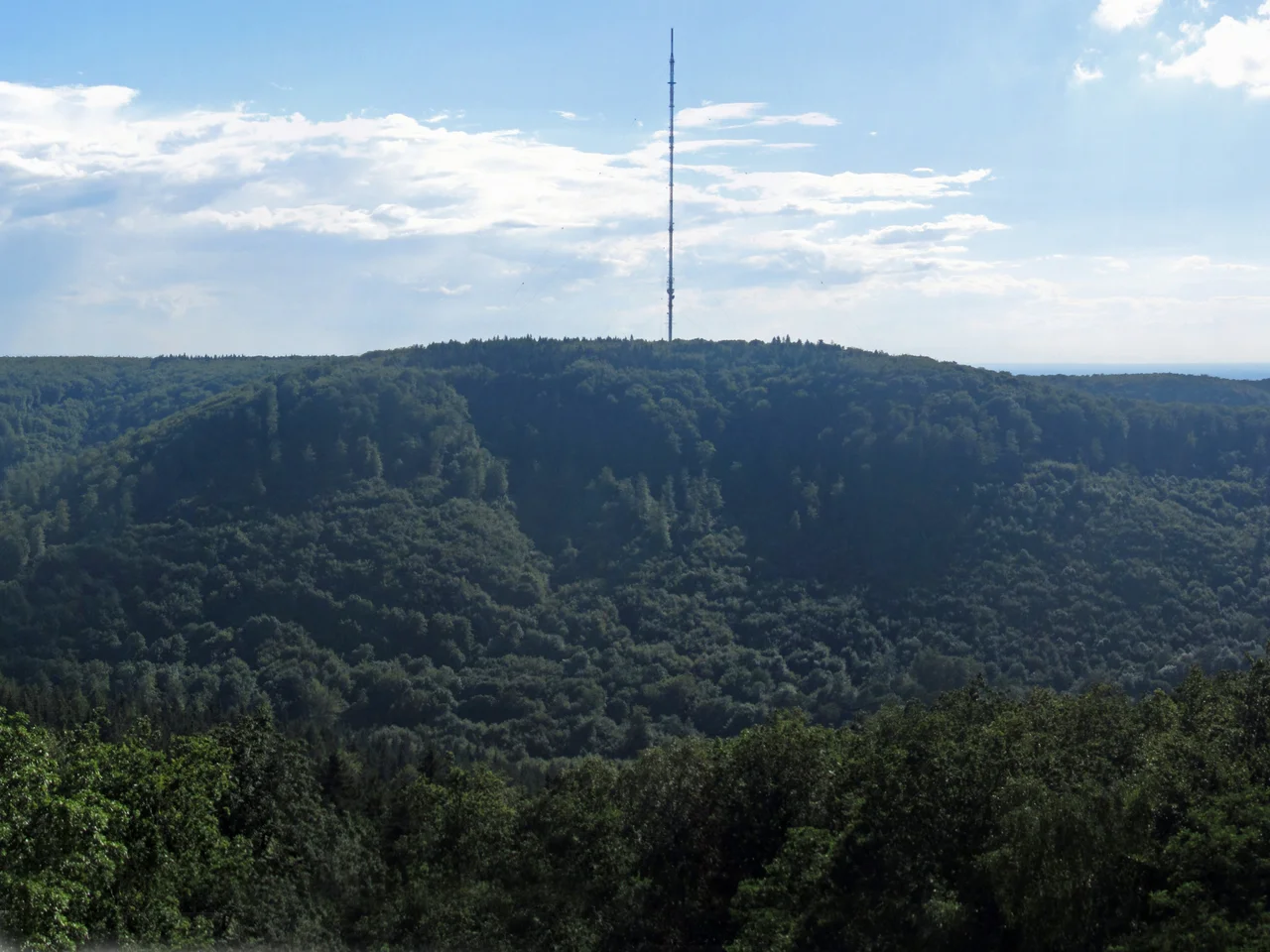
The Teutoburg Forest is not a great expanse of woodland. It is a narrow wooded ridge running north-west to south-east, dividing flat farming country from the uplands that lead east to the Weser, and the region takes its name from it.
The name is borrowed. Roman writers mentioned a saltus Teutoburgiensis where three legions were destroyed in 9 AD, and in the nineteenth century that label was attached to this ridge, along with a colossal statue of Arminius on a hilltop near Detmold. Twentieth-century archaeology has since put the battle at Kalkriese near Osnabrück instead, well outside the region that carries the name. It has made no difference at all to local identity. The 53-metre Hermann is still the unofficial symbol of the place, and the visitors still come.
Weser Renaissance
The small territories competed the way small territories do, and by the sixteenth and seventeenth centuries the competition took architectural form. The local dialect of Renaissance building is known as Weser Renaissance, and it usually sits on top of something older: a High Medieval castle built to be defended, later remodelled into a residence built to be admired.
Schloss Neuhaus at Paderborn has a baroque garden around it. Detmold has its former princely residence, and Burg Blomberg stands 17 kilometres east of the town. Not every one of these buildings has a comfortable history. The Wewelsburg, a triangular early seventeenth-century castle near Büren built for the prince-bishops of Paderborn, was taken over by the SS in the Nazi period and rebuilt to Heinrich Himmler's designs - a use it neither invited nor has been able to shed.
Höxter Keeps the Monasteries
The Höxter district in the east holds an unusual concentration of former monastic houses. The greatest of them is Corvey, a Benedictine abbey founded in the ninth century that became one of the most important in Europe and whose Carolingian westwork, together with the buried remains of the settlement that grew around it, is now a UNESCO World Heritage site.
Elsewhere the churches are episcopal rather than monastic: Minden and Paderborn both have cathedrals worth the detour. And the towns themselves are a large part of the appeal. Paderborn, Bad Salzuflen, Blomberg, Detmold and Lemgo all keep well-preserved historic cores of half-timbered houses, with fragments of their medieval fortifications still standing between them.
Spa Water and Windmills
Note the number of towns here whose names begin with Bad. The region runs on mineral springs and the leisurely nineteenth-century industry that grew up around them, and the spa gardens are the visible result: Bad Lippspringe, Bad Oeynhausen and Bad Salzuflen all keep formal grounds designed for people with time to walk slowly. Bad Driburg has its earl's park, Gütersloh a botanical garden, and Rheda-Wiedenbrück and Rietberg both retain former horticultural show grounds.
Further north, around Minden and Lübbecke, the local speciality is machinery. The district holds so many watermills and windmills that it is simply called the mill district, and they turn up along the lanes with a regularity that starts as charming and ends as slightly uncanny.
On Foot, on Wheels, in the Air
The hills are modest, which makes this good country for moving slowly through. Paths for walkers and cyclists are signposted across the whole region and graded for a range of abilities, so it is genuinely possible to plan a day around ability rather than ambition. There is canoeing on the rivers, rock climbing, horse riding and golf, and organised outings by hot-air balloon, vintage car and motorcycle.
Getting in is straightforward. Paderborn-Lippstadt handles a handful of domestic flights and seasonal charters to the Mediterranean. Münster/Osnabrück is 65 kilometres west, Dortmund 85 to the south-west, Hannover 75 to the north-east, and Düsseldorf - the nearest airport with a full international network - about 170 kilometres away. High-speed trains stop hourly at Bielefeld from Berlin, Hannover, Düsseldorf and Cologne, with slower intercity services calling at Minden, Bad Oeynhausen, Herford and Gütersloh.
From the Air
The region centres on roughly 51.90°N, 8.81°E in eastern North Rhine-Westphalia. From the air its defining feature is the Teutoburg Forest ridge, a continuous dark wooded band running north-west to south-east for about 100 km, with open farmland on the north-eastern side and the Senne heath and Paderborn plateau to the south-west. The Hermannsdenkmal on its bare hilltop clearing near Detmold and the pale rock line of the Externsteine a little to the south-east are the two most reliable visual fixes; the Weser valley marks the eastern edge of the region, and the A2 autobahn crosses the lowlands to the north. Paderborn-Lippstadt (EDLP) sits centrally to the south; Bielefeld (EDLI) is on the ridge itself; Münster/Osnabrück (EDDG) lies about 65 km west, Hannover (EDDV) about 75 km north-east, Dortmund (EDLW) about 85 km south-west and Düsseldorf (EDDL) about 170 km south-west. Terrain is undemanding at 1,500-4,000 ft, but the ridge produces low cloud, mechanical turbulence in strong north-westerlies, and persistent valley fog on autumn mornings.
Nearby Stories
- Meller Möbelfabrik 6.6 km away
- RAF Gütersloh 9.3 km away
- Intercity Experimental 9.5 km away
- Sababurg 16 km away
- GEO600 22 km away
- Fagus Factory 22 km away
- Niederhagen concentration camp 22 km away
- Warsteiner 29 km away