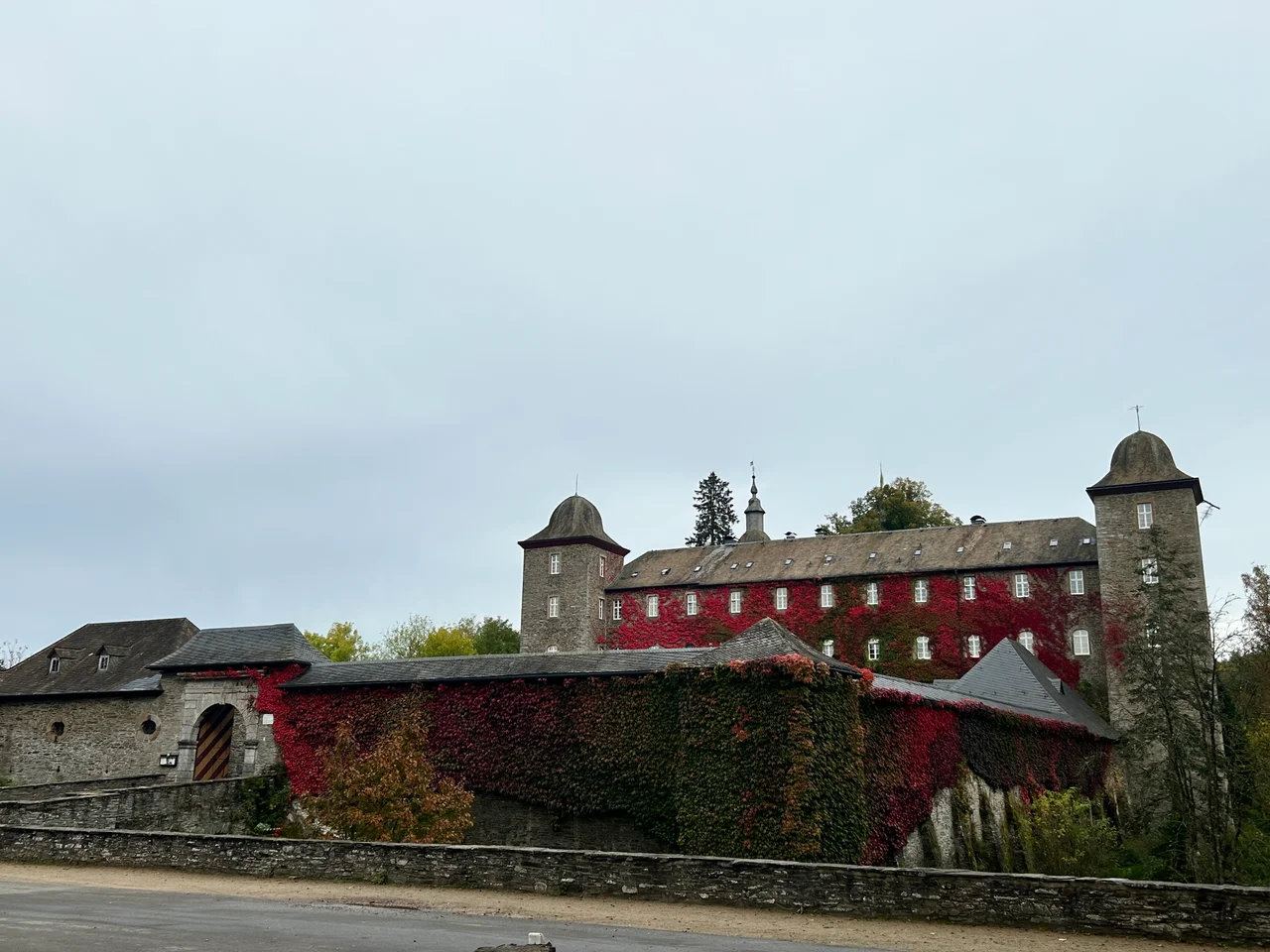

Schnellenberg Castle
When the Cologne Elector Gebhardt Truchsess von Waldburg converted to Protestantism in 1583, he set off a small chain reaction whose end point was a castle. Kaspar von Furstenberg, a Catholic loyalist and bailiff in the Sauerland, refused to follow his sovereign over the confessional line. After Gebhardt was deposed, the new elector, Ernst of Bavaria, rewarded Kaspar's loyalty. In 1594 Kaspar used that favor to buy a half-ruined 13th-century castle on a mountain spur above the Bigge river, just outside Attendorn. Schnellenberg is still in the Furstenberg family today, more than four centuries later, and is now run as a hotel. It is one of those castles whose history is best understood as a family heirloom, not a public monument.
Guarding the Heidenstrasse
Schnellenberg sits on a strategic mountain spur above the southern bank of the Bigge, at a height that lets the eye sweep east toward Attendorn and west toward the Biggesee reservoir. The original castle was raised at the direction of Archbishop Engelbert von Berg of Cologne in the early 13th century, at the same moment the town fortifications of Attendorn were being built. The reason was traffic. The Heidenstrasse, a significant medieval trade route, crossed the Bigge here, and whoever controlled the crossing controlled the tolls. An agreement with the Counts of der Mark gave the count two castle fiefs in return for cooperation. The first written mention of the castle is 1222. By 1411 the structure had grown enough that Archbishop Friedrich of Cologne could grant Grete, widow of Wilhelm Vogt von Elspe, permission to build a house inside the castle walls. By 1441 the Vogt von Elspe brothers and the Schnellenbergs were splitting the property between them, with Johann von Schnellenberg retaining the main tower house, the so-called Vogte altes Haus, and three quarters of the surrounding fields.
The Furstenberg Restoration
When Kaspar von Furstenberg took possession in 1594, the castle was in poor repair. He pulled in a small team of artists and craftsmen, with funding provided by his brother, Dietrich von Furstenberg, prince-bishop of Paderborn. The sculptor Johann Hocheisen cut the new stonework. The carver Hans Miltenberger laid intricate wooden inlays into ceilings and walls. The painter Augustin Jodefeld of Paderborn finished interiors with the Old Testament inscriptions the family preferred. The result was a mannerist interior considered unique in Westphalia, blending late Renaissance polish with the dense biblical iconography of a Counter-Reformation patron. The Furstenberg silver treasure assembled during this period is still regarded as a masterpiece of late Renaissance German silversmithing. It is not on public display. It lives at Haus Herdringen, the family's main seat near Neheim, in the same family hands that bought the castle in the first place.
St George's Chapel
The 16th century Renaissance chapel inside Schnellenberg, dedicated to St George, is the heart of the building's religious story. Its ceiling paintings were whitewashed over in 1837, a common 19th century Protestant or Enlightenment response to baroque interiors, and only restored to view in 1974. The ceiling portrait of Bishop Dietrich von Furstenberg, painted as the likeness of Saint Jakobus rather than as himself, is one of the more telling details of the restoration. A semi-precious stone relic in the form of a circular plate sits in front of the altar today, a quiet reminder that the family that bought a ruin in 1594 has held its Catholic identity unbroken through the long centuries since.
Castle, Cellar, and Conference Hall
Today Schnellenberg is a working hotel. The same building that anchored the Heidenstrasse contains a 16th century Renaissance chapel, an underground cellar, a Knights Hall, and a Gobelin Hall now run as a restaurant. The conference facilities suggest the present economic strategy. Guests sleep in a building that has been occupied without serious break since around 1222, and they eat in rooms where the Furstenberg family hosted bishops and electors in the 1590s. The castle is said to be the largest hilltop castle in the Sauerland area, a regional claim that depends on how a few rivals are measured. Standing on the entrance road and looking up at the silhouette against the sky, the boast feels fair. The mass of stone is real, the Bigge runs cold below, and the family that bought this hill in 1594 is still here in 2026, still finding new uses for a very old building.
From the Air
Schnellenberg Castle is at 51.1238°N, 7.9257°E, on the southern bank of the Bigge between the Biggesee reservoir and the town of Attendorn. Cruise the Biggesee corridor at 3,000 to 4,500 ft for a panoramic view of the castle's spur, the reservoir, and the limestone hills that hide the Atta Cave less than a kilometer to the east. Nearest airports: Siegerland (EDGS) about 30 km south, Dortmund (EDLW) about 60 km north. The Biggesee is a dark blue ribbon snaking through green hills, an unmistakable visual reference.
Nearby Stories
- Festspiele Balver Höhle 2.9 km away
- Schloss Allner 6.1 km away
- Eschbach Dam 15 km away
- Marienstatt Abbey 15 km away
- Ruhr University Bochum 15 km away
- Eresburg 32 km away
- Marburg 36 km away
- Observation Post Alpha 106 km away