
Bielefeld conspiracy
In August 2019 the city council of Bielefeld offered one million euros to anyone who could produce incontrovertible evidence that Bielefeld does not exist. This was a real offer, from the real municipal government of a real city of roughly 330,000 people, the eighteenth largest in Germany. It was made in earnest, because for twenty-five years a large stretch of the German-speaking internet had been insisting — with the elaborate patience of true believers — that the place was a fabrication.
Three Questions
The Bielefeld conspiracy holds that the city does not exist, and that its apparent existence is an illusion maintained by an entity known only as SIE — German for THEY — with the cooperation of the authorities.
The evidence is a questionnaire. Do you know anybody from Bielefeld? Have you ever been to Bielefeld? Do you know anybody who has ever been to Bielefeld? Most people, asked cold, answer no three times. Anyone who answers yes, or who volunteers any other knowledge of Bielefeld, is by definition either part of the conspiracy or one of its victims. The structure admits no disproof, which is the joke, and which is also the standard architecture of every conspiracy theory that has ever been meant sincerely. On the question of who is behind it all, the theory declines to commit. The CIA, Mossad, and aliens using Bielefeld University to conceal their spacecraft have all been proposed.
Das gibt's doch gar nicht
It started at a student party in 1993, when a friend of Achim Held met someone from Bielefeld and said, "Das gibt's doch gar nicht." The phrase does two jobs in German. It means "Unbelievable!" and, read flat, "That doesn't exist."
Held, a computer science student at the University of Kiel, kept turning it over — helped along, he has said, by a conversation with a devoted reader of New Age magazines and by a drive past Bielefeld at a time when the Autobahn exit happened to be closed. On 16 May 1994 he posted the theory to the newsgroup de.talk.bizarre. He has been consistent ever since, including in a television interview marking the posting's tenth anniversary, that it was a joke and that it was his.
By then it had comprehensively escaped him.
'Bielefeld' Defines Nondescript
The joke needed a particular kind of city to land on, and the historian Alan Lessoff has spelled out what Bielefeld supplied: no major national institutions, no famous tourist attraction, no great river running through it. His verdict — "'Bielefeld' defines nondescript" — is unkind and, as an explanation, difficult to argue with. A town with a cathedral on a postcard could not have carried this.
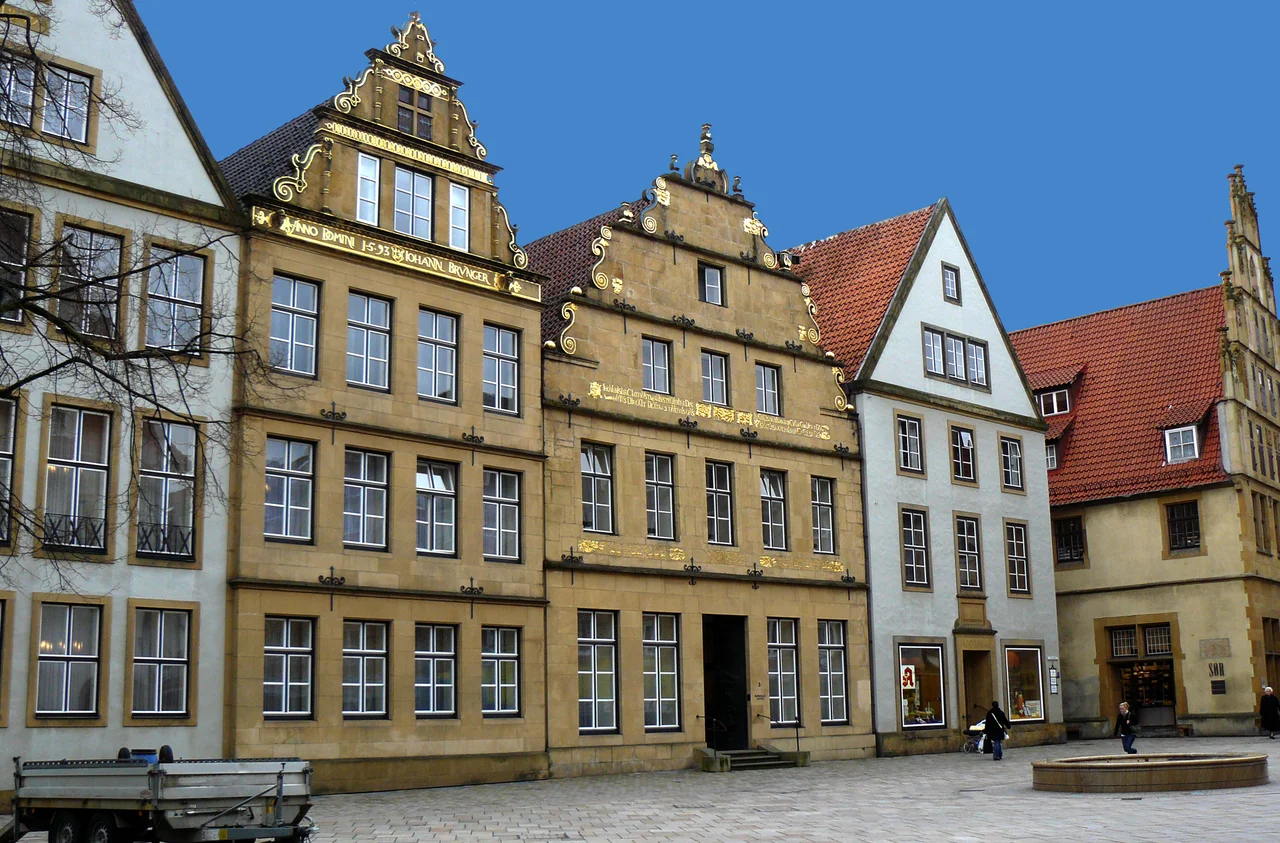
None of which makes Bielefeld nothing. It sits on the Teutoburg Forest ridge in eastern Westphalia, and the Leineweber monument in the old centre commemorates the linen weavers the place was built on. It is simply not a city that anyone outside the region had ever been given a reason to picture.
Even the Chancellor
The council spent years trying to build a public image that would outrun the theory, without much success. A decade in, the mayor's office was still fielding phone calls and emails from people professing doubt that the city was there. In November 2012 Chancellor Angela Merkel, speaking publicly about a town hall meeting she had attended in Bielefeld, added "... if it exists at all," and then, "I had the impression that I was there."
There was also a film. In 2009 students at Bielefeld University — the same institution the theory accuses of hiding a spaceship — began a feature based on the conspiracy, financed by the university and local sponsors, with a screenplay by Thomas Walden and a cast drawn largely from students and staff. It premiered in Bielefeld on 2 June 2010.
A Million Euros, Unclaimed
Which brings us back to August 2019. Nobody collected. The city considered the matter settled — its existence conclusively established by the failure of anyone to establish otherwise — and declared the conspiracy over. To mark the ending, Bielefeld set a glacial erratic, a boulder carried there by ice, in the historic centre near the Leineweber monument, with a QR code on it pointing to the whole story.
The joke has never quite lain down. When Arminia Bielefeld improbably reached the German cup final in 2025, the BBC World Service and the New York Times both reached for it. And Bielefeld has plenty of company: Molise, Wyoming, Tlaxcala, Drenthe, Teruel, Saitama, Zhytomyr, Rancagua, Finland and Australia have all been declared fictional by somebody. Only one of them ever offered to pay.
From the Air
Bielefeld lies at 52.0228°N, 8.5333°E in eastern Westphalia, and from the air the terrain gives it away long before the buildings do: the Teutoburg Forest runs north-west to south-east as a single narrow wooded ridge, and the city straddles the gap cut through it, spilling onto the flat Ravensberg country to the north and the Senne heath to the south. From 2,000–4,000 ft look for the ridge line, the Sparrenburg castle tower standing on it above the old centre, and the A2 autobahn crossing the lowland to the north. Nearest airfields: Bielefeld (EDLI) about 7 km south of the centre, Paderborn-Lippstadt (EDLP) about 45 km south-east, Münster/Osnabrück (EDDG) about 60 km west, Hannover (EDDV) about 95 km east-north-east. Terrain is undemanding, though the ridge generates low cloud and rotor in strong north-westerlies.
Nearby Stories
- Osnabrück Zoo 4.9 km away
- Warendorf 6.5 km away
- Battle of Villinghausen 6.5 km away
- Wewelsburg 8.5 km away
- Meller Möbelfabrik 19 km away
- Bad Nenndorf Interrogation Centre 21 km away
- Reich Harvest Thanksgiving Festival 22 km away
- Sababurg 31 km away