.jpg)
Spandau Citadel
In the last days of April 1945, with the Red Army fighting street by street through Berlin, Soviet commanders arrived at the edge of an island where the Havel meets the Spree and looked at Spandau Citadel. It was three and a half centuries old. It was also low, thick, and cut into four arrowhead bastions arranged so that every approach could be swept by fire from two directions at once, and the arithmetic of taking it by assault was terrible. So they surrounded it and talked instead. Just after three in the afternoon on 1 May the commander surrendered to Lieutenant-General Perkhorovich's 47th Army, and a fortress designed by Italian engineers in the 1550s saved, at the very end of its working life, both itself and everyone inside it.
Angles Instead of Height
There has been something defensive on this island since 1157, when Albert the Bear planted a frontier fort here; by the middle of the fifteenth century it was the seat of government for the Margraves of Brandenburg. Then gunpowder made tall stone walls obsolete, and in 1560 Joachim II Hector commissioned a new kind of structure. Christoph Romer began it, Francesco Chiaramella de Gandino took over in 1562, and Rochus Graf zu Lynar finished the design from 1578. Troops moved in by 1580; the work was not complete until 1594.
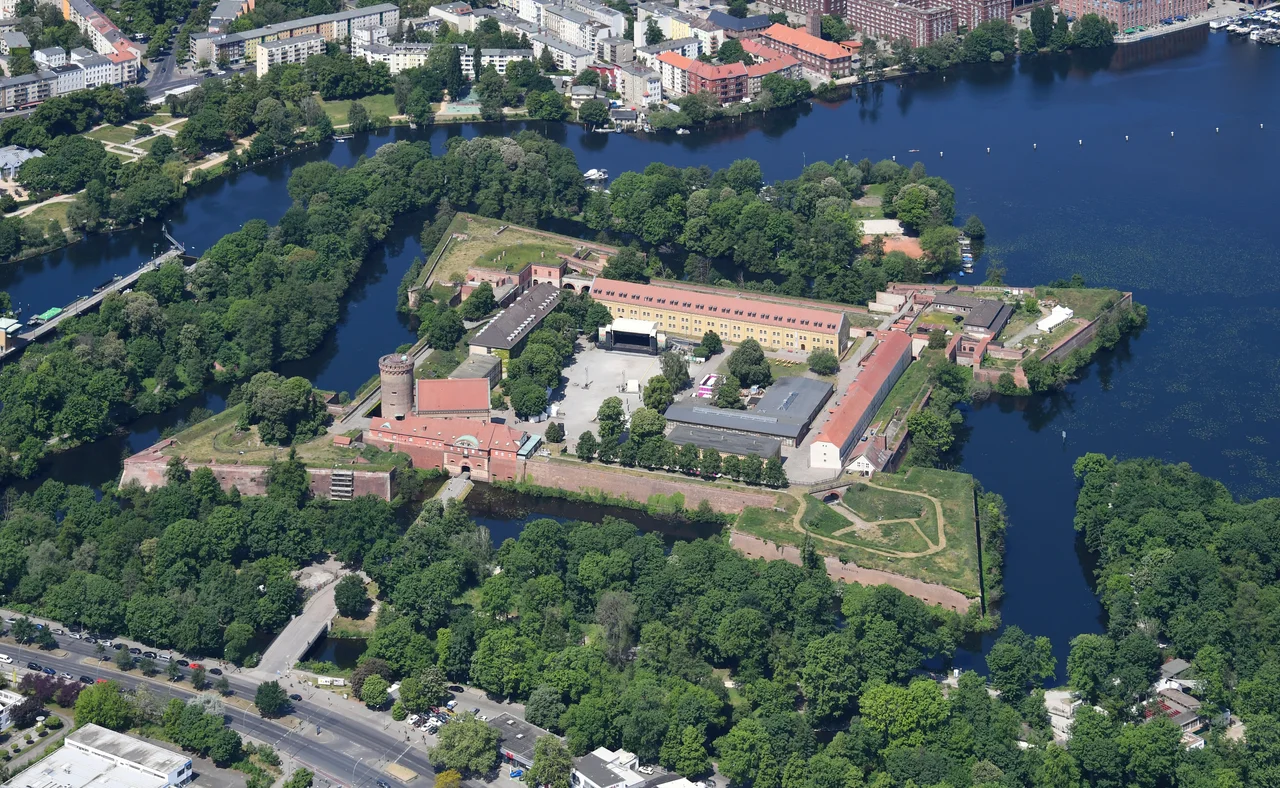
What they built is a trace italienne fortress, the Renaissance answer to artillery: a squat quadrilateral roughly 208 by 195 metres, four bastions named Kronprinz, Brandenburg, Konigin and Konig at the corners, connected by straight curtain walls, with water all around. The point of the pointed bastions is that they leave no blind spot. Anyone approaching a wall is exposed to flanking fire from the bastion beside them. It is a shape you recognise instantly from the air, and one of the best-preserved examples in Europe.
The Tower That Names a Budget Surplus
The oldest thing standing inside the walls is the Julius Tower, built as a keep and used at times as a residence, its castellated crown added by Karl Friedrich Schinkel in 1838. After the Franco-Prussian War of 1870-71, part of the indemnity France paid Germany - 120 million marks in gold coin - was carried into that tower and left there as the empire's war chest.
The gold is long gone, but the word stuck. In German, a Juliusturm is a hoard of unspent public money. West Germany accumulated a famous one: by 1956 the federal surplus had passed seven billion Deutsche Mark, about a quarter of that year's budget, and was spent down over the following two years, mostly on social programmes rather than the rearmament it had been set aside for. A medieval keep on a Havel island still turns up, by name, in German fiscal argument.
Prisoners, Napoleon, and the Laboratory
The citadel spent most of its career not fighting. Swedish troops besieged it in 1675. In 1806 its garrison surrendered to Napoleon's army without firing a shot; Prussian and Russian forces took it back in 1813, wrecking the ramparts in the process and requiring years of restoration. In between it did duty as a prison for Prussian state prisoners, among them the nationalist gymnastics campaigner Friedrich Ludwig Jahn.
Its darkest period was also its quietest. In 1935 the German army installed a Gas Protection Laboratory inside the fortress. Around 300 scientists and technicians worked here on chemical weapons - synthesis, munitions design, manufacturing processes, and testing on animals and on people - and much of the development of nerve agents, including tabun, was done behind these walls. This is not the site people usually mean when Spandau comes up: Spandau Prison, where the Nuremberg convicts were held, was a separate building in the same borough.
Winter Tenants in the Casemates
The casemates were built to keep cannonballs out, which incidentally makes them close to perfect for something else. They are dark, damp, cold without freezing, and almost never disturbed - exactly the conditions bats need to get through a winter without burning the fat they will not be able to replace until spring. Several species now hibernate in the citadel's vaults, and it counts as one of the most important bat winter quarters in Europe.
The fortress is managed accordingly. Parts of the underground are closed in the colder months so that nobody wakes the tenants; a bat cellar opened in 2003 for visitors, and the conservation group NABU runs an annual bat night with guided tours. A structure designed for the loudest possible use has ended up being valued mostly for its silence.
What Berlin Took Down
The citadel now works as a museum, and its permanent exhibition is a strange, well-executed idea: it collects the public monuments Berlin decided, at various points, it no longer wanted to look at. Twenty-six statues and forty busts from the Siegesallee, that avenue of Hohenzollern marble Wilhelm II gave the city. Friedrich Wilhelm III and Queen Luise. Art made under the Nazis. And the head of the giant Lenin that stood in Friedrichshain until 1991, hacked apart, buried in a sand pit, and dug up twenty-three years later to sit on the floor of a Renaissance gun emplacement where visitors walk around it at eye level.
Other corners of the complex have had gentler afterlives. Gravestones dating back to 1244 record the Jewish community of a medieval trading town that used the fortress as a refuge. A vocational school occupied the buildings from 1950 to 1986. Since 2005 the inner courtyard has been a summer concert venue, and on a warm July night the bastions that once denied cover to attacking infantry make an excellent acoustic bowl.
From the Air
Spandau Citadel sits at 52.5410 N, 13.2126 E on an island at the confluence of the Havel and the Spree, at the northeastern edge of Spandau in western Berlin. From the air it is one of the most legible objects in the city: a four-pointed star of earth and brick, about 208 by 195 metres, ringed by water and set against green, with Spandau old town immediately southwest and the Havel running north to the Tegeler See. Berlin Brandenburg (EDDB) is roughly 35 km southeast; Schonhagen (EDAZ) lies about 45 km south-southeast. The star shape reads best from directly overhead in midday light, when the bastion faces cast short shadows and the geometry snaps into focus.
Nearby Stories
- Silvio Gesell 3.3 km away
- Brandenburg an der Havel 9.4 km away
- Gigafactory Berlin-Brandenburg 10 km away
- Sperenberg Airfield 11 km away
- Eberswalde Hoard 13 km away
- Tropical Islands Resort 19 km away
- Wittenberg 38 km away
- Battle of Wittstock 49 km away