
Schwerbelastungskörper
It sank nineteen centimetres, and that was the whole answer. At the point in Tempelhof where Dudenstrasse, General-Pape-Strasse and Loewenhardtdamm meet, a grey concrete cylinder twenty-one metres across and fourteen metres tall sits among apartment blocks and railway lines, weighing 12,650 tonnes and serving no function whatsoever. It was never a building. It has no windows, no rooms above ground, no purpose beyond the one it performed for three years in the early 1940s: to press down on Berlin's sandy, boggy soil and record how far the soil gave way. Albert Speer needed that number before he could build a triumphal arch. He got it. He did not like it.
The Question It Was Built to Ask
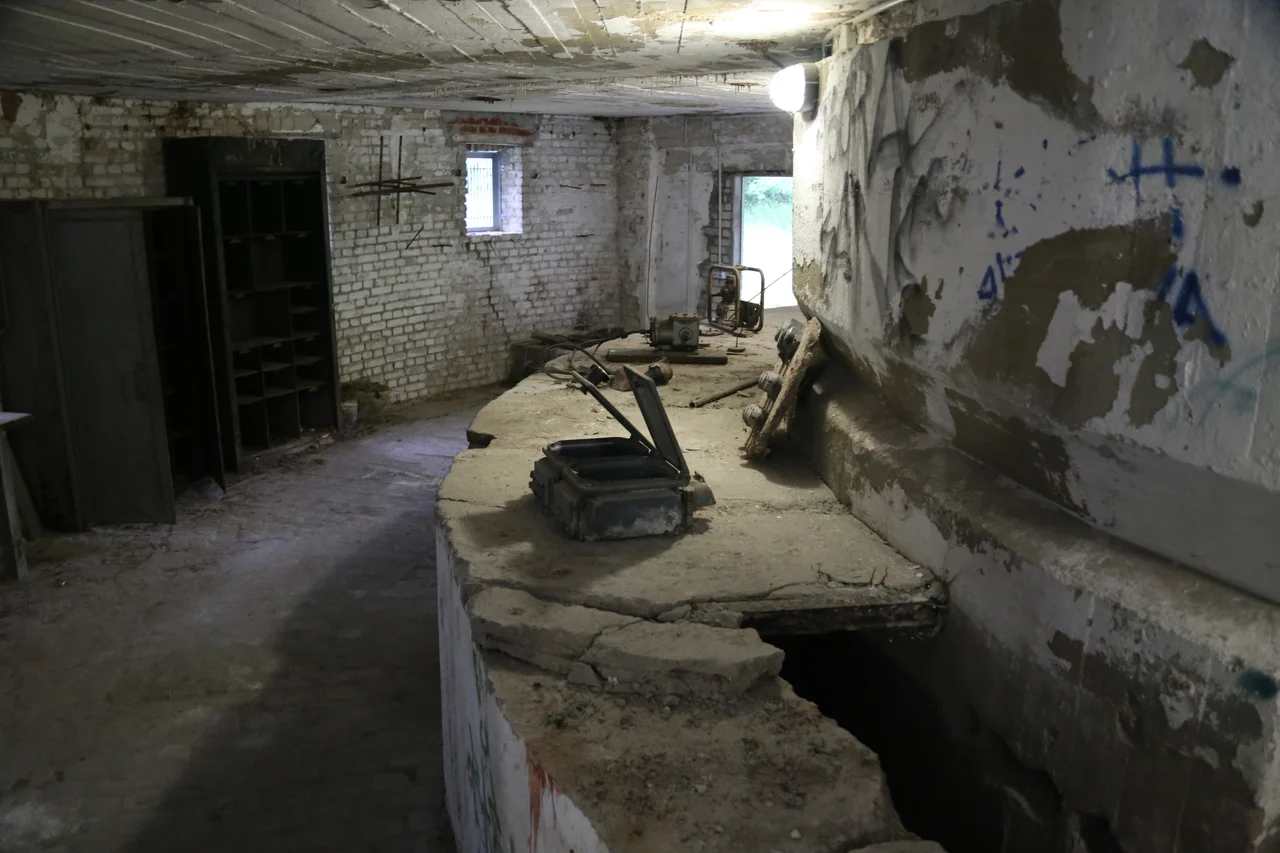
Erected between 1941 and 1942 at a cost of 400,000 Reichsmark, roughly 1.69 million euros in today's money, the Schwerbelastungskörper, the 'heavy load-bearing body', is laboratory equipment at architectural scale. The visible cylinder rests on a foundation eleven metres across that drives 18.2 metres into the earth, and within that foundation are rooms that once held the instruments measuring how far the mass settled. The load was calculated to match what a single pillar of Speer's planned arch would exert on the ground. The arch was to stand about three times the size of the Arc de Triomphe in Paris, anchoring the southern end of a boulevard cut through the middle of the city. Nothing of that weight had ever been attempted on ground like this, and Berlin's ground is not rock but sand, gravel and old marsh.
Germania
The arch was one component of the capital Hitler and Speer intended to build and call Germania. Its centrepiece was the Volkshalle, a domed assembly hall 290 metres high with space for more than 180,000 people. When Speer described the design to British and American structural engineers in 1945, they told him the interior would have been so vast that condensation from the breath of a full crowd would have formed clouds inside it.
None of it was to rise on empty ground. Rebuilding the centre of Berlin meant demolishing thousands of homes, and Speer's General Building Inspectorate solved the resulting housing shortage by taking housing from Jewish Berliners: from 1939 his office used the Nuremberg Laws to clear some 15,000 flats of their Jewish tenants, who were crowded into designated houses and, before long, put on deportation trains. The same office built and administered forced-labour camps across the city. The monumental capital was to be assembled out of other people's homes and other people's labour, and the accounting for that began years before the first stone would have been laid.
Nineteen Centimetres
Engineers read the instruments for two and a half years. A settlement of less than six centimetres would have shown the ground was suitable. The cylinder sank nineteen. Measurements stopped in June 1944, by which point the finding was academic: the arch could have been built only after extensive stabilisation of the subsoil, and there was no longer a state capable of stabilising anything. The most honest verdict on Germania came not from an architect or a historian but from the sand under Tempelhof, which simply gave way and kept giving way.
Why Nobody Removed It
After the war the obvious course was demolition, and nobody could work out how. A charge large enough to break 12,650 tonnes of concrete would have taken the neighbouring rail tracks and apartment buildings with it. So the cylinder stayed where it was, the city grew back around it, and for decades Berliners walked past without knowing what they were passing. In 1995 it was placed under monument protection, described as the only tangible relic of National Socialist urban planning left in the city. It is open to the public, with guided tours and panels beside it setting out what Speer intended to put here.
What Full Scale Looks Like
There is something clarifying about the object. Berlin holds no shortage of Germania drawings, models and newsreel, all of it seductive in the way unbuilt architecture always is; the scheme survives in the imagination precisely because it never had to meet a wall, a budget or a water table. This is the one part poured at full size, and it is not a gate, a hall or a monument. It is a weight. Stand beside it and you are looking at the exact quantity of concrete one column of the arch would have driven into the earth, and at the answer the earth returned.
From the Air
Located at 52.484 N, 13.3716 E in Berlin-Tempelhof, at the junction of Dudenstrasse, General-Pape-Strasse and Loewenhardtdamm. From the air the cylinder is small but distinctive: a pale grey drum roughly 21 m across, isolated on its own plot beside the S-Bahn cutting, about 1.5 km northwest of the former Tempelhof Airport apron and 1 km east of Viktoriapark on the Kreuzberg hill. Best identified from 1,000-2,000 ft AGL with the old Tempelhof crescent terminal as the anchor landmark. Berlin Brandenburg (EDDB) lies about 15 km southeast. The site is in dense city airspace; low overflight requires clearance, and summer haze can wash out the concrete against surrounding rooftops.
Nearby Stories
- E11 hiking trail 3.4 km away
- Bogensee 4.3 km away
- Maybach I and II 4.9 km away
- Treuenbrietzen 15 km away
- Battle of Fehrbellin 18 km away
- Falkenhagen Bunker 20 km away
- St. Mary's Church, Chojna 35 km away
- Eisenhüttenstadt 39 km away