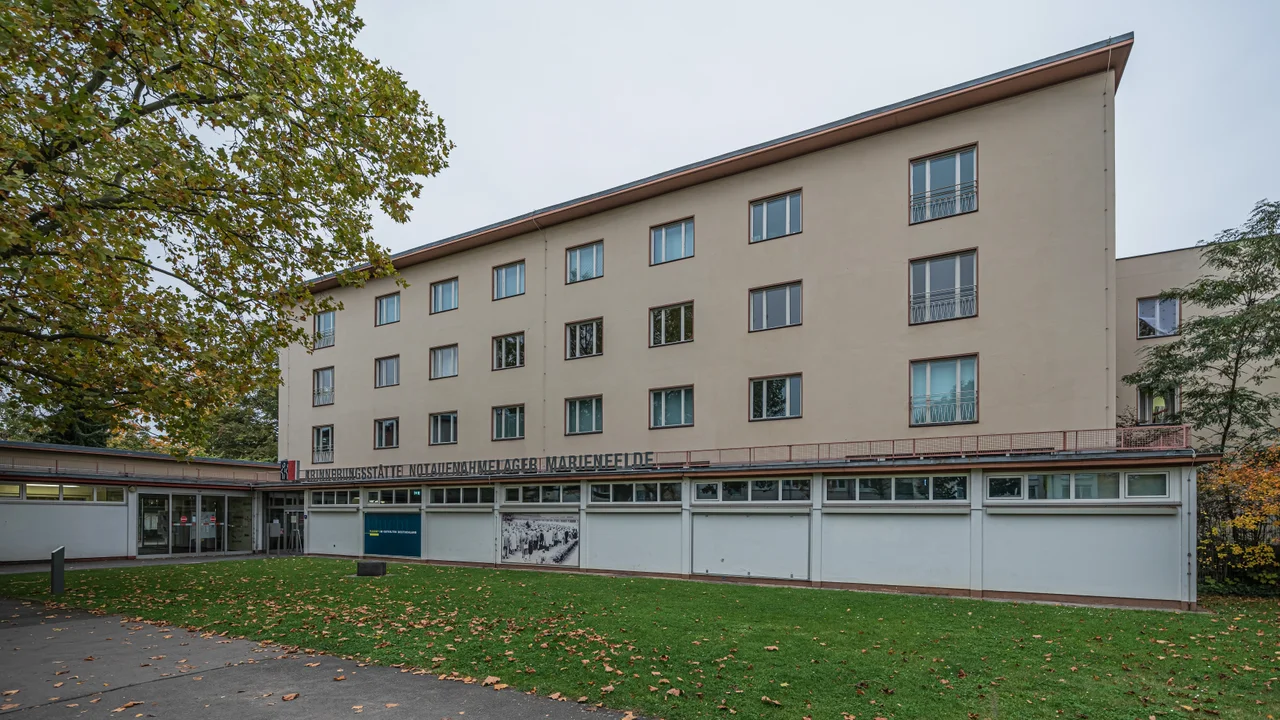

Marienfelde Refugee Transit Camp
On 12 August 1961 two thousand four hundred people arrived at Marienfelde in a single day. The camp's first ten residential blocks had been built, eight years earlier, to hold around two thousand at a time. None of the people queuing that Saturday knew it was the last ordinary day — that before the next morning was out, East German authorities would seal the boundary between the two halves of Berlin and begin laying the wire that hardened into the Berlin Wall. They knew only what everyone in the East had been reading in the air for months, and had acted on it. Roughly 1.35 million people passed through this reception centre in its working life, out of the four million who left the GDR between 1949 and 1990.
Why Berlin Was the Last Door
The movement began long before the camp did. In 1949, 129,245 people left the Soviet occupation zone for the West. About 200,000 followed in 1950, some 165,000 in 1951, 182,000 in 1952. West Germany passed its Federal Emergency Admission Law on 22 August 1950 to give the arrivals a legal footing; West Berlin adopted the same law on 4 February 1952.
Then the ground shifted. On 26 May 1952 the East German government closed the inner German border — fences, a ploughed strip, a controlled zone, villages cut off from their own fields. What remained was Berlin, where the sectors still touched, streets still ran across them, and an S-Bahn ticket still worked. For nine more years that gap in the middle of a sealed country was the way out, and tens of thousands of people used it.
Ten Blocks Near Tempelhof
A small camp had operated in Charlottenburg since January 1950 and was hopelessly overrun. On 30 July 1952 the cornerstone of a much larger centre was laid at Marienfelde, on the southern edge of the American sector — chosen because it stood near Tempelhof airport and the S-Bahn lines, and a reassuring distance from the Soviet sector boundary. The new barracks opened on 14 April 1953 and the centre began full operation that August.
What arrivals found was a bureaucracy and a bed: registration, a medical examination, food, identity papers, a room shared with strangers, and a wait for resettlement somewhere in the West. Nobody was staying. Everyone in those blocks had walked out of one life that week and was waiting for permission to start another, in most cases having left behind a flat, a job, relatives and a return address they could no longer use. On 20 September 1956 the centre formally registered its one-millionth arrival.
What Do You Know About the Place You Just Left
There was another routine at Marienfelde that appears in no brochure. Western Allied intelligence officers interviewed arrivals as a matter of course, and the questions were about the country they had just walked out of.
It was the one commodity every new arrival carried. They had lived in East German towns, worked in East German plants, done East German military service, and the West wanted all of it — which meant that people at the most exposed moment of their lives, hours or days after a decision that had cost them everything, sat down with strangers who would not say who they worked for. The screening ran both ways: Western authorities feared agents entering with the crowds, so the same conversations also served as a filter. Whatever their intelligence value, the experience belonged to people who had come looking for shelter and were asked, first, to be useful.
The Summer It Broke
The numbers in 1961 tell you that people could feel what was coming. June brought 19,198 arrivals to Marienfelde. July brought 30,444 — a thousand a day. In the first days of August it passed twelve hundred a day, and on 12 August it hit two thousand four hundred.
On 13 August the buffer zone between the two halves of the city was closed and construction of the Wall began. The camp did not empty at once. For a few days more people kept coming through the gates, most of them East Germans who had crossed into West Berlin for an ordinary visit and, watching the news, decided not to go home. That is the quietest and hardest fact about that week: many families were divided not by an arrest or a border guard but by a decision taken in an afternoon, by someone who had only meant to be out for the day.
Still a Reception Centre
A memorial was inaugurated on the site in 1993. Since April 2005 the permanent exhibition "Flight in Divided Germany" has occupied about 450 square metres with more than 900 objects, run by the Berlin Wall Memorial foundation. The centre marked its sixtieth anniversary in 2013 with a ceremony attended by President Joachim Gauck alongside former refugees, the people the whole place had been built for. In 2021 Hans Ticha's painting "The Wall" went on display.
The part that unsettles visitors most is not in the exhibition. Marienfelde never stopped being what it was built to be. It processed ethnic Germans resettling from the former Soviet Union, and since December 2010 the buildings have again housed refugees and asylum seekers arriving in Berlin from other wars and other borders, under the management of the Internationaler Bund. The museum is due to close in December 2026 for a rebuild, and to reopen in 2028 around a new permanent exhibition on flight and migration — a subject the site has never had to look up.
From the Air
The camp stands at 52.4203°N 13.3667°E in Marienfelde, in the Tempelhof-Schöneberg borough of southern Berlin, about 11 km south of the Brandenburg Gate. The unmistakable navigation feature is 4 km north: the enormous open green rectangle of the former Tempelhof airfield, its curved terminal arc still intact along the northern edge and its two runways left in place as paths. Marienfelde itself reads as a band of low postwar housing between that green void and the outer suburbs, with the Teltow Canal cutting east–west a couple of kilometres to the north and the Berlin outer ring railway to the south. From 1,500–2,500 ft AGL the barrack blocks are legible as a regular comb of parallel buildings. Berlin Brandenburg (EDDB) lies about 13 km east-southeast, which puts Marienfelde close under the approach and departure structure — this is controlled airspace throughout and needs clearance. Schönhagen (EDAZ) is roughly 20 km southwest, Strausberg (EDAY) some 40 km northeast. Note that Tempelhof and Tegel are both long closed to traffic; Tempelhof is a public park and no longer an available field.
Nearby Stories
- E11 hiking trail 3.4 km away
- Bogensee 4.3 km away
- Maybach I and II 4.9 km away
- Treuenbrietzen 15 km away
- Battle of Fehrbellin 18 km away
- Falkenhagen Bunker 20 km away
- St. Mary's Church, Chojna 35 km away
- Eisenhüttenstadt 39 km away