
Karl May Museum
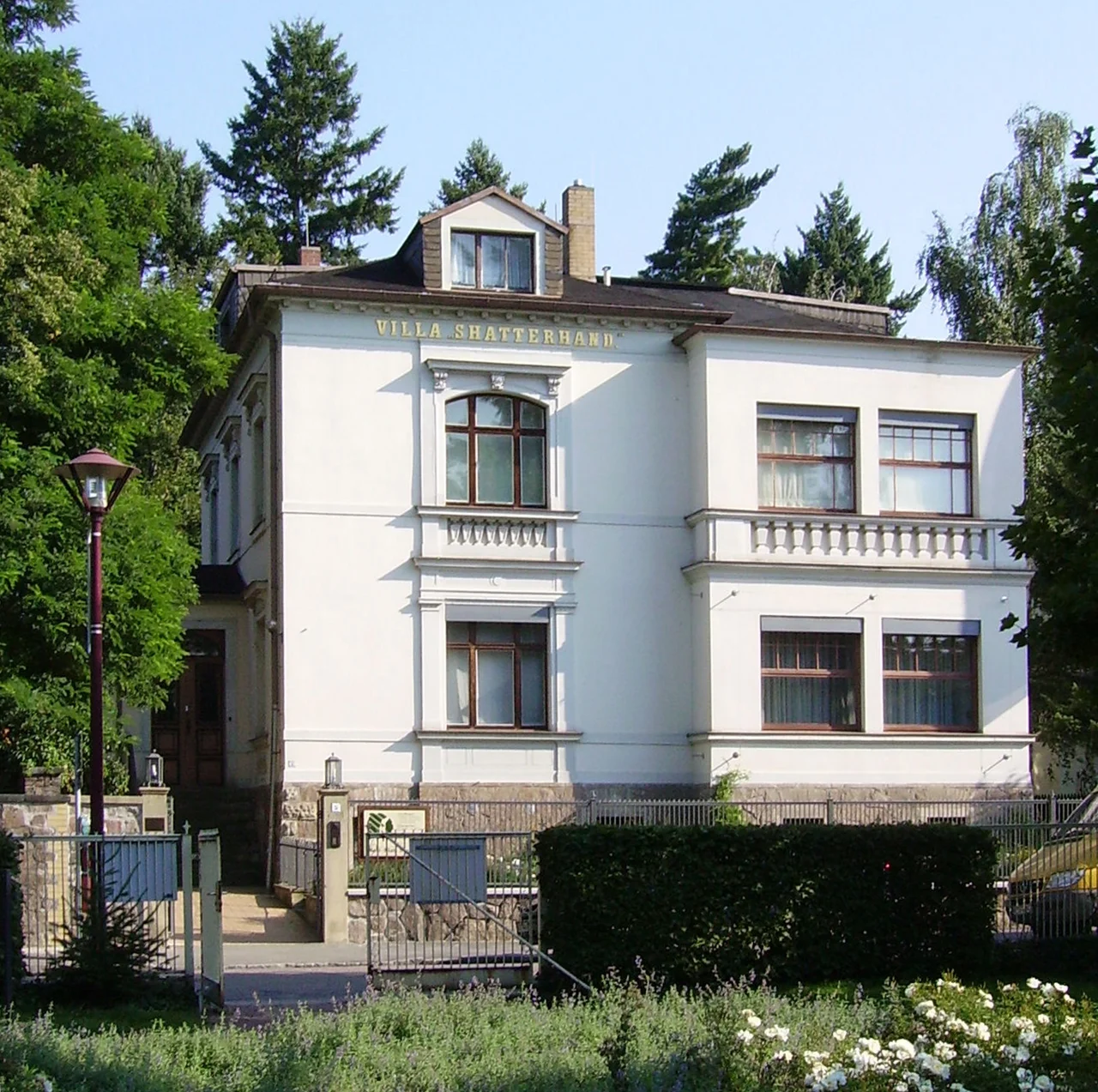
Karl May named his house after his own invention. Villa Shatterhand, an Italian Renaissance villa in the Dresden suburb of Radebeul, carries the name of Old Shatterhand — the German frontiersman May sent riding across an American West he assembled largely out of other people's books. Behind the house, in the garden, stands a log cabin. Villa Bärenfett went up in 1926 for a Viennese variety performer named Ernst Tobis, who worked under the stage name Patty Frank, had travelled in the American West, and had come home with a large collection of Native American objects. In 1928 an annexe of that cabin opened as the Karl May Museum. Dresden's Sarrasani circus came for the occasion, and the Native performers travelling with the show sang death songs for May, who had by then been dead sixteen years.
A West Made of Books
May (1842–1912) wrote adventure after adventure set on the American frontier, and two of his characters became permanent furniture in German childhood: Winnetou, a Mescalero Apache chief drawn as noble, wise and doomed, and Old Shatterhand, the European settler who becomes his blood brother. The books sold on a scale few German novels have matched, and they did something more consequential than sell. They installed a Wild West in the German imagination, one that generations of readers met long before they encountered any real account of the peoples it borrowed from. Winnetou is not a portrait of anybody. He is a European idea of nobility in Apache dress, invented by a Saxon novelist for a Saxon readership, and the Mescalero Apache had no hand in his making and no say in what he came to mean. Everything the museum has done since sits inside that gap: a serious ethnographic and art collection, housed in a shrine to a fiction.
The Cabin and Its Keeper
Patty Frank lived in the log cabin he had built and kept the museum until his death in 1959, telling visitors the stories behind the objects. Some of those visitors came under orders. When the Nazis took power they appropriated the museum along with May's image, and they took a particular interest in swastikas that appear on a few pieces of Native American work — a form that had carried entirely unrelated meanings, for centuries, among the peoples who made those objects. Hitler Youth groups were sent to Radebeul to hear Tobis talk. The property changed hands during the war for quieter reasons: Klara May, the author's widow, died in 1944, and the villa passed to the Karl May Foundation. The main house waited another four decades before the public was let in. Since 1985 Villa Shatterhand has held the museum's biographical department, its study rooms and its exhibitions on May's own life.
Two Germanys, One Frontier
After 1945 the museum found itself in East Germany, and a rival version opened in Bamberg in the West — the same obsession, duplicated on either side of a closed border. In Radebeul the placards were rewritten. Displays were recast to foreground the dispossession of Native Americans by the United States, part of a wider Soviet effort to enlist indigenous struggle against the West. The uncomfortable part is that the new placards were largely accurate, and that propaganda and truth were doing the same work for a while. Nor was all of it staged from above. East German enthusiasts made contact with the American Indian Movement and some did genuine work alongside it, which meant that a country using Native history as an argument also produced people who took that history seriously on its own terms.
What Was Taken, and What Was Returned
The founding donation that started the museum included seventeen scalps: skin and hair cut from human heads, which is what they are before they are anything else. From 2010, activists in the United States began pressing for their return. Berlin-based journalist Mark Worth brought them to the attention of Karen Little Coyote of the Cheyenne and Arapaho Tribes, who wrote in the autumn of 2013 asking for the remains of her ancestors to come home; Cecil E. Pavlat made a further request in March 2014. The museum had institutional cover of a kind. A 2013 German Museums Association guideline on human remains listed scalps taken by peoples who "fashioned trophies from the heads of their killed enemies" as an exception to remains acquired in a context of injustice — a clause that let a German institution keep what a descendant had asked for. The argument ran in the New York Times, the Guardian and German broadcast news for years. The scalp was returned in 2021.
The Museum Now
A quarter of a million people a year came through in the late 1980s, when Winnetou was still close to a state-sanctioned hero; by 2013 the annual count had fallen to around 54,000, and the decline has continued. René Wagner directed the museum from 1985 to 2013, and Christian Wacker took the post in 2018. The collecting has not stopped — modern and contemporary art, archival material, a substantial donation of new artefacts in 2018 — and the questions have not stopped either. What Radebeul holds is genuinely valuable: objects, images and documents from Native nations, gathered by a man who loved a story about them. Working out how to show them honestly, in a garden behind a villa named after a character who never existed, is the museum's actual subject now.
From the Air
The Karl May Museum sits at 51.1027°N, 13.6735°E in Radebeul, on the Elbe's north-western side between Dresden and Meissen. From the air the marker is the Elbe valley itself: Radebeul occupies the terrace below the vine-covered slopes of the Saxon wine route, a continuous ribbon of villas and vineyards linking the two towns, with the river's broad curve to the south. The museum's two buildings — a villa and a log cabin — sit close together in a garden plot and are not distinguishable from altitude. Dresden (EDDC) is about 8 km north-east, Leipzig/Halle (EDDP) roughly 95 km north-west. Meissen and the Albrechtsburg rock lie some 15 km north-west along the same valley. Fog collects in the valley on still autumn mornings; 1,500–3,000 ft AGL gives the best view of the vineyard terraces, which are at their most legible in low afternoon light.
Nearby Stories
- Bastei 11 km away
- Polabian Language 14 km away
- Ore Mountain Toy Museum, Seiffen 18 km away
- Lusatian Lake District 21 km away
- Battle of Mühlberg 25 km away
- Torgau 26 km away
- Horch 38 km away
- Ještěd Tower 65 km away