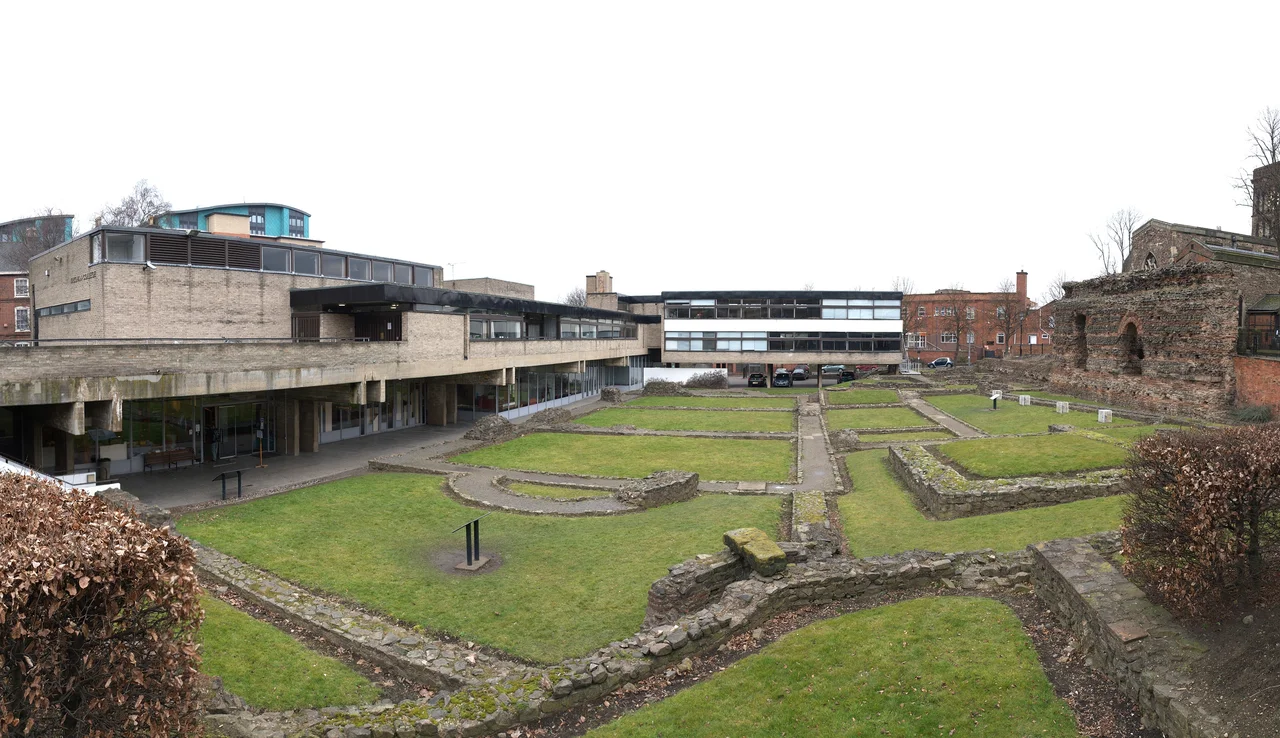

Jewry Wall Museum
For eight years the Jewry Wall Museum was closed and the joke around Leicester was that nobody minded much. The building had been an awkward proposition for decades - a Brutalist 1960s box squatting beside one of the most important pieces of Roman masonry in Britain, designed by the architect Trevor Dannatt to do too many things at once, and steadily underfunded into the kind of municipal embarrassment that gets weary write-ups in local newspapers. In 2004 Councillor John Mugglestone had said the quiet part out loud: 'At Jewry Wall, we have more curators than visitors.' The remark was meant to defend cuts to the opening hours; it became, instead, the line that everyone remembered. Then in July 2025, after the city council had bought the building outright and spent £16.8 million on it, the museum reopened. The reviews were extraordinary. Visitor numbers climbed past anything Mugglestone could have imagined. The building that nobody loved had become, almost overnight, one of the most interesting visitor experiences in the East Midlands.
A Building Designed Twice
The 1960s context for the original museum was specific and now slightly poignant. Post-war Leicester needed both an adult learning college - the successor to the long-running Vaughan Working Men's College - and a place to house the city's growing collection of Roman and medieval archaeological finds, which Kathleen Kenyon's pre-war excavation of the Jewry Wall site had massively expanded. The compromise was a single building that did both, with Vaughan College on the upper floor and the museum on the ground floor, looking out at the wall and bath foundations through full-height glazing. Trevor Dannatt, an English modernist with a careful eye for materiality, designed it. The result is Grade II listed today as a piece of post-war architecture. It also, by the early 2000s, was visibly tired. Vaughan College vacated in 2013. The University of Leicester, which had owned the building, put it on the market. Leicester City Council bought it in 2016 and began planning what would become almost a decade of reinvention.
The Collection
What the museum holds is the kind of provincial Roman collection that ought to be much better known. The Cyparissus Pavement is a 4th-century mosaic floor depicting the mythological figure Cyparissus mourning the deer he accidentally killed - the kind of mosaic you would expect to see in a museum in Italy, not in a city more famous for hosiery and football. The Blackfriars Pavement is another substantial Roman floor, lifted in pieces from a city-centre excavation and reassembled. The Norfolk Street Wall Paintings preserve fragments of Romano-British domestic decoration, ochres and reds and Pompeii-style geometric patterns surviving in a climate that destroyed almost all the equivalent material elsewhere in northern Europe. The Thurmaston Milestone marks a road that has long disappeared. And throughout the collection is the slow accumulation of finds from modern Leicester's redevelopments - every time a developer breaks ground in the city centre, the archaeologists arrive first, and the museum has been the steady beneficiary.
Saved by an Argument
The story of how the museum survived its low point is worth telling because it shows what civic institutions actually depend on. In 2004, when the city council moved to reduce opening hours to save money, a group of regulars and former patrons constituted themselves as the Friends of Jewry Wall Museum and began making noise. The cuts went through anyway. But the Friends kept pushing - through the press, through the council chamber, through the slow drip of letters and questions and motions. The hours were eventually restored after a motion led by former Labour council leader Ross Willmott. None of this is dramatic; all of it mattered. By the time the University put the building up for sale in 2013, the constituency that wanted to keep the museum had become organised enough to push the council into buying it. None of the cinematic version of museum-saving applies here. The actual version involved committee meetings.
The 2025 Reopening
The renovated museum is built around full visual access to the Roman ruins outside. The previous building had treated the bath foundations and the Jewry Wall almost as an exterior accident - something you looked at through a window but did not interact with. The new design changes that. Multimedia exhibits sit alongside the original artefacts; immersive sound and projection environments recreate the bathhouse in operation; the upper floor, freed from its old life as a college, now extends the display space dramatically. The pandemic and the discovery of unexpected building problems pushed the reopening back repeatedly, but the result has been received as worth the wait. The entry fee, introduced for the first time, is structured to help the council recoup the cost of the work. The café is free to enter. If the Friends had not fought through the lean years, none of this would exist. If Trevor Dannatt's original building had been demolished rather than rethought, the city would have lost a particular kind of mid-century optimism. Both survived. Both, finally, are working.
From the Air
The Jewry Wall Museum sits at 52.6349°N, 1.1418°W in central Leicester, on the western edge of the historic core. From altitude the museum is identifiable by its position immediately east of the open archaeological enclosure containing the Jewry Wall and Roman bath foundations, with St Nicholas' Church just beyond. The Vaughan Way ring road runs immediately to the west. East Midlands Airport (EGNX) lies approximately 15nm to the northwest. The museum is part of a tight cluster of central Leicester landmarks including Leicester Cathedral, the King Richard III Visitor Centre, and Leicester Castle, all within a few hundred metres.
Nearby Stories
- National Shell Filling Factory, Chilwell 1 km away
- Staffordshire Regiment Museum 2 km away
- Rutland Water 3.3 km away
- Grantham 4.4 km away
- Wellingborough 9.9 km away
- Croxden Abbey 11 km away
- Bordesley Abbey 14 km away
- Electric Railway Museum 17 km away