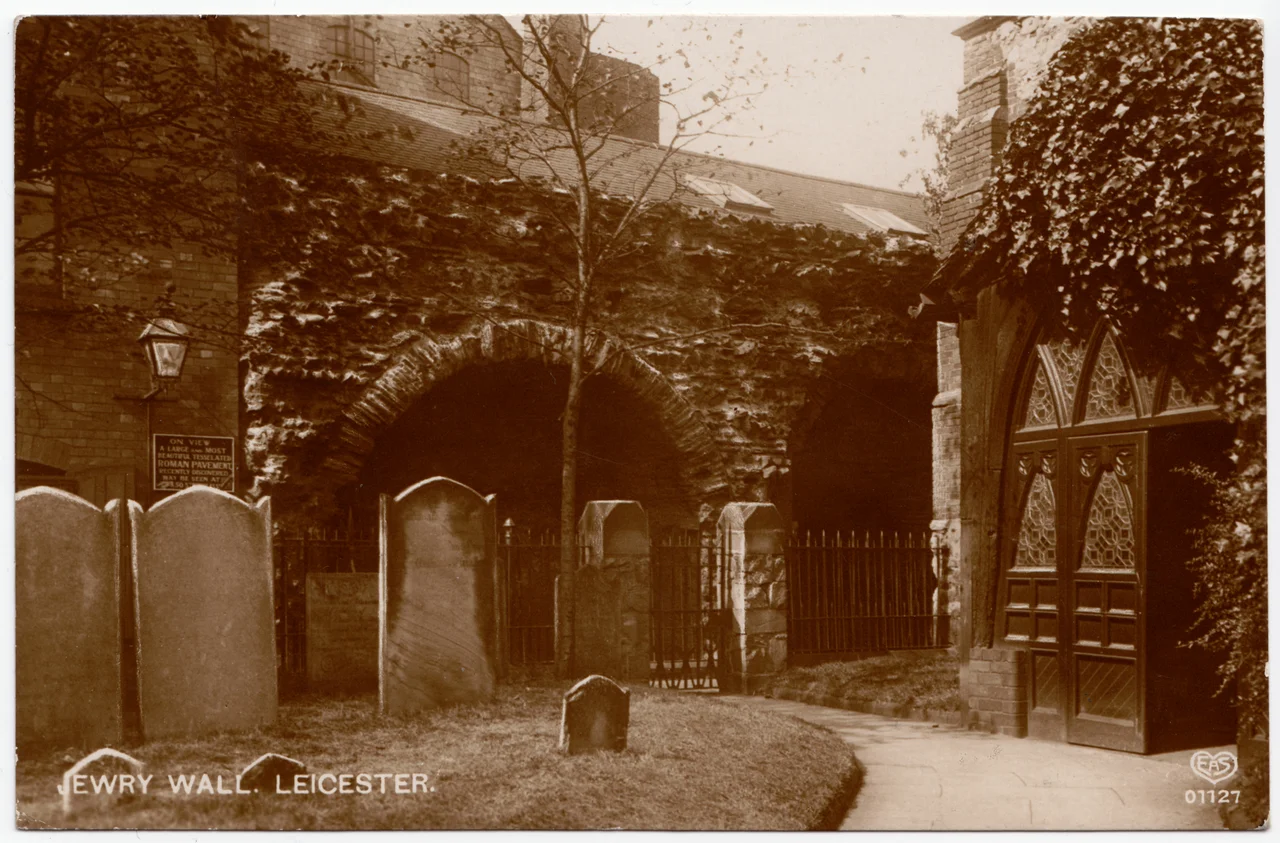

Jewry Wall
The name is a trap. The Jewry Wall has nothing to do with Jewish history. Leicester's small medieval Jewish community was expelled by Simon de Montfort in 1231 and there is no evidence the community ever had a particular connection to this corner of town. The likely explanation is duller and stranger: in medieval England, ruins of unknown origin were frequently attributed to 'the Jews' by a population that had no better explanation for monumental masonry standing where no one alive remembered building it. The same misattribution sits on other Roman sites around Europe. Strip the misleading label away and what remains is one of the most substantial pieces of Roman civil architecture left above ground anywhere in Britain - a 9-metre-tall, 23-metre-long fragment of a public bathhouse built in the 2nd century, in a town the Romans called Ratae Corieltauvorum, in honour of the Iron Age tribe whose lands they had occupied.
Brick, Stone, and the Logic of Roman Building
Look closely at the wall and you can read the construction method like a textbook. Bands of Roman brick - thin, almost tile-like, designed to bond at regular intervals through the wall's thickness - alternate with courses of local granite, limestone and sandstone. This is Roman opus mixtum, the standard provincial technique for major public buildings, and it is one of the reasons the wall is still standing. Two large arched openings sit in the centre at roughly head-height: doorways that once led somewhere now lost. Smaller arched alcoves break up the eastern face. The wall was originally interior, not exterior - it was the west wall of one of the great public rooms of the bathhouse complex, probably the palaestra, the open-air or covered exercise yard where Roman citizens trained, wrestled, and warmed up before bathing. Across the road today, in the museum that bears the wall's name, the artefacts pulled from the surrounding ground tell the rest of the bathhouse's story.
Kathleen Kenyon Digs
The wall has stood here, in various states of misidentification, for the better part of two thousand years. For most of the 19th century antiquarians believed it was part of a Roman town gate. By the early 20th century the prevailing theory was that it had been part of the town's basilica - the great civic hall of any Roman colonia. It took the arrival of one of the 20th century's most formidable archaeologists to settle the question. Kathleen Kenyon, who would later become famous for her work at Jericho and Samaria, excavated the area west of the wall in four seasons between 1936 and 1939. What she uncovered was unmistakable: hypocaust pillars, the under-floor heating system of Roman bath houses, plus drains, channels, and the foundations of three furnaces. The wall was not a gate. It was not part of a basilica. It was, in her revised interpretation, the surviving fragment of a major public baths complex. That reading has held ever since, and the official scheduled monument descriptions still rest on Kenyon's groundwork.
An Adjacent Saxon Church Made of Spolia
Walk a few metres east of the wall and you enter the churchyard of St Nicholas', a small medieval parish church whose fabric quietly tells its own story. Look closely at the masonry. Among the local stone you can pick out Roman bricks reused as building material - spolia, in the technical term, the term archaeologists use for the reuse of older worked stone in newer buildings. Saxon and early medieval Leicester recycled what the Romans had abandoned. The hill of debris from the collapsed bathhouse complex was a quarry. St Nicholas' Church is the result. The result is that two phases of the same site sit side by side: the wall as it was originally built, and the wall as it was systematically broken up and worked into the masonry of the building next door. Few sites in Britain show the transition from Roman to post-Roman so plainly.
Custodianship and a Second Life in Pop Culture
The wall was taken into state care in 1920 and is now the responsibility of English Heritage; the wall itself is Grade I listed, and the broader site, including the adjacent bath foundations and St Nicholas' Church, forms a scheduled monument. The adjacent Jewry Wall Museum reopened in July 2025 after almost eight years closed for a £16.8 million renovation. The museum now charges entry to recoup the work; the café remains free. The wall itself stands free of charge in the open air, behind low railings, available to anyone who walks down Vaughan Way. It has reached a small kind of fame beyond the city as well: it appears as the 'Old Bathhouse' in the 2020 video game Assassin's Creed Valhalla, in the rendering of Ledecestre - the form of Leicester's name recorded in the Domesday Book of 1086. Roman engineers, Saxon spoliators, Victorian antiquarians, modern game developers: each generation has reinterpreted the wall to fit its own questions. The wall, meanwhile, just stands there.
From the Air
Jewry Wall sits at 52.6350°N, 1.1411°W in central Leicester, immediately west of St Nicholas' Circle and east of the River Soar. From altitude, the site is visible as a small open archaeological enclosure between the ring road and the medieval street grid, with the modernist 1960s Jewry Wall Museum building on its eastern flank. East Midlands Airport (EGNX) lies approximately 15nm to the northwest. The cathedral spire and Leicester Castle motte are both visible within 0.3nm. The wall is set within the line of what would have been the Roman town's main north-south axis.
Nearby Stories
- National Shell Filling Factory, Chilwell 1 km away
- Staffordshire Regiment Museum 2 km away
- Rutland Water 3.3 km away
- Grantham 4.4 km away
- Wellingborough 9.9 km away
- Croxden Abbey 11 km away
- Bordesley Abbey 14 km away
- Electric Railway Museum 17 km away