
Julia-Ann Square Historic District
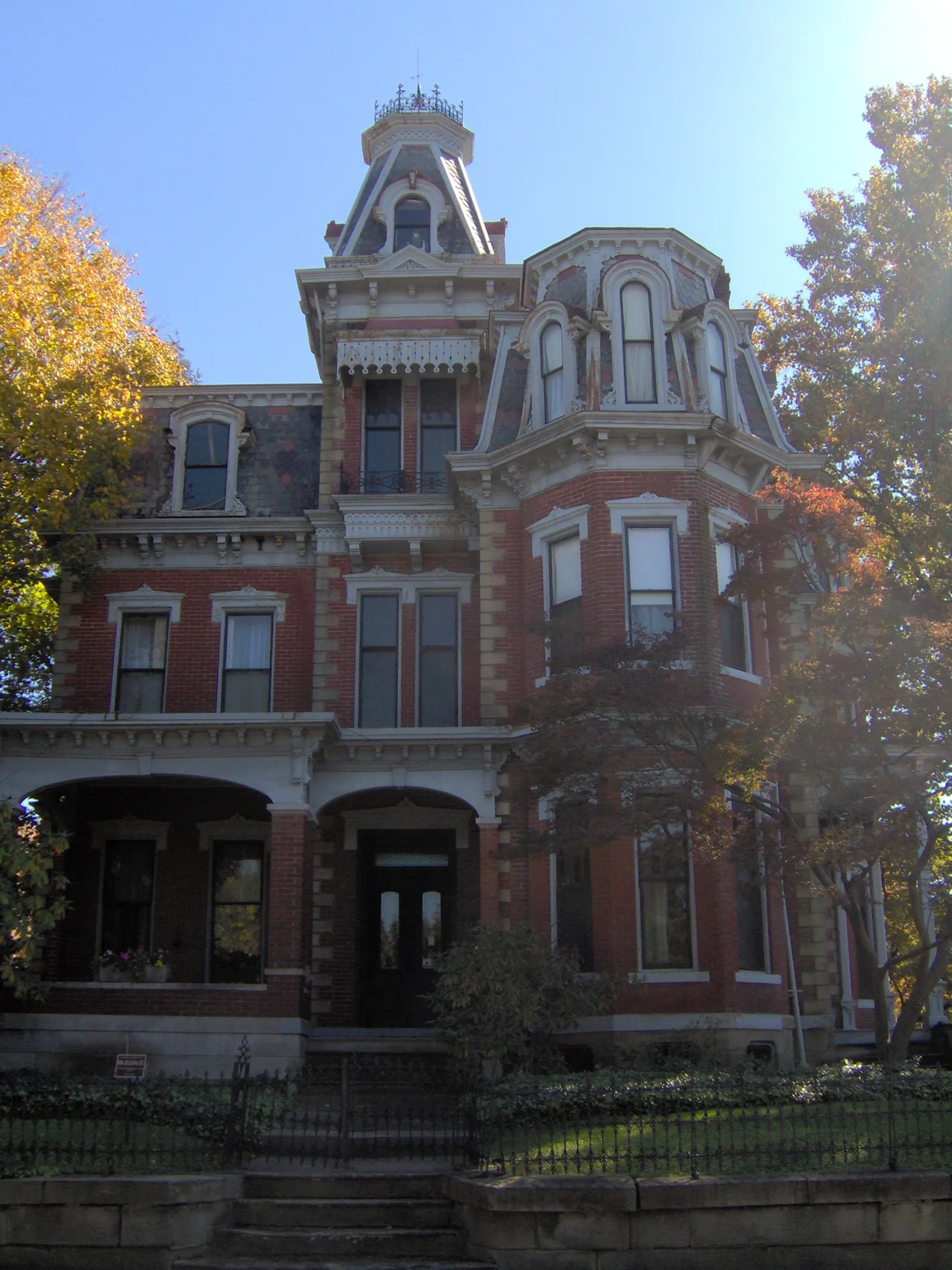
Sometime in the late 19th century, a wealthy Parkersburg family quite literally turned their house around. The Van Winkle-Wix House, built in 1836 by Peter Van Winkle on what was then the western edge of Parkersburg, had originally faced west onto Murdoch Avenue. By 1900, after a long series of expansions that added a third floor, a north wing, multiple turrets, and a steady accumulation of spires, the family reversed the entrance to face Ann Street. The change was practical rather than symbolic. Ann Street had become the more important address in the meantime. The house is one of 116 contributing structures in what is now the Julia-Ann Square Historic District, the heart of Parkersburg's 19th-century residential elite.
The Streets
Juliana and Ann Streets run parallel through downtown Parkersburg, stretching from Riverview Cemetery on the north end to 9th Street on the south. The names come from the two daughters of Alexander Parker, the Virginia officer who acquired the land in the 1780s as a Revolutionary War land grant and in whose honor the town was officially named Parkersburg in 1810. The district covers a small but architecturally remarkable area: 116 contributing buildings, mostly residences, in a continuous sequence that documents Parkersburg's prosperity from the 1830s through the early 20th century. The National Register added the district in 1977, making it one of the earliest such listings in West Virginia.
The Van Winkle-Wix House
Peter G. Van Winkle was one of the most prominent figures of early Parkersburg. He served as the city's mayor, as president of the Northwestern Virginia Railroad, and as one of the two original United States senators from the new state of West Virginia after its admission to the Union in 1863. The 1836 house he built at Juliana and Ann predates his political prominence; it was the residence of a successful young Virginia attorney and businessman. The structure has been modified continuously since - the third floor and north wing were added in the years 1875 to 1899, along with the late-Victorian decorative elements that give the house its current rooftop complexity. The entrance reversal from Murdoch Avenue to Ann Street happened during that same period of expansion.
Boom Architecture
Most of the district's 116 contributing buildings date from the period 1875 to 1915 - the years when oil and gas money flooded into Parkersburg, when the population doubled and tripled, and when the city's leading families built or remodeled their homes on a scale they could not have imagined a generation earlier. The architectural styles are the ones that defined late-19th and early-20th-century American domestic prosperity: late Victorian in its many subtypes, Colonial Revival as it came into fashion after 1890, and especially Queen Anne, with its asymmetrical massing, polygonal corner towers, and decorative shingled wall surfaces. The district is, like Avery Street to the east, a working catalog of American residential architecture during the period.
The Demolition of 1994
Not every Van Winkle property survived. The Peter G. Van Winkle House at 600-602 Juliana Street - a separate, later residence built by or for the senator himself - was demolished in 1994, twenty-eight years after the district's National Register listing. The demolition is one of those local controversies that historic-preservation advocates remember and use as an example of what happens when listing alone does not protect a building. The National Register, despite popular perception, is primarily an honor and a research tool. It does not, by itself, prevent demolition. Local protections - zoning, historic-district ordinances, conservation easements - are what actually keep buildings standing. The 1994 loss prompted Parkersburg to strengthen its local preservation framework. The remaining 116 contributing structures benefit from that strengthening.
A Working Neighborhood
The Julia-Ann Square Historic District is still a residential neighborhood. The houses are still houses. Some have been subdivided into apartments. Some have been restored to single-family use after decades as boarding houses or duplexes. Several function as bed-and-breakfasts. The neighborhood holds an annual house tour that draws visitors from across the state. Like Avery Street and the adjacent Parkersburg High School-Washington Avenue district, Julia-Ann Square works because it is alive - because people still live there, raise children, mow lawns, repair gutters, and gradually pass the houses down to the next generation. A historic district is not a museum. It is a neighborhood that has agreed, collectively, to preserve the things that make it distinctive. Julia-Ann Square has been doing that for almost 50 years.
From the Air
Located at 39.27 degrees N, 81.56 degrees W in Parkersburg, Wood County, West Virginia. The Julia-Ann Square Historic District runs along Juliana and Ann Streets in the historic core of the city, west of the Avery Street Historic District. Mid-Ohio Valley Regional Airport (KPKB) is the nearest tower-controlled field about 6 nm north. Recommended viewing altitude 3,000 to 4,500 feet MSL. Expect dissected plateau terrain throughout the area; the Ohio River runs along the west side of the city, and Riverview Cemetery anchors the north end of the district.
Nearby Stories
- Mountaineer Power Plant 5.3 km away
- Burning Springs Complex 7 km away
- Glenville, West Virginia 10 km away
- Strouds Run State Park 11 km away
- Salem University 26 km away
- West Virginia Penitentiary 42 km away
- The Y-Bridge of Zanesville 44 km away
- The Wheeling Suspension Bridge: The Longest Span in the World 81 km away