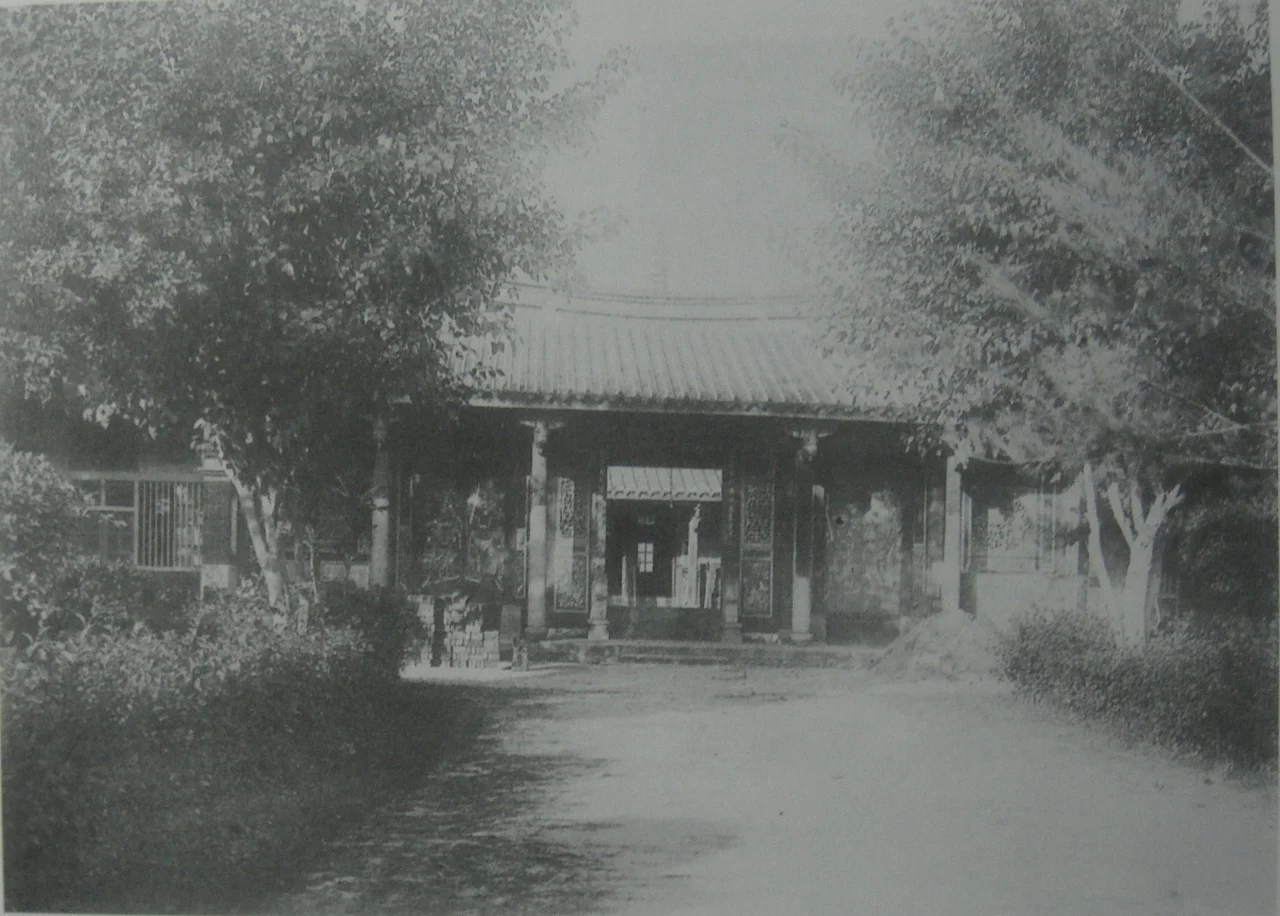

Kaiyuan Temple
Three people died in this villa within a single year, and the place has been trying to find peace ever since. In 1680, Zheng Jing — ruler of the Kingdom of Tungning and son of the legendary Koxinga — retreated to Tainan from a failed military campaign on the Chinese mainland. He built Beiyuan Villa, the Northern Garden Retreat, for himself and his aging mother, Queen Dong. He died there the following March. His son Zheng Kezang was killed in a coup in the same compound shortly afterward. Queen Dong died in August. By 1683, the Qing dynasty had conquered the kingdom entirely, and the villa stood abandoned. Seven years later, it was reborn as a Buddhist temple. That transformation — from a place of political ruin to a place of spiritual practice — defines Kaiyuan Temple to this day.
The Villa That Became a Temple
When Qing officials converted Beiyuan Villa into a Buddhist institution in 1690, they justified the decision on practical grounds: there were no Buddhist temples in Tainan at the time. They named it Haihui Temple. It was a reasonable administrative solution to a spiritual gap, but it was also a quiet act of erasure — converting the most personal space of the defeated Zheng dynasty into something that served the new order. The temple was expanded and renovated in 1777 by the governor of Taiwan, who gave it the name it still carries: Kaiyuan Temple. Between 1796 and 1859, it was briefly renamed Haijing Temple to honor the Jiaqing Emperor's coronation, before reverting to its more familiar identity. Names changed. The rectangular compound, with its four central halls and two flanking side halls, remained essentially the same layout it has held since 1777.
A Bell from 1695
Inside the Daxiongbao Hall — the main worship space dedicated to Gautama Buddha, Samantabhadra, and Manjushri — hangs a bronze bell cast in 1695. It is the oldest bronze bell in Taiwan. The hall itself was rebuilt in 1972 with a slightly reduced footprint, but the bell survived the reconstruction, as it has survived everything else: the collapse of the Qing dynasty, the Japanese colonial period, the turbulences of the twentieth century. A bell like this is a kind of historical anchor. It was cast before the temple had its current name, before the dynasty that commissioned the conversion was itself overthrown, before any of the political categories that would come to define modern Taiwan had taken shape. When it rings, it rings across all of that.
Poetry in the Face of Erasure
During the Japanese colonial period, a group of Tainan academics gathered at Kaiyuan Temple under the name Nanshe — the South Society — to write and recite classical Chinese poetry. It was a form of cultural resistance, an insistence on maintaining a literary tradition that the colonial Japanization campaign was actively working to suppress. Nanshe was eventually shut down in 1930. A stone memorial still stands in the temple compound, left behind by the group. The inscription translates as 'poetry spirit.' That the stone remains — that it was kept, not removed — says something about the temple's relationship to memory. Kaiyuan Temple has always been a place where things that seemed finished turned out not to be.
Halls, Gates, and Guardian Figures
Walking into Kaiyuan Temple today means passing through an outer shanmen — the mountain gate — built in 1960 to face the street, before reaching the older inner gate that marks the actual entrance to the compound. The inner gate is five kaijian wide, meaning it spans six columns, with three doors. What distinguishes it from most comparable temples is the choice of menshen, the guardian figures painted on the doors: instead of the warriors Qin Shubao and Yuchi Gong, who appear on temple doors across the Chinese world, Kaiyuan Temple displays Sangharama and Skanda — Buddhist protective figures rather than military ones. It is a small difference with a pointed meaning. The temple, built on the grounds of a failed kingdom, guards itself with different gods.
From the Air
Kaiyuan Temple is located at approximately 23.0112°N, 120.2226°E in the North District of Tainan, slightly north of the main historic core around Chikan Tower. From the air at 1,500–2,500 feet, the temple's rectangular compound and traditional rooflines are visible within the surrounding residential and commercial streets. The nearest major airport is RCKH (Kaohsiung International), approximately 30 km to the southwest. Tainan Airport (RCNN) is the closer regional option, roughly 8 km to the west. The flat Tainan plain offers unobstructed approaches from multiple directions.
Nearby Stories
- Chung Li-ho Museum 0.7 km away
- Jingzaijiao Tile-paved Salt Fields 8 km away
- Wanchin Basilica of the Immaculate Conception 9.3 km away
- Namasia District 16 km away
- Battle of Penghu 21 km away
- Shoushan (Kaohsiung) 21 km away
- Penghu Air Raids 62 km away
- Daya Bay 512 km away