
Kaniv Nature Reserve
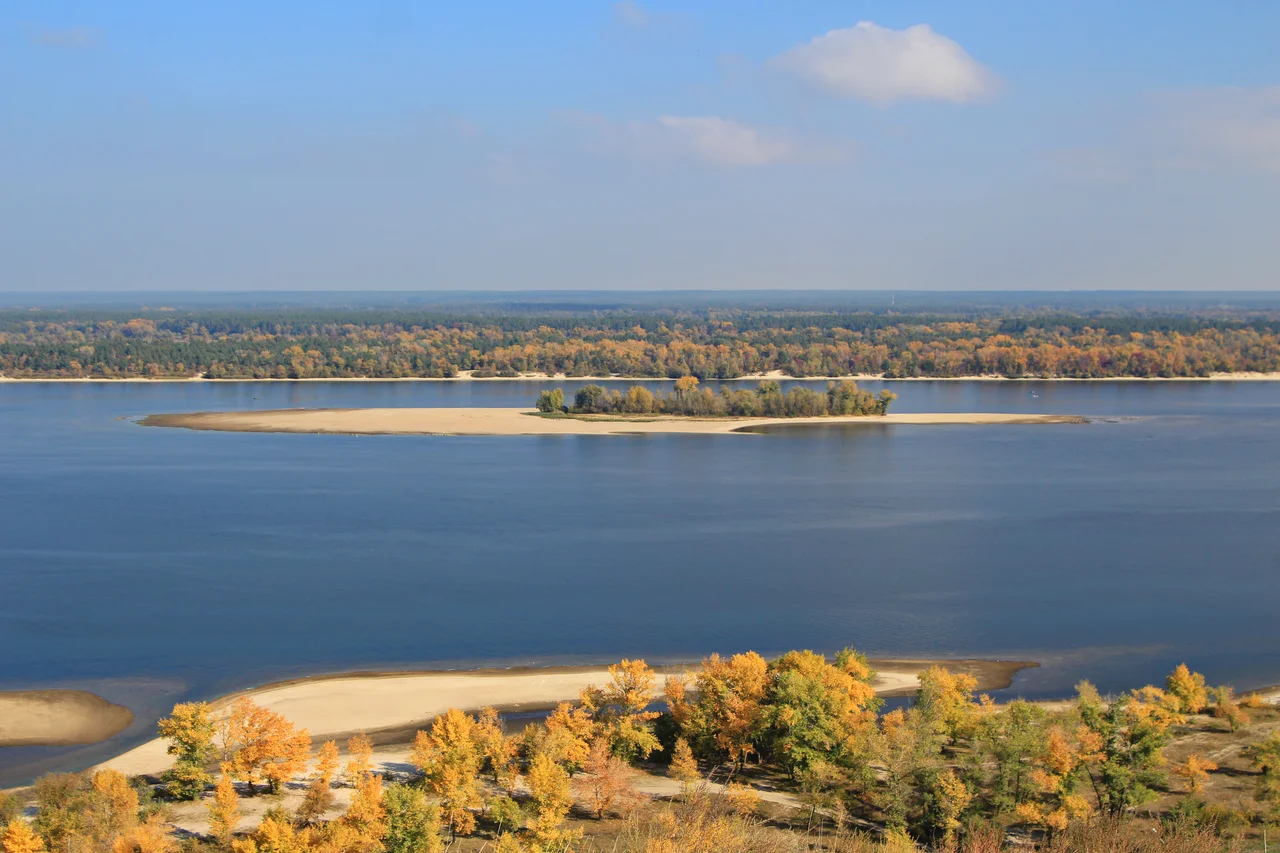
Where the Dnieper widens into a reservoir near the town of Kaniv, the western bank rises abruptly into steep, wooded hills, and it is on these slopes and the low green islands offshore that Ukraine set aside one of its oldest nature reserves. Founded in 1923, the Kaniv Nature Reserve protects a patch of forest-steppe and floodplain that has drawn living things, and people, for tens of thousands of years. It is a place of oak canopy and river light, roe deer moving through the underbrush, and, beneath the leaf litter, the buried record of Stone Age hunters who once camped on the same high ground.
Bluffs and Islands
The reserve is really two landscapes stitched together by the river. Most of it climbs the forested right bank of the Dnieper, along the northeastern edge of the Dnieper Upland, where the hills are cloaked in trees. The rest lies out in the water itself: floodplain islands, including the Serpentine Islands in the Kaniv Reservoir and the larger Shelest and Kruglik islands in the Dnieper. A protective buffer of more than thirteen hundred hectares wraps the reserve's edges. Since its founding in 1923 as a forest-steppe reserve, it has passed through several changes of stewardship before settling into its present shape in 1986. The mix of dry upland and wet island gives the place an unusual variety within a compact area.
A Crossroads of Forests
Kaniv sits on an ecological seam. The reserve straddles the transition between the Central European mixed forests and the East European forest-steppe, two great ecoregions that meet and blend here. The climate is humid continental, with sharp seasonal swings, cold winters and warm but not scorching summers, that shape what grows and lives. Roughly eighty-five percent of the reserve is forested, with elm and oak the dominant trees, their crowns closing over slopes that fall toward the water. It is precisely this borderland quality, neither purely northern woodland nor purely southern grassland, that makes the small reserve a rich sample of central Ukraine's natural inheritance.
The Life of the Reserve
For all its quiet, the reserve is busy with life. The animals are those of the forest-steppe: roe deer stepping delicately through the trees, badgers rooting in the earth, marten slipping along the branches. Above all it is a place for birds. More than two hundred and thirty species have been recorded within its bounds, filling the oak woods and the reedy island shores with song and movement through the seasons. Protected from the plow and the axe for a century, these hills and islands offer a glimpse of what much of this river country looked like before farms and cities spread across it, a working fragment of wild Ukraine held in trust.
Deep Human Time
The Dnieper hills did not wait for the reserve to be discovered; people found them long ago. Kaniv is famous among archaeologists for the abundance of sites layered into its ground, reaching back to the Paleolithic, the Old Stone Age. The same bluffs that now shelter deer and oak once sheltered hunters who watched the river for game and passage, leaving behind the flaked stone and scattered traces that tell of their lives. To walk here is to move through deep time as well as living forest, on ground that has been both refuge and vantage point for as long as humans have known this bend of the great river. The reserve also borders the Shevchenko National Reserve, joining wild nature to national memory on the same stretch of bank.
From the Air
The reserve lies around 49.72 degrees north, 31.53 degrees east, on the forested right bank of the Dnieper and its islands near Kaniv in Cherkasy Oblast, central Ukraine. From altitude, the broad Dnieper and Kaniv Reservoir dominate, with the dark wooded bluffs rising sharply on the western shore. The nearest major airfields are at Cherkasy downstream and Bila Tserkva to the west.
Nearby Stories
- Trakhtemyriv 11 km away
- Cherkasy 24 km away
- Motronynskyi Monastery 33 km away
- Khotiv Hillfort 56 km away
- Bila Tserkva 61 km away
- Kholodnyi Yar 63 km away
- Maidanetske 67 km away
- Kachanivka Palace 112 km away