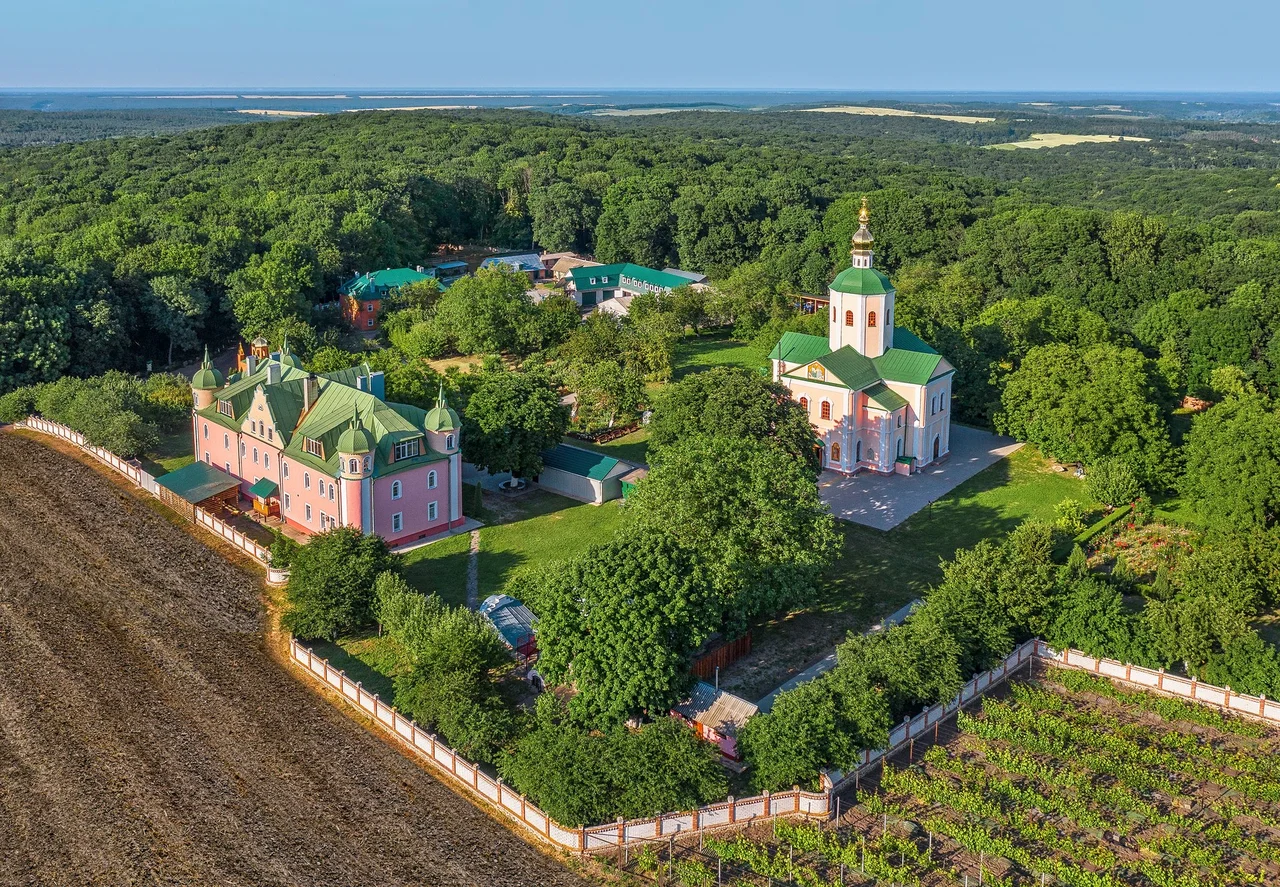

Motronynskyi Monastery
Deep in the Kholodnyi Yar forest, where the oaks grow old and the ravines hold their chill, a white-walled convent keeps a vigil that predates almost everything around it. The Motronynskyi Monastery of the Holy Trinity is a working nunnery today, but its roots reach back some nine hundred years, to a religious community that gathered on this forested hill in the twelfth century. Kings and khans have burned it. A revolution abolished it. And still, again and again, monks and nuns have returned to this exact patch of ground, drawn back to a place that seems to insist on being sacred.
A Monastery of Hetmans
The monastery as we know it existed by 1568, founded first as a community of monks. In the century that followed it became closely tied to the Cossack world beyond the trees. Leading figures of the Zaporozhian Sich lent it their support - among them Petro Konashevych-Sahaidachny, the great hetman and defender of Orthodoxy, along with Pavlo Teteria, Petro Doroshenko, and Ivan Skoropadsky. In an age when a Cossack's faith and his cause were tightly bound, a fortified monastery in a defensible forest was more than a house of prayer. It was a fixed point in a shifting frontier, a place the Sich could shelter and be sheltered by, standing where the settled world gave way to the Wild Fields.
Destroyed and Rebuilt
That frontier exacted its price. During the Ruin - the brutal decades of the later seventeenth century when Ukraine was torn between competing powers - the monastery was destroyed, caught in turn by the armies of the Ottoman Empire, the Crimean Khanate, and the Polish-Lithuanian Commonwealth. Yet it did not vanish. The community rebuilt and endured, and in 1911 its character changed: the men's monastery became a convent of nuns. It had survived war and reinvention alike, keeping its place among the oaks while the world beyond the forest remade itself over and over. Few institutions anywhere absorb that much upheaval and simply carry on.
Closed by Decree, Returned by Faith
The twentieth century brought a different kind of assault. After the Russian Revolution and the Ukrainian-Soviet War, the new state let the convent operate at first, though it seized much of its land - some 273 hectares taken away. Then, on the 21st of November 1929, the monastery was abolished outright, and a commune was set up in its place. For more than sixty years the hill fell silent of prayer. Only in 1991, as the Soviet order dissolved, was the convent reestablished, an Orthodox community returning once more to the ground it had never truly left. The pattern held: burned, closed, forgotten - and then, once again, alive.
The Vigil That Won't End
There is a lesson in the sheer stubbornness of this place. Cities have risen and fallen within a single lifetime; this community has counted its history in centuries and refused to be finished by any of them. The forest that surrounds the convent is itself a keeper of resistance - the same Kholodnyi Yar where rebels and refugees hid for generations - and the monastery belongs to that long tradition of holding on. Pilgrims still come to the wooded hill, some to pray, some simply to stand among the oaks and feel the weight of continuity. Whatever the century has thrown at it, the vigil resumes. The bells return. The community gathers again in a clearing that has drawn the faithful for the better part of a thousand years.
From the Air
Motronynskyi Monastery sits at 49.154N, 32.256E, within the Kholodnyi Yar forest of Cherkasy Oblast, central Ukraine. From 2,000 to 3,000 feet, look for the pale monastery buildings and church set in a clearing amid the surrounding dark oak forest; the town of Chyhyryn lies to the east near the Dnieper. The nearest airport is Cherkasy (UKKE).
Nearby Stories
- Cherkasy 9.6 km away
- Melgunov Kurgan 22 km away
- Korsun-Shevchenkivskyi 26 km away
- Battle of Kurukov Lake (1625) 41 km away
- Battle of Korsun-Cherkassy 42 km away
- Battle of Blue Waters 67 km away
- Battle of Zhovti Vody 80 km away
- Velyki Sorochyntsi 114 km away