
Karl Guthe Jansky
At 7:10 p.m. on September 16, 1932, in a New Jersey field, a faint hiss reached the strongest point on the chart paper that a 27-year-old engineer named Karl Jansky had set up. He had been trying to find the source of static that was interfering with Bell Labs' trans-Atlantic radio telephone service. He had instead found something nobody expected and nobody knew what to do with: a steady whisper of radio waves coming from the constellation Sagittarius. Jansky had just heard the center of the Milky Way. He died eighteen years later, at 44, of the kidney disease that had haunted him since college, without ever working full-time on the discovery that founded an entire branch of astronomy.
Born in the Territory, Trained at Bell Labs
Karl Guthe Jansky was born on October 22, 1905, in what was then the Territory of Oklahoma - statehood would come two years later. His father, Cyril M. Jansky, was the dean of the college of engineering at the University of Oklahoma in Norman, born of Czech immigrants in Wisconsin and a teacher his entire working life. Karl's mother, Nellie Moreau, was of French and English descent. His older brother Cyril Jr. built some of the earliest radio transmitters in the country, including 9XM at the University of Wisconsin - now WHA of Wisconsin Public Radio. Karl studied physics at the University of Wisconsin, earned his BS in 1927, and completed most of a master's degree before joining Bell Telephone Laboratories in July 1928 at age 22. Because of a kidney condition that would eventually kill him, Bell sent him to the field station at Holmdel, New Jersey, where the air was cleaner than around the Manhattan headquarters.
Jansky's Merry-Go-Round
Bell Labs wanted to understand short-wave static so it could improve trans-Atlantic radio telephone service. Jansky was assigned the job of locating where the static came from. He built a directional antenna 100 feet across and 20 feet tall, tuned to 20.5 megahertz - a wavelength of about 14.6 meters. The antenna was mounted on a turntable supported by four Ford Model-T wheels, which let him rotate it through 360 degrees and measure where signals were strongest. The contraption cost less than $1,000 to build. It looked enough like a children's playground ride that Jansky's colleagues nicknamed it the merry-go-round. After several months of recording, Jansky was able to sort the static into three categories: nearby thunderstorms, distant thunderstorms, and a faint hiss whose origin he could not place.
The Sidereal Clue
Jansky tracked the unknown hiss for over a year. Its peak intensity rose and fell once a day. At first he assumed it came from the sun. Then the peak began drifting away from the sun's position, and he timed the cycle more precisely: 23 hours and 56 minutes. He took the puzzle to his friend Albert Melvin Skellett, an astrophysicist. Skellett recognized the number immediately - it was the length of a sidereal day, the time it takes for the "fixed" stars to make a full revolution against Earth's rotation. Whatever Jansky was hearing was tied to a point on the celestial sphere, not to anything in the solar system. By comparing his observations with optical maps, Jansky determined that the radiation peaked in the direction of Sagittarius - in the direction of the center of the Milky Way. He had heard our galaxy.
Announced, Then Ignored
Jansky announced his discovery at a meeting in Washington in April 1933. The audience was small and the implications largely escaped them. The New York Times picked up the story on May 5, 1933, and NBC interviewed Jansky for a special program titled "Radio sounds from among the stars." There was a brief flicker of public interest. Jansky proposed in 1935 that the signals came from interstellar gas - specifically from "thermal agitation of charged particles" - which turned out to be approximately correct. But astronomers had no apparatus for following up his work and considered it foreign to their field. Bell Labs, in the depths of the Great Depression, could not justify spending money on a phenomenon that did not interfere meaningfully with telephone service. Jansky was assigned to other duties. He never built a follow-up antenna.
What His Memory Built
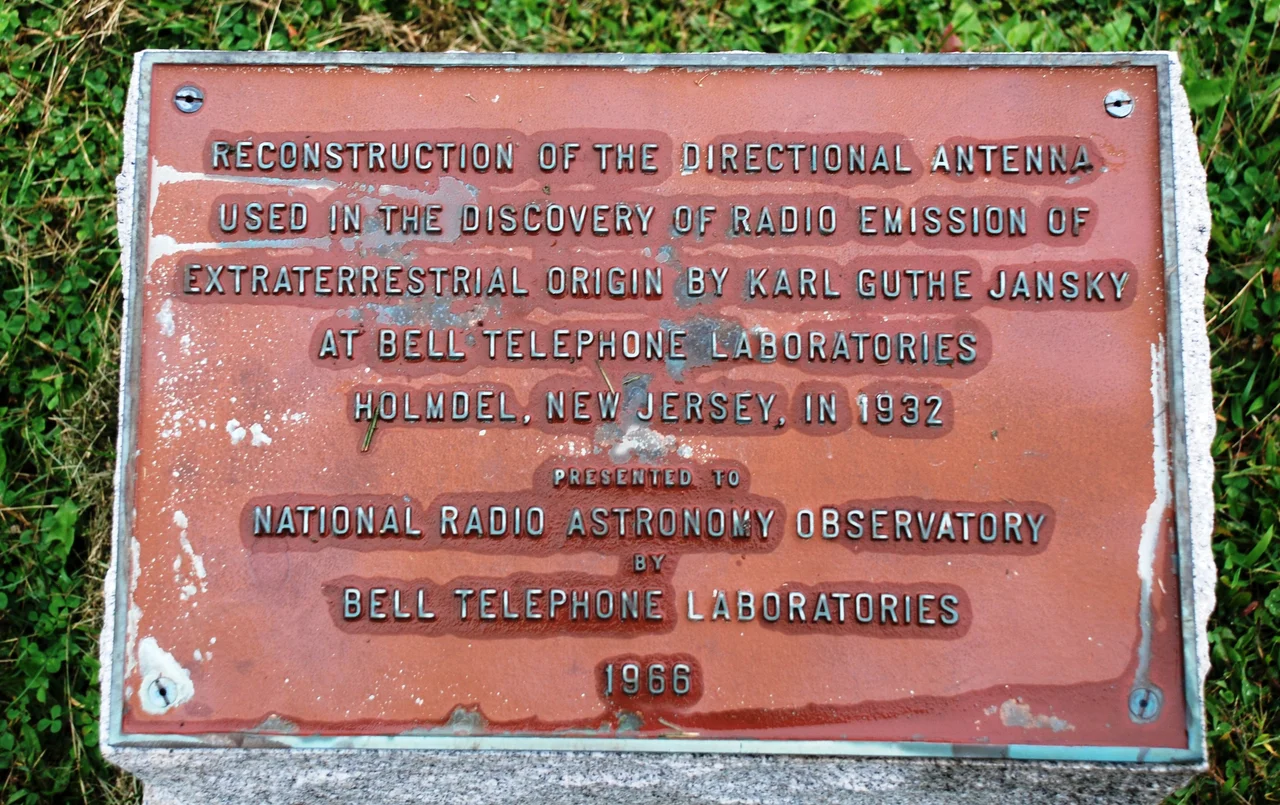
Jansky died on February 14, 1950, at age 44. Radio astronomy as a discipline was still in its infancy. Two men in particular had picked up where Jansky left off: Grote Reber, the Illinois radio engineer who built a 9-meter parabolic dish in his backyard in 1937 and conducted the first systematic survey of radio sources in the sky, and John D. Kraus, who founded a radio observatory at Ohio State University after World War II. Today, the unit radio astronomers use to measure the brightness of cosmic radio sources is the jansky - one jansky equals 10 to the minus 26 watts per square meter per hertz. There is a crater on the moon named Jansky. There is an asteroid 1932 Jansky. The Very Large Array in New Mexico was renamed the Karl G. Jansky Very Large Array on March 31, 2012. At Green Bank, a full-scale replica of his merry-go-round antenna stands on the observatory grounds, near a reconstruction of Reber's backyard dish. In 1998, Tony Tyson and Robert Wilson found the original site of Jansky's antenna in Holmdel and placed a monument there - a stylized sculpture of the antenna, oriented exactly as Jansky's was at 7:10 p.m. on September 16, 1932, the moment of maximum signal from the center of the galaxy.
From the Air
The coordinates given for this biographical article (38.43 degrees north, 79.82 degrees west) point to the Green Bank Observatory in Pocahontas County, West Virginia, where a full-scale replica of Jansky's merry-go-round antenna stands among the working telescopes. The original site of Jansky's antenna is at the Bell Labs Holmdel Complex in Holmdel, New Jersey, far from this location. Best viewed at Green Bank from VFR altitudes of 4,500 to 7,500 feet AGL. The closest airport is Marlinton Municipal (W99). The observatory is at the center of the National Radio Quiet Zone - check NOTAMs for any restrictions on aircraft transmissions before transiting.
Nearby Stories
- Pendleton County, West Virginia 8.1 km away
- Mountains and Lakes Country 9.4 km away
- Fort Edward Johnson 12 km away
- Tygart Valley Homesteads Historic District 13 km away
- Fort Dinwiddie 14 km away
- 2020 Williamsburg Massacre 17 km away
- Richwood, West Virginia 21 km away
- Frontier Culture Museum 35 km away