
Katanga Province
The uranium that destroyed Hiroshima came from a mine called Shinkolobwe. Before anyone in the American Manhattan Project had heard the word, Belgian geologists working for Union Miniere du Haut Katanga had already extracted uranium ore of a grade that has never been matched, anywhere, before or since. The mine lay in a remote corner of a province the Belgians had taken by force from a king named Msiri. That mine is closed now. The province itself was dissolved in 2015, broken into four smaller provinces. But Katanga - the name, the identity, the memory - refuses to go away.
The Copperbelt
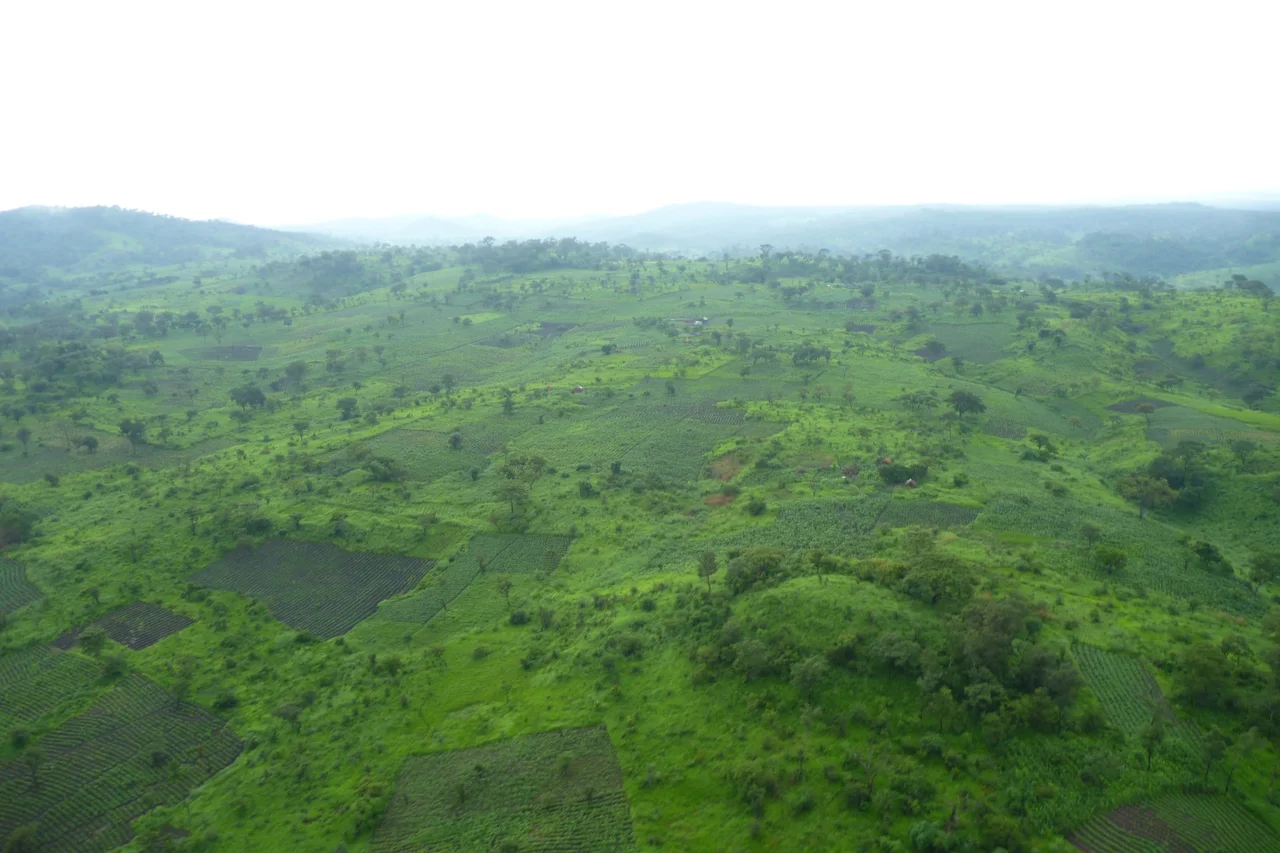
Copper mining in Katanga dates back over a thousand years. By the end of the 10th century, local smiths were producing standard-sized copper ingots for long-distance trade - these crosses of copper moved through networks that reached the Indian Ocean coast and the Zambezi valley. The seams that made this possible lie along what geologists now call the Central African Copperbelt, a mineralized arc that swings through southern Katanga and into northern Zambia. The ore here is unusually rich: 4 to 5 percent copper in commercial grades, and the world's largest known reserves of cobalt. The Katanga Plateau rises to around 1,500 meters, cool enough for cattle ranching and Katanga's farmers produce maize, cassava, and sweet potatoes across its gentler slopes.
Msiri and the Belgians
In the 1890s Katanga was beleaguered from two directions. From the south came Cecil Rhodes, pushing up from Northern Rhodesia. From the north came the agents of King Leopold II of Belgium, whose private Congo Free State wanted the copperbelt for itself. In the middle stood Msiri, the Nyamwezi-born founder of the Yeke Kingdom, who had built a trading empire based on copper, ivory, and slaves. Msiri refused to sign away his country to either power. In December 1891 the Belgian Stairs Expedition reached his capital at Bunkeya; when negotiations broke down, a Belgian officer shot him dead. The kingdom collapsed. Katanga passed into the Belgian Congo, which ran it through a private company, Union Miniere du Haut Katanga, founded in 1906. By World War II the mining corporations 'constituted a state within the Belgian Congo,' as one colonial-era assessment put it.
Shinkolobwe and the Bomb
In 1915 UMHK geologists discovered a deposit of pitchblende at a place called Shinkolobwe that was richer than anything previously known. The find was kept secret; the company set up a refining factory at Olen in Belgium and announced the production of the first gram of radium from the ore only at the end of 1922. When the United States needed uranium for the Manhattan Project during World War II, most of what it used came from this single Katangan mine. The bombs dropped on Hiroshima and Nagasaki in August 1945 were built, in large part, from stone lifted out of the ground near Likasi. The mine was officially closed in 1961 but has continued as a site of artisanal digging, an inheritance that has left its own quiet legacy of radioactive contamination in the surrounding communities.
The Secession
When the Congo became independent in June 1960, Katanga contained most of the country's mineral wealth and most of its hard currency. Within weeks the provincial leader Moise Tshombe - backed by UMHK, the Belgian government, and Belgian troops - declared Katanga an independent state. The Congolese Prime Minister Patrice Lumumba demanded the province's return. He was arrested, flown to Katanga, and murdered there in January 1961 by Tshombe's government with Belgian complicity. The Katangan secession lasted until 1963, when United Nations troops finally brought it to an end after years of fighting. The Congo Crisis killed tens of thousands of Congolese. The scars on the province - and on the country - have not fully healed in six decades.
Dissolution and Memory
The 2005 Congolese constitution specified that Katanga should be split. It finally happened on 16 July 2015 in a provincial assembly session in Lubumbashi, when Katanga was divided into Haut-Katanga, Lualaba, Haut-Lomami, and Tanganyika Provinces. Lubumbashi - the second-largest city in the country - remained the mining capital. But the province that produced more than half the world's cobalt had already been reshaped many times. It was named Shaba during Mobutu Sese Seko's rule from 1971 to 1997. It was briefly taken over by the Mai Mai Kata Katanga militia in 2013, under the warlord Gedeon Kyungu Mutanga. Katanga persists as an idea more than a border, a name that people still use for the country south of the Lualaba. The minerals keep coming out. The children of the people who dig them still face some of the world's highest infant-mortality rates.
From the Air
Former Katanga Province centers around 9°S, 26°E on the southern Congolese plateau at 1,200-1,500m elevation. Lubumbashi International Airport (FZAA) serves the mining capital with a 3,266m paved runway and international connections; Kolwezi (FZQM), Kamina, and Manono also have airfields. The Katanga Plateau and the copperbelt arc are visible from cruise as a mosaic of savanna, cultivated valleys, and the bright scars of open-pit mines near Kolwezi, Likasi, and Lubumbashi. Cruise FL200-FL280. Dry season (May-September) offers excellent visibility; rainy season (October-April) brings strong afternoon convection.
Nearby Stories
- Upemba National Park 24 km away
- Ciments du Katanga 71 km away
- Bunkeya 137 km away
- Luba Empire 160 km away
- Piana-Mwanga Hydroelectric Power Station 228 km away
- Sakeji School 240 km away
- Kalene Hill 266 km away
- Lomami Province 309 km away