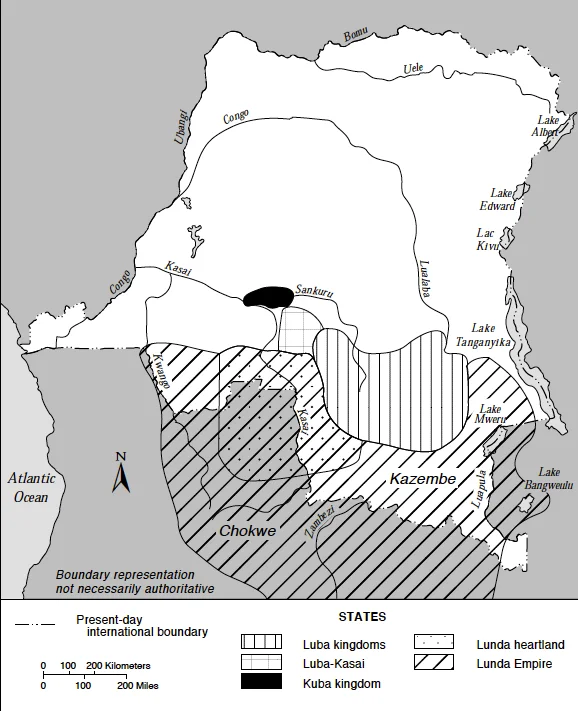

Luba Empire
In the Luba heartland, official historians were called 'men of memory.' Trained in a society known as the Mbudye, they were responsible for keeping the oral histories of kings, villages, and customs across a state that governed a vast stretch of Central Africa. They were not court entertainers. They were civil servants of memory - the state's institutional knowledge walking on two legs. When Europeans finally reached this part of the continent in the late nineteenth century, they found a political tradition already more than a millennium old.
Beginnings in the Upemba Depression
Archaeology tells the earliest part of the story. The marshy grasslands of the Upemba Depression, in what is now southern Democratic Republic of Congo, have been continuously occupied since at least the fourth century AD. By that time the region held iron-working farmers. Over the following centuries, its people developed fishing nets, harpoons, dugout canoes, and canals cut through swamps. They learned to dry fish as a protein store. By the sixth century, communities along the lakeshores were working iron, trading palm oil, and building the economic foundation on which larger political systems would rise. Vansina, the historian, described the next step: 'Lords of the land' held priestly authority because of their relationship with the spirits of place. Their influence spread across multiple villages. As lineages grew, some absorbed or conquered others. Small kingdoms formed. The Luba state was built on these foundations, though the exact founding date is still debated - Congolese historians place it in the 8th, 12th, 14th, or 15th century, while some Western scholars argue for the 18th.
The Rainbow King and the Sacred Hunter
Luba oral tradition starts with Kyubaka Ubaka - 'Maker of huts' - and Kibumba Bumba, 'Pottery maker.' Their descendants moved westward generation by generation until they reached the Luba lands. One of them, Mwamba, took the name Nkongolo - 'the rainbow.' He was a mukalanga, a self-made ruler, known for cruelty; he carried a curved knife called a nkololo. His capital at Mwibele sat near Lake Boya. He ruled with a court of nobles called Bamfumus, while clan kings known as Balopwe governed the subjects. Then, according to the Mbudye tradition, came Kalala Ilunga, a mystical hunter who toppled Nkongolo and introduced advanced iron-forging techniques. From him, every subsequent Luba king traced their ancestry. When these kings died, they became deities, and their villages were transformed into living shrines. The regalia of Luba rulers was richly carved with female figures - mwadi, female incarnations of ancestral kings - reflecting the central role of women in creation myths and political life alike.
A Commercial Empire
The Luba economy was not subsistence. It was a sophisticated system that linked the Congo forest to the north with the Copperbelt's mineral wealth to the south. Luba traders moved along routes that eventually connected to both the Atlantic and Indian Ocean coasts - a continental trade network in which the Luba sat at the middle. The ruling class held a near-monopoly on the key trade items: salt, copper, and iron ore. Tribute flowed upward to nobles, who redistributed agricultural, hunting, and mining resources across the realm. This was a state with a specific answer to the problem of governing dispersed people: extract surplus at the top, redistribute selectively, and keep the whole structure bound by the authority of sacred kingship. It worked for centuries.
Arts, Headrests, and Poetry
The Luba prized their artists. A carver held relatively high status, marked by the adze he carried over his shoulder. Luba art is diverse because the territory was vast, but certain things repeat: female figures on prestige objects, paired priestesses on headrests, single figures on royal staffs representing dead kings whose spirits are carried in a woman's body. Dreams were understood as messages from the other world, so sleeping surfaces became ritual spaces. At the head of every genealogy appears the name 'Nkole' - 'the essentially powerful,' an honorific given to the three most distant patriarchs. The kasala is a Luba poetic form: free-verse slogans recited or chanted, sometimes with instruments, by professionals trained in the genre. It dramatizes battle courage, collective joy, or bereavement. Proverbs, myths, fables, riddles, tales - the kasala holds all of these together as a form of public memory. The Luba word for 'historian' and the Luba word for 'poet' are not far apart.
Fire Kingdoms and the Slow Collapse
Between 1700 and 1860, the Luba Empire expanded dramatically, targeting population-dense regions that lacked strong military resistance. Rather than directly conquering land, they focused on tribute. In the 19th century they developed a new institution: the 'fire kingdom.' Vassal states on the Luba frontier received the sacred royal fire embers of the Luba king, but the fire would 'burn out' when that king died. The status was temporary, tied to a specific relationship. Three major fire kingdoms were set up: Kyombo Mkubwa in the Hemba and Tumbwe lands between the Lukuga and Luvua rivers; Buki among the decentralized Songye chiefdoms along the Congo; and Katondo's Chiefdom northwest of Lake Mweru. Then the 1870s brought East African slave traders hunting for people and ivory. The empire was raided repeatedly. In 1889 a succession dispute split the state in two. The unified Luba Empire ended, and the territory was absorbed into Leopold II's Congo Free State. The 'men of memory' kept their work going - but the political structure that had held for a millennium was gone.
From the Air
Coordinates: 7.36°S, 25.68°E, centered on the Upemba Depression in Haut-Lomami Province, Democratic Republic of Congo. The region features marshy grasslands and the lakes of the Upemba complex. At cruising altitude, the wetlands contrast with surrounding miombo woodland. Nearest airports include Kamina (FZSA) and Lubumbashi (FZQA). The area is historically significant across much of southern and central DRC.
Nearby Stories
- Lulenge 38 km away
- Luvua River 72 km away
- Lomami Province 135 km away
- Lake Uniamési 160 km away
- Katanga Province 161 km away
- Upemba National Park 164 km away
- 2003 Ukrainian Cargo Airways Ilyushin Il-76 accident 228 km away
- Kisenge 419 km away