
Kearney Park: A Raisin King's Utopia in the Dust
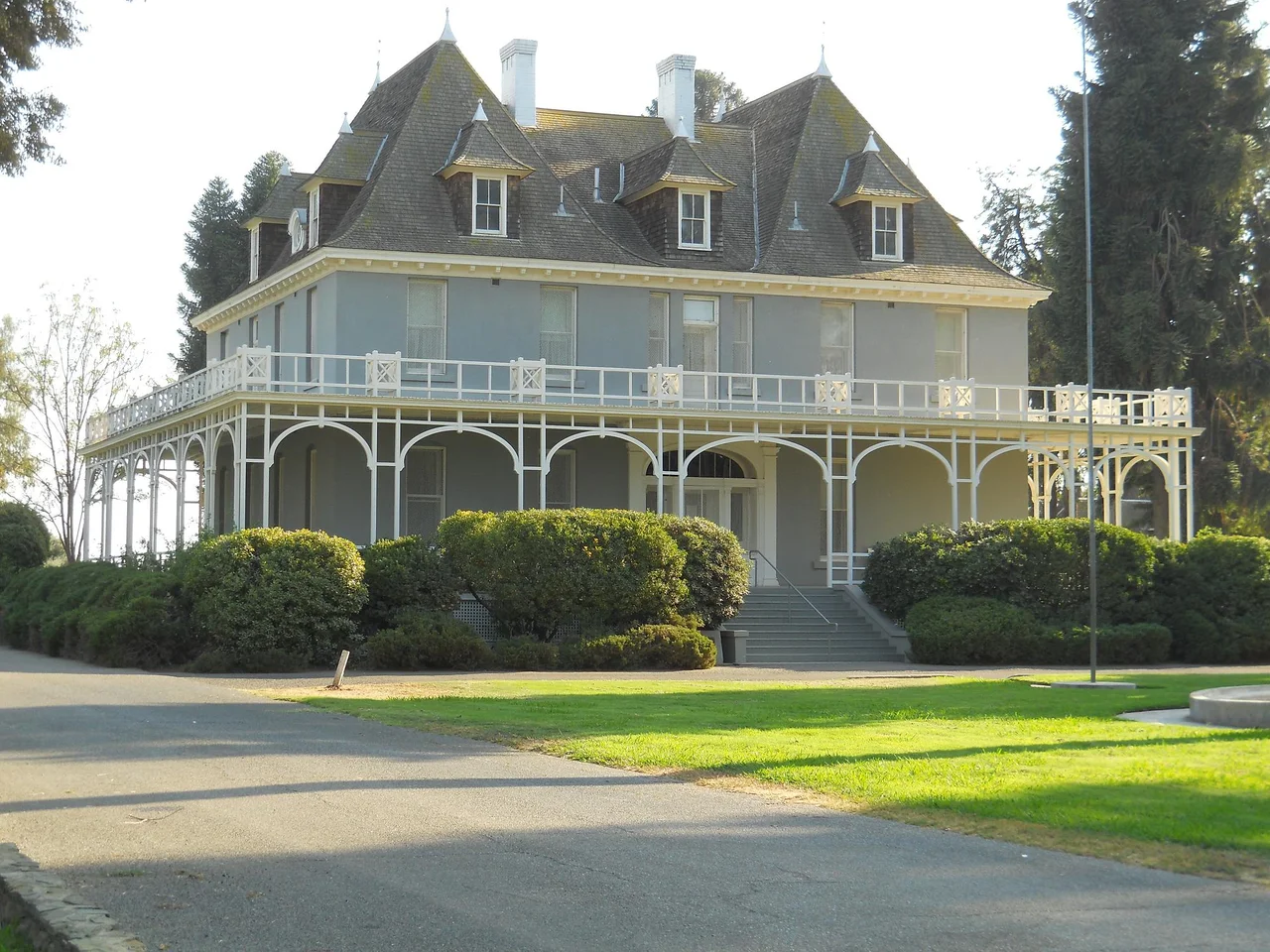
Behind the wrought-iron gates of the Kearney Mansion, the wallpaper still shows its original pattern - French imports chosen by a man who believed that growing raisins in the California sun could be as dignified as any profession in the world. Martin Theodore Kearney was not born to farming. He arrived in Fresno in the 1880s, an ambitious promoter with ideas about cooperative agriculture and enough charisma to persuade hundreds of families to follow him into the desert heat west of town. What he built there, the Fruit Vale Estate, became one of the most successful agricultural colonies in California history. What remains of it today is a 225-acre county park, a mansion museum, and a story about ambition, generosity, and the strange afterlife of a dead man's wishes.
The Colony That Worked
In 1889, Kearney established the Fruit Vale Estate on 6,800 acres of San Joaquin Valley farmland just west of Fresno. His model was radical for its time: middle-class families could purchase ten- or twenty-acre lots and begin farming without the enormous capital outlay that typically made agriculture a rich man's game. The cooperative structure shared the costs that would have bankrupted individual smallholders - fencing, irrigation infrastructure, even marketing. At the center of the estate, Kearney built what amounted to a small town: a general store, livestock barns, a dairy, a post office, and a bell tower that called workers from the fields. By 1903, the estate hummed with the organized energy of a community that had turned dry valley land into productive orchards and vineyards. The raisin industry that would make Fresno famous was taking root in Kearney's carefully planned rows.
A Gift the University Didn't Want
Kearney died in 1906, and his will contained a grand bequest: the entire 5,400-acre estate would go to the University of California, with the hope that they would establish an agricultural experiment station as part of the College of Agriculture. It was the kind of gift that sounds irresistible - thousands of acres of productive farmland, free of charge. The University said no. They decided against establishing a college on the site, and instead began selling off parcels while allowing the land to continue operating as a working ranch and vineyard. The decision disappointed those who had imagined a great agricultural university rising from the valley floor, but it also set the stage for what the land would eventually become. Piece by piece, the estate shrank. The orchards were sold. The cooperative infrastructure dismantled. But the core of Kearney's domain - his mansion, his grounds, the heart of the community he had built - survived.
The Mansion on the Park
The Kearney Mansion stands today as the centerpiece of the park, operated by the Fresno Historical Society as a museum. The house reflects its builder's contradictions - a man who preached cooperative agriculture but lived with European wallpaper and imported furnishings, a promoter of middle-class farming who built himself a gentleman's estate. The mansion's rooms preserve the era when Fresno's agricultural elite imagined themselves as California aristocrats, growing wealth from irrigated desert. Visitors walk through parlors where Kearney entertained investors and planned the expansion of his raisin empire, past the bell tower that once summoned field workers, through grounds that have traded their agricultural purpose for picnic tables and playground equipment. The transition from working estate to public park is itself a kind of California story - productive land becoming recreational space as the city grows outward to meet it.
A Park Between Past and Present
Kearney Park today covers 225 acres of the original estate, a green interruption in the agricultural grid west of Fresno. The park hosts Civil War reenactments - an incongruous sight in the San Joaquin Valley, where the Civil War barely registered - along with festivals, family gatherings, and the quieter daily use of people seeking shade in a region where shade is a commodity. The park sits on the National Register of Historic Places, a designation that recognizes both the mansion and the broader landscape as significant to California's agricultural history. Around the park, the valley continues to do what Kearney first envisioned: grow food at an industrial scale. The orchards and vineyards that surround the park are the direct descendants of his cooperative vision, even if the small family farms he championed have largely given way to corporate agriculture. His park endures as a green reminder of the man who believed farming could be democratic.
From the Air
Located at 36.73°N, 119.92°W, approximately 7 miles west of downtown Fresno in the San Joaquin Valley. From altitude, Kearney Park appears as a dense green rectangle amid the geometric agricultural grid of the valley floor. The Kearney Mansion is visible at the park's center. Nearest airport is Fresno Yosemite International (KFAT), about 12 miles to the east-northeast. The Sierra Nevada rises to the east on clear days, though valley haze often obscures the view. Best viewed at 2,000-3,000 feet AGL.
Nearby Stories
- The Forgotten Rush 11 km away
- Panoche Hills: California's Last Desert Refuge 13 km away
- Merced National Wildlife Refuge 30 km away
- Sequoia: Standing Among the Largest Living Things on Earth 88 km away
- Hearst Castle 94 km away
- Great Bakersfield Fire of 1889 121 km away
- Mono Lake: Where Salt Towers Rise From Dying Water 130 km away
- Carrizo Plain: California's Secret Serengeti 138 km away