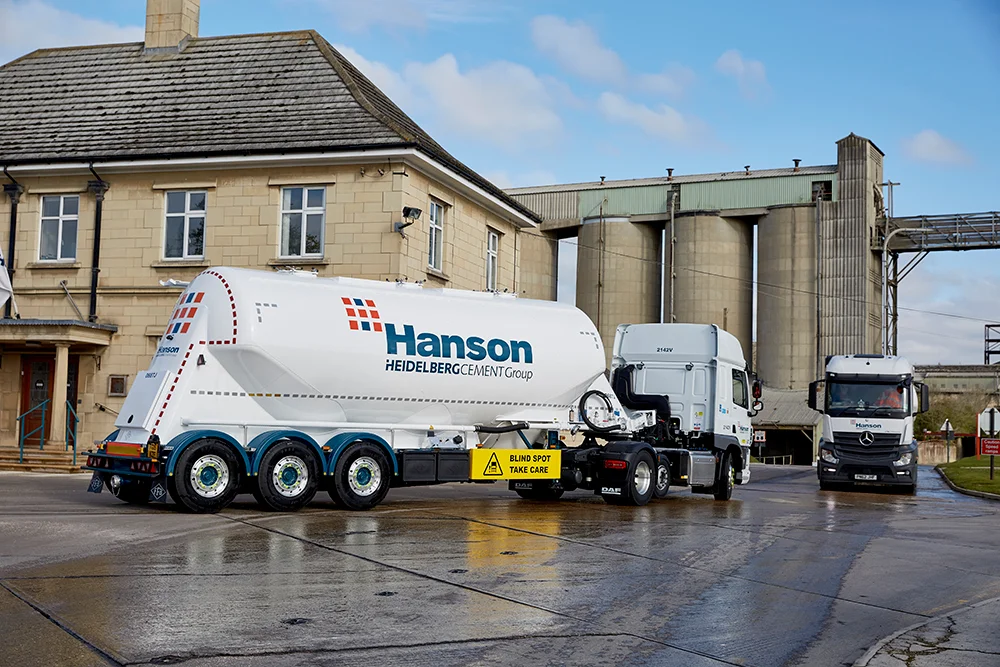

Ketton Cement Works
About one in ten bags of cement sold in Britain comes from a single Rutland village. Ketton, an unhurried place of pale stone cottages on the Welland tributary, sits on top of a Jurassic oolitic limestone so good it has been quarried for building stone since the sixteenth century. Trinity, King's and Clare colleges in Cambridge are mostly Ketton stone. So is much of Burghley House up the road. The colour has a name in geology textbooks: the warm honey of buildings in this particular corner of England comes out of these quarries. Since 1928 the same beds have been mined for cement, and the village now lives alongside an eighty-metre kiln tower and a Site of Special Scientific Interest, which is what the older quarries became when the diggers moved on.
From Sheffield to the Limestone
The works owes its existence to a Sheffield builder named Frank Walker who, in 1921, bought up eleven hundred and seventy-four acres of Ketton parish, most of it abandoned quarries and clay pits. Walker wanted to make sectional concrete buildings. He set up a block factory in 1925 under the name Walkers Ketton Stone Company, and by 1927 was trying to raise the capital for a cement works. The project was picked up by Joseph Ward, brother of the Sheffield industrialist Thomas William Ward whose firm Thos. W. Ward dealt in scrap metal, ship-breaking, machinery and fuel. The Wards bought Walker's land and block business in the summer of 1928. Work began on 1 August. The first weekly wage bill, for around ninety men working through August's heat, came to two hundred and two pounds, two shillings and elevenpence. By November the workforce had grown to two hundred and fifty men and boys, and the bill was over six hundred pounds. The first kiln fired before the year was out.
The Tallest Thing for Fifty Miles
A second kiln was added in 1933, a third in 1939 with a reinforced-concrete chimney 338 feet tall, then the tallest structure in the south of England and visible for fifty miles. By the start of the Second World War, production had grown from fifty thousand tonnes a year in 1930 to over two hundred thousand. The war itself nearly doubled demand again, as Britain poured concrete for airfields, pillboxes, anti-tank obstacles and bomb shelters across the country. Like every industrial site in the era, Ketton lost most of its able-bodied men to military service and ran short of labour. A fourth kiln went in in 1954; production passed three hundred thousand tonnes by the late 1950s. The post-war slum-clearance programmes drove demand higher still, and by the late 1960s the plant had seven kilns and was producing six hundred thousand tonnes a year. The Ketton laboratory developed rapid-hardening cement under the brand name Kettocrete, as well as waterproof and masonry varieties, much of the work proceeding by hand-controlled adjustments to the clinker mix.
Castle, Hanson, Heidelberg
The shape of the modern plant comes from a single decision in the mid-1980s. Kiln 8, built for around seventy million pounds, is sixty-eight metres long with a preheater tower around eighty metres high, capable of replacing the output of six earlier kilns at lower energy cost. Once it was running reliably in 1986, Kilns 1 to 4 were closed; Kilns 5 and 6 followed in 1987. The workforce fell from around five hundred and twenty to three hundred and ten, mostly through compulsory redundancies. The smoke that visitors used to see drifting across the valley reduced. The corporate name kept changing: Thos. W. Ward sold to Rio Tinto Zinc in the early 1980s, who rebranded the operation as Castle Cement; Castle was bought by Scancem in 1989; Scancem was bought by HeidelbergCement in 1999; Heidelberg merged Castle with Civil and Marine in 2009 to form Hanson Cement, replacing the medieval castle turret logo with a corporate H. The Castle turret survived on the bags because the customers wanted it there.
Tyres in the Kiln, Solar on the Slag Heap
In the 1990s the plant began burning shredded paper and plastics under the trade name Profuel; from 1996, used car tyres. Both are commonly used as cement-kiln fuels because the kiln operates at temperatures hot enough to destroy organic pollutants and the steel in tyre wire is incorporated into the clinker. Local communities were not all happy. Public meetings, open days every July, newsletters and visits became part of how the works defended its licence to operate. In 2013 Lark Energy built a solar farm on land reclaimed from a 1940s quarry next door; a second phase opened in 2015, with the then Secretary of State for Energy and Climate Change Amber Rudd cutting the ribbon. The solar farm supplies around thirteen per cent of the works' electricity. Cement leaves the plant by rail four or five days a week, headed mostly for the King's Cross Central terminal in north London, and by road in tankers and palletised bags. Ketton Quarries, where the kilns no longer dig, are managed as a nature reserve by the Leicestershire and Rutland Wildlife Trust. A 1960 Fowler diesel shunter named Ketton No. 1 is preserved at the nearby Rutland Railway Museum. The plant employs around two hundred and twenty people.
From the Air
Ketton Cement Works sits at 52.6400 degrees north, 0.5470 degrees west, on the south side of the village of Ketton in Rutland. From 3,000 feet AGL the eighty-metre Kiln 8 preheater tower is the most prominent landmark for miles, with the quarry depression and adjacent solar farm clearly visible. Nearest airports: RAF Wittering (EGXT) 5 nm south-east, RAF Cottesmore (closed, EGXJ) 5 nm north-east. Class G airspace; the Wittering MATZ and Cottesmore overhead both sit close by.
Nearby Stories
- 2022 Leicester Unrest 3.7 km away
- Trent Bridge 6 km away
- Ancaster, Lincolnshire 6.7 km away
- Murder of Una Crown 9.9 km away
- Wellingborough 15 km away
- RAF Witchford 16 km away
- Batemans Brewery 26 km away
- Canons Ashby House 27 km away