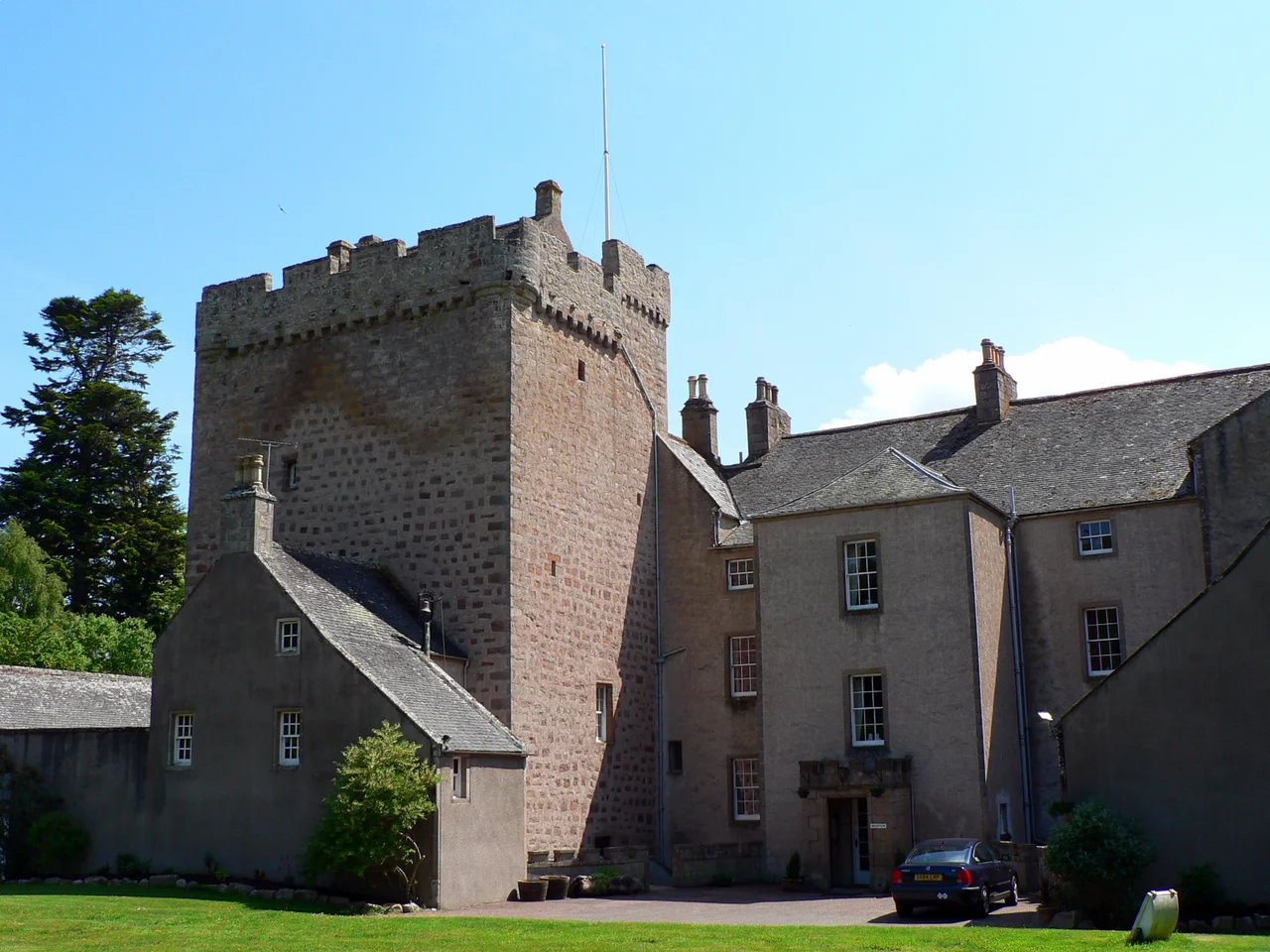

Kilravock Castle
Four days before the Battle of Culloden, Prince Charles Edward Stuart sat at dinner in Kilravock Castle as a guest of the Rose family. He was charming, by all accounts. He admired the music. He took an interest in the library. Days later, the slaughter on Drumossie Moor ended the Jacobite cause forever, and the Prince was a fugitive with a price on his head. The man hunting him - William Augustus, Duke of Cumberland, who would earn the nickname 'Butcher' for what his army did to the wounded and to civilians in the months that followed - arrived at the same castle shortly after the battle to be entertained by the same hosts. The Roses of Kilravock had been there since the 13th century and would continue to be there until 1984. Their tower house, begun around 1460, had already received Mary Queen of Scots, would later receive Robert Burns, and would survive Prince and Duke and Poet without changing very much at all. It is pronounced Kilrawk. The Gaelic original, Cill Rathaig, means 'church at the small circular fort'.
How the Roses Got the Land
The lands of Kilravock first appear in record as the property of the Boscoe family. The Bissetts came next by marriage in the 12th century, and in the 13th century the lands passed to Hugh II de Ros - the family that would Anglicise its name to Rose and hold the estate for the next seven hundred years. In 1293 John Balliol, briefly king of Scotland under English suzerainty, created the Roses Barons of Kilravock. The original castle was built in 1460 under licence from the Lord of the Isles, the powerful Gaelic magnate who effectively ruled the western Highlands as an independent kingdom. The tower house went up in stone - massive walls, narrow windows, the practical architecture of a region where private feuds could turn into private wars without warning. A square stair tower and a south range were added in the 17th century. The north and west sides of the surrounding quadrangle came later still. The Roses extended their home in step with the centuries' notions of comfort, but the original keep remains the heart of the building.
Mary and the Yett
Mary Queen of Scots was received at Kilravock in 1562. She was twenty years old, recently widowed, and progressing through the north of her kingdom in a determined effort to assert royal authority over the Highland chiefs. The visit was a moment of formal courtesy in what was, for Mary, a fraught and politically complicated tour. Six years later, in February 1568, a blacksmith called George Robertson of Elgin made a new iron yett - the heavy iron grille that secures the doorway of a Scottish tower house - for the great tower at Kilravock. Yetts were both decorative and functional: a properly made yett could turn a determined assault back from the door. The 1568 yett may still hang at Kilravock; it is the kind of practical detail that gives a tower house its character. By that date Mary herself had been forced to abdicate, was a prisoner in England, and would never return to Scotland. The yett outlasted the queen who had sat at dinner in the house it secured.
The Visitors of 1746 and 1787
The 18th century brought the castle's most famous succession of guests. In April 1746, Prince Charles Edward Stuart was entertained at Kilravock four days before the Battle of Culloden. The Roses, like much of the Highland gentry, had complicated loyalties: a clan tradition with sympathies that ran in both directions. The Prince's army was already running on rumour and exhaustion. Days later, the battle ended in a slaughter of the Jacobite force on the moor at Culloden, just a few miles to the west. The Duke of Cumberland - the king's son, the Hanoverian commander, the man who would earn the name 'Butcher' for his treatment of the defeated - visited Kilravock shortly after the battle. The Roses entertained him too. Forty-one years later, in September 1787, Robert Burns came to the castle on his Highland tour. He wrote nothing memorable about the visit; he had less to say about a thirteenth-generation laird than about a barmaid or a field mouse. But he came.
The Last Baron
The Roses held Kilravock for more than seven hundred years. In 1984 the family transferred the castle to a charitable Christian Trust, ending the unbroken line of clan ownership. Anna Elizabeth Emily Guillemard Rose, 25th of Kilravock and Chief of Clan Rose, died at Nairn on 9 December 2012 aged 88. The Lord Lyon - the heraldic officer who governs such matters in Scotland - recognised her nephew David Hugh Heriot Baird Rose as Chief of Clan Rose and 26th Baron of Kilravock in June 2013. The chiefly title continues; the castle has another purpose. It is a category A listed building, a 15th-century tower house with later additions, the home for centuries of a family that hosted a queen, a prince, a duke who became a byword for cruelty, and a poet who wrote about mice. The walls remember all of it.
From the Air
Kilravock Castle stands at 57.52°N, 3.98°W near the village of Croy, about 5 nautical miles east of Inverness Airport (EGPE). It sits on the Highland coastal plain south of the Moray Firth, between the rivers Nairn and Findhorn. Recommended viewing altitude is 2,000-3,500 ft AGL. Look for the four-storey tower house with its later additions sitting amid mature parkland; the castle is roughly midway between Inverness and Nairn, a few miles south of the A96 road. The Culloden battlefield - directly relevant to the castle's most famous chapter - sits about 4 nm to the west. EGPE provides full instrument approaches and the airfield is plainly visible to the north-west. The Moray Firth coastline runs east-west to the north and makes a clean visual handrail.
Nearby Stories
- Conon Hydro Scheme 2.3 km away
- Royal Dornoch Golf Club 5.4 km away
- Alladale Wilderness Reserve 5.6 km away
- Pluscarden Abbey 5.8 km away
- Monadhliath Mountains 16 km away
- Fort Augustus 19 km away
- Corgarff Castle 23 km away
- Hill o' Many Stanes 58 km away