
King Charles's Castle
King Charles's Castle has a problem with geometry. Built between 1548 and 1551 on the highest point of Castle Down, forty metres above the entrance to New Grimsby harbour, its guns can only fire on enemy ships in the harbour by being angled steeply downward - and downward-angled cannon do not shoot straight. Francis Godolphin, who rented Tresco from the Crown in the late sixteenth century, complained that the fortress 'neither discovereth the whole harbour' and that its design was 'of so weak form as it cannot be defended.' He was correct. By 1594 a much better fort - the eight-pointed Star Castle on St Mary's - had taken over its role. By 1651 the Royalist defenders had blown up part of it themselves. By 1752 the antiquary William Borlase was calling it 'a work of labour and expense, rather than of skill.' Today it is a Grade II* listed ruin maintained by English Heritage, and visitors can walk through walls that survive up to 3.4 metres high.
A French Invasion Scare
The castle was built in the reign of the boy-king Edward VI, but the fear that drove it back to his father's time. Henry VIII had built a chain of artillery forts around the south coast of England in the 1530s and 1540s - bold, low, thick-walled batteries designed to fire the newer long-range cannon at French invasion fleets. By 1547 those defences extended west to the Scilly Isles, where the Killigrew family had Royal connections and a personal interest in seeing the islands fortified. Construction at Tresco started in 1548 and continued through 1551 and 1552 under successive surveyors. Between 1548 and 1552, the Crown spent 3,123 pounds on Scilly's defences; a 1579 survey put the total cost including garrisons at 6,000 pounds. Edward's successor Mary I planned a garrison of 150 men but probably never achieved it. By 1558 Killigrew was styling himself 'captain in the Castell of Tresco'.
The Design Problem
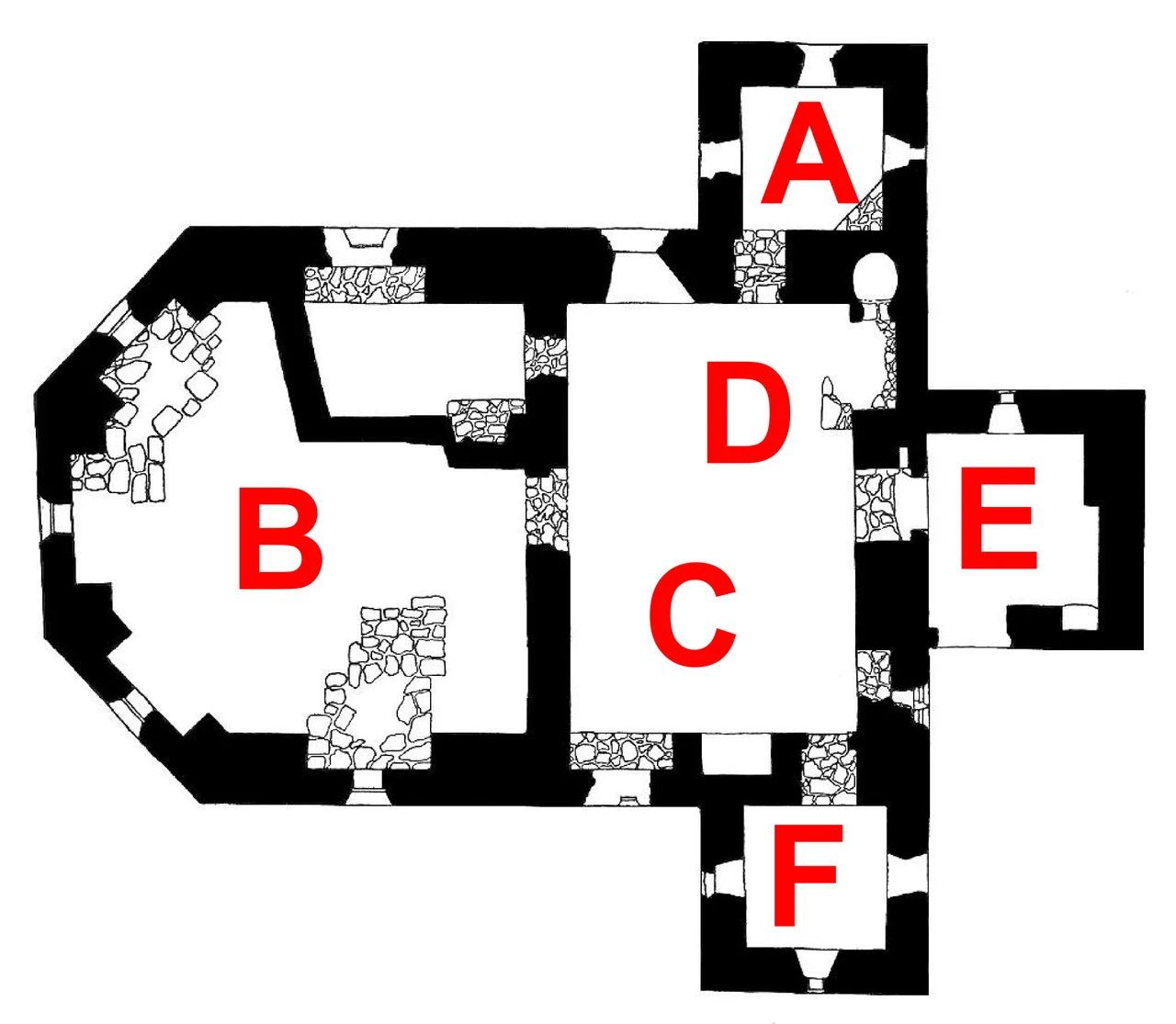
The castle is polygonal, built from local granite, with a gun battery at the front and a dining room, kitchen and living quarters behind. The plan is unusual for the period and survives elsewhere only in a few small blockhouses along the River Thames - none of which were exposed to the kind of weather that Castle Down catches. The fundamental problem was the elevation. Forty metres above sea level meant that even a heavy cannon fired from the parapet could only depress its barrel so far, and the guns simply could not be aimed at ships moving through the channel below. To compensate, a small blockhouse was probably built down by the water - on the same rocks where Cromwell's Castle would later stand - but the main fort itself was, militarily, almost useless from the moment it was finished.
The Royalists and the Demolition
During the English Civil War the Scilly Isles backed Charles I, and after a brief period in Parliamentary hands they rebelled in 1648 to support him. The Royalist garrison on Tresco believed - perhaps optimistically - that the castle on Castle Down was a critical defensive position, and they built new earthwork defences around it to protect against attack from the landward side. (Some scholars think those defences actually date from around 1627, built by the King's engineer Bernard Johnson.) The castle picked up its current name during this Royalist occupation. In April 1651 Admiral Robert Blake arrived with a Parliamentary task force, landed at Old Grimsby harbour on the other side of Tresco, and simply marched south past the castle - ignoring it entirely. Its commander, William Edgecumbe, retreated on 19 April and his men blew up part of the building as they went, leaving what remained to the Parliamentary colonel George Fleetwood.
The Stone Reused
Some of the stone from the demolished King Charles's Castle was almost certainly carried downhill and incorporated into the new Cromwell's Castle, which Blake's masons built at sea level over the following year. The exchange feels almost narrative: a Royalist fort blown up by its own defenders, repurposed by Parliamentary stonemasons into a Republican one. In 1660 Charles II was restored and Edward Sherburne came to Scilly to inspect the defences. He recommended repairs to King Charles's Castle, which was then being used to house soldiers, but no serious restoration appears to have happened. The antiquary William Borlase visited in 1752 and dismissed the building as labour without skill. By the end of the eighteenth century the writer John Troutbeck was praising the thickness of the walls but reaching the same conclusion: the fort was useless for what it had been built to do.
What Remains
In 1922 the lease of the castle passed to Arthur Dorrien-Smith of Tresco Abbey, who handed it - along with several other Tresco properties - to the Ministry of Works. In 1954 the site was partially excavated, uncovering coins, pottery and a buckle, and parts of the first floor of the battery were rebuilt from fallen stonework dug out of the rubble. What you see today is what survived. A large room on the west side, facing the sea, originally held the battery with embrasures for five guns. Two small bedrooms, each 2.9 metres square, lead off the main hall. A guardroom 3.5 metres square forms the entrance. The walls survive in places up to 3.4 metres high and 1.65 metres thick, though they average half that. It is impossible to be certain whether the castle was originally two storeys throughout or just at the gun battery, with the accommodation as a single-storey wing. English Heritage controls the site today, and it is open to visitors year-round.
From the Air
King Charles's Castle stands at 49.9636 N, 6.34858 W, on the western edge of Castle Down on Tresco, 40 metres above sea level on the cliff overlooking New Grimsby harbour. From the air the ruined polygonal walls are visible as a low stone outline on the headland directly above the round tower of Cromwell's Castle at the waterline. The two castles together make one of the most distinctive aerial features in the whole Scilly archipelago. Nearest airport St Mary's (EGHE) is about 3 nautical miles south. Tresco Heliport sometimes operates seasonal services at the southern end of the island. The Tresco Channel between Tresco and Bryher is heavily used by inter-island launches and yacht traffic - New Grimsby is a popular anchorage. Best viewing altitude 1,500 to 2,500 ft AGL for clear reading of both castles and the surrounding heath of Castle Down.
Nearby Stories
- SS Vigrid 6.2 km away
- SS Georgia (1890) 32 km away
- SS Irma (1905) 35 km away
- 1979 Fastnet Race 45 km away
- Great Wheal Charlotte 53 km away
- SM U-27 55 km away
- Wolfpack Prien 151 km away
- Tower of Hercules 715 km away