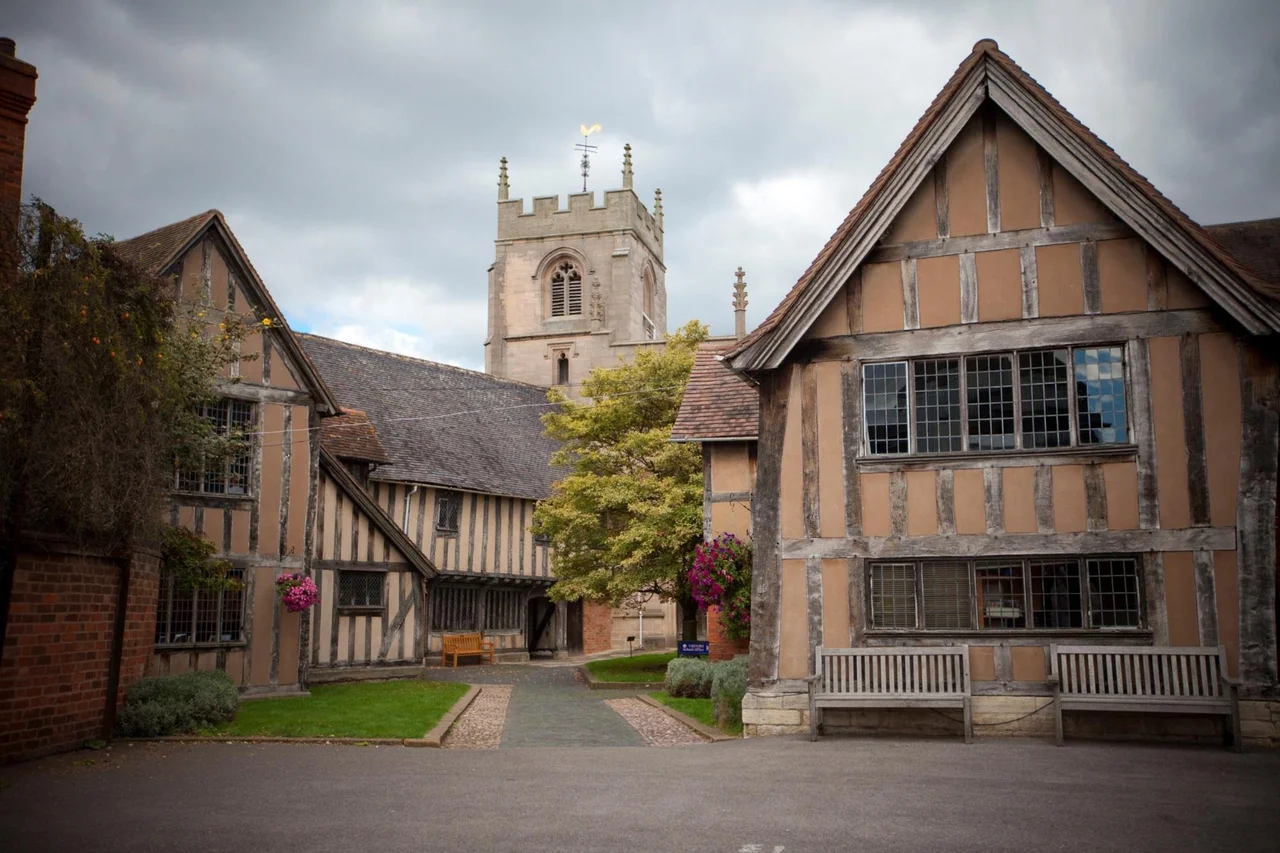

King Edward VI School, Stratford-upon-Avon
On the first floor of a half-timbered guildhall in central Stratford-upon-Avon, in a long, low-ceilinged room that the Victorians began calling Big School, the pupils of King Edward VI School still sit for lessons. The room dates from the 15th century. Beneath the timbers, in the ground-floor guildhall, the rods that supported temporary stages for travelling players in the 1570s have left visible holes in the woodwork. It is almost certain that William Shakespeare attended this school between roughly 1571 and 1578. It is also nearly certain that, as a small boy of seven, he watched some of those travelling companies set up their boards in the room beneath his classroom. The school is still teaching boys here. The boards have gone, but the holes remain.
A Schoolroom from 1295
Education at this address goes back further than most English schools can claim. A Stratford Register of Deacons from May 1295 records the ordination of a man called Richard as rector scholarum - schoolmaster - to teach the alphabet, the psalter and the basic rites to boys. The school was already an established arm of the Guild of the Holy Cross, the medieval religious confraternity that ran most of Stratford's social institutions. In June 1553, nine days before the young king Edward VI died of tuberculosis at age fifteen, the borough of Stratford-upon-Avon was granted its royal charter, and one of the provisions of that charter was the re-founding of the school. A schoolroom, a schoolhouse, and £20 a year for the master. King Edward VI School is widely believed to be the last of the King Edward VI Schools to be founded under his name - established, as it were, just inside the bell.
Shakespeare in the Classroom
There is no surviving register that names William Shakespeare among the pupils of the school, because no such pupil registers from the 1570s survive anywhere. What there is, instead, is overwhelming circumstantial evidence. His father John Shakespeare was an alderman and bailiff - the equivalent of mayor in 1568 - and as the son of a senior borough officer young William would have been entitled to free entry to the school. It was the only school within practical walking distance of New Place. The curriculum at the time was almost entirely Latin: Cicero, Ovid, Plautus, Terence. Shakespeare's plays show fluency with all four. His likely classmates included Richard Field, who would grow up to be a printer in London and to publish Shakespeare's earliest narrative poems Venus and Adonis and The Rape of Lucrece, and Robert Dibdale, who became a Catholic priest and was hanged at Tyburn in 1586 - declared Blessed by Pope John Paul II four centuries later, in 1987. The class of 1577 produced a national poet and a martyr.
The Annual Procession
On 23 April each year - Shakespeare's traditional birthday, by Stratford reckoning - the pupils and teachers of King Edward VI walk in formal procession from the school in Church Street down to Holy Trinity Church on the riverbank, where they lay flowers on his grave. The tradition began in 1893 and has been kept up almost continuously ever since. It is not a tourist event in the obvious sense, though tourists come; it is a school ceremony, the bookend on a school year that began with the boys studying him in some form or other. In 2003 the school celebrated the 450th anniversary of its 1553 re-foundation. In 1982 it had marked the 500th anniversary of the smaller, earlier endowment by the priest Thomas Jolyffe.
Pedagogue's House and the Guild Chapel
The school's buildings are a microcosm of English architecture from the late medieval to the present. Pedagogue's House, built around 1427, is believed to be the oldest half-timbered schoolroom still in use anywhere in England. It is attached to the Old Vicarage where the headmaster lives. The Guildhall, restored and now opened to the public from 11am each day, has the ground floor where Shakespeare's town council met and the first floor - Big School - where he was very probably taught. Adjacent to the school stands the Guild Chapel, the medieval chapel of the Guild of the Holy Cross, now owned by the Stratford-upon-Avon Town Trust and used by the school for morning service, carol service, and other ceremonies. The newer buildings cluster around: the 1930s teaching block; the 2008 Denis Dyson science wing; the 2017 Richard Spender block, named after an old boy and Second World War poet killed in March 1943 assaulting German machine-gun positions at Sedjenane, in northern Tunisia.
What the School Has Produced
Beyond Shakespeare and Richard Field and Robert Dibdale, the alumni list is its own small Who's Who of English public life. Two 14th-century brothers, John and Robert de Stratford, both became great officers of state and bishops; John eventually Archbishop of Canterbury. In the 20th century the school produced Reginald 'Rex' Warneford, the first naval airman to receive the Victoria Cross, killed in a flying accident in 1915 at the age of 23. Sir Richard Gale, who commanded the 6th Airborne Division at Normandy in 1944. Alex Henshaw, chief production test pilot of the Supermarine Spitfire at Castle Bromwich. Tim Pigott-Smith, the actor, killed off characters across most of the major Shakespeare productions of his career. The school is selective and traditionally for boys, with girls admitted to the Sixth Form since 2013. It became an academy in 2011. It still teaches Latin.
From the Air
King Edward VI School lies at 52.190 degrees N, 1.708 degrees W, on Church Street in central Stratford-upon-Avon, about 200 metres north of Holy Trinity Church. Best viewed from 2,000 feet on a low pass over Stratford. The site reads from the air as a courtyard of half-timbered medieval buildings hard against the road, with the more recent 20th-century brick teaching blocks behind. The adjacent Guild Chapel is the most architecturally distinct building on the school side of the street. Coventry Airport (EGBE) is 15 nautical miles north-east; Birmingham Airport (EGBB) is 19 nautical miles north-north-west; the M40 motorway runs 5 nautical miles to the south-east.
Nearby Stories
- RAF Defford 3.6 km away
- Great Witcombe Roman Villa 4.1 km away
- Coventry War Memorial 4.5 km away
- Hagley Hall 4.6 km away
- Battle of Naseby 5.4 km away
- Silverstone Circuit 5.9 km away
- Waddesdon Manor 8.8 km away
- Woodstock Palace 15 km away