
King Richard III Visitor Centre
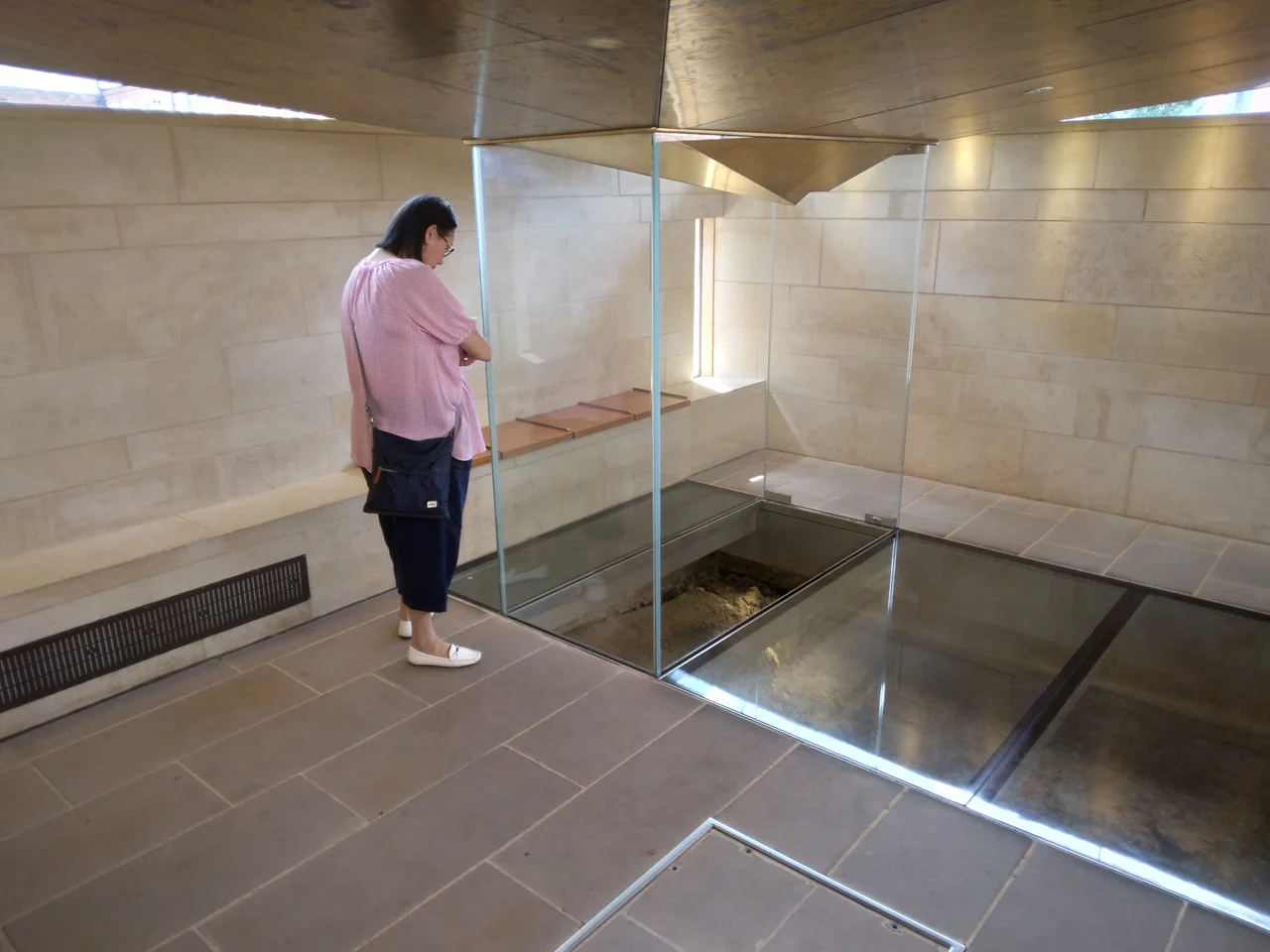
Most museums about kings are built somewhere else and the king is shipped in. This one is built where the king actually was. You walk through a Victorian school - red brick, tall sash windows, the kind of building Leicester has plenty of - and the route bends, the ceiling drops, and you find yourself looking down through a glass floor at a rectangle of plain earth. A projector throws the outline of a skeleton onto the dirt: head twisted slightly to one side because the medieval friary's grave was too short and the gravediggers had not bothered to dig a longer one. This is where the bones of Richard III lay between August 1485 and August 2012. Five hundred and twenty-seven summers of being walked over without anyone knowing. The Alderman Newton's School, decommissioned and ready for demolition before the dig, instead became the unlikely architectural envelope for one of the most specific museum experiences in Britain.
A School That Was Almost Demolished
Alderman Newton's School sat next door to the Social Services car park where Philippa Langley and the Richard III Society had pushed for the excavation in 2012. The building was Victorian, no-frills, and structurally unremarkable - a state school of the kind built in industrial cities across England in the late 1800s. When the dig confirmed that Richard had been buried directly beneath the friary's choir, the location of which corresponded with a corner of the school plot, demolition plans were quietly shelved. Leicester City Council, working with architect Paul East of Maber Architects, set about converting the school into a £4 million visitor centre. The challenge was specific: to preserve the grave site itself, in situ, while building a museum that could welcome visitors, interpret the medieval friary, the battle of Bosworth, and the modern dig - and tell the story without slipping into either solemnity or theme-park kitsch. The centre opened on 26 July 2014. In October 2018 it won 'Best Museum' at the Group Leisure and Travel Awards, beating the British Museum and the National Railway Museum in its category.
The Grave Room
The journey through the centre is structured to delay the moment you see the grave. You move first through galleries about Richard's life - his Yorkist upbringing, his brother Edward IV's reign, the disputed events of 1483 when he took the throne, the controversies that have followed his memory ever since. There is a replica of his armour, a replica of his skeleton, and the reconstructed face produced by the University of Dundee's craniofacial team from the actual skull - a face that is recognisably the face of the oldest surviving portrait, painted around 1520, and is not the face Shakespeare made anyone expect. Then you cross into a low room, lit deliberately dim, with a glass floor over the dirt. The grave is not a replica or a representation. It is the grave. The choir of the friary has been picked out with a partial floor of the church above ground level, so you can see where the altar must have stood. The body had been placed roughly, not reverently. There was no coffin. Whatever the monks of Greyfriars thought about the king they were burying, they did not have time or inclination to do it carefully.
Curatorial Choices and the Question of Richard
Five and a half centuries is a long time to argue about a man. Was Richard III the murderous usurper of Shakespeare's history play, the man who almost certainly arranged the deaths of his two young nephews in the Tower? Or was he the conscientious northern administrator and reformer of English law that the Richard III Society has spent more than a century rehabilitating? The visitor centre handles this question with a deliberate generosity - presenting the cases on multiple sides without trying to issue a verdict. The Princes in the Tower are not glossed over; neither is Richard's legal reform of the bail system or his apparent personal courage at Bosworth, where contemporary accounts describe him charging into the middle of Henry Tudor's forces and being unhorsed and killed within metres of the man who would become Henry VII. The skull tells its own evidence: the death blow was a halberd or bill strike that sliced off a portion of the back of the skull. He was 32 years old. He was the last English king to die in battle.
What the Building Does with Memory
The site is now a scheduled monument; in December 2017, Historic England formally scheduled a significant part of the former Greyfriars friary, recognising the archaeological potential even though the medieval buildings themselves have long been gone. The visitor centre's adjacency to Leicester Cathedral, where Richard was reinterred in March 2015, means that visitors can do both halves of the journey on foot in a single afternoon: the place he was found, then the place he now rests, separated by a few hundred yards of city street. The result is not quite like any other museum experience in Britain. It is part archaeology, part forensic science, part medieval history, part contemporary detective story - and it works because, in the end, it points to a real thing in a real place. The dirt is under the glass. The king was here.
From the Air
The King Richard III Visitor Centre sits at 52.6342°N, 1.1362°W in central Leicester, on St Martins, immediately adjacent to Leicester Cathedral. From altitude, the cathedral's 220-foot spire is the most prominent feature; the visitor centre occupies the redbrick block immediately to its southwest. East Midlands Airport (EGNX) lies approximately 15nm to the northwest. Bosworth Field, where Richard III was killed in 1485, sits 12nm west-southwest. The visitor centre is part of a tightly clustered historic core that includes the Cathedral, the Guildhall, and Leicester Castle within a few hundred metres.
Nearby Stories
- National Shell Filling Factory, Chilwell 1 km away
- Staffordshire Regiment Museum 2 km away
- Rutland Water 3.3 km away
- Grantham 4.4 km away
- Wellingborough 9.9 km away
- Croxden Abbey 11 km away
- Bordesley Abbey 14 km away
- Electric Railway Museum 17 km away