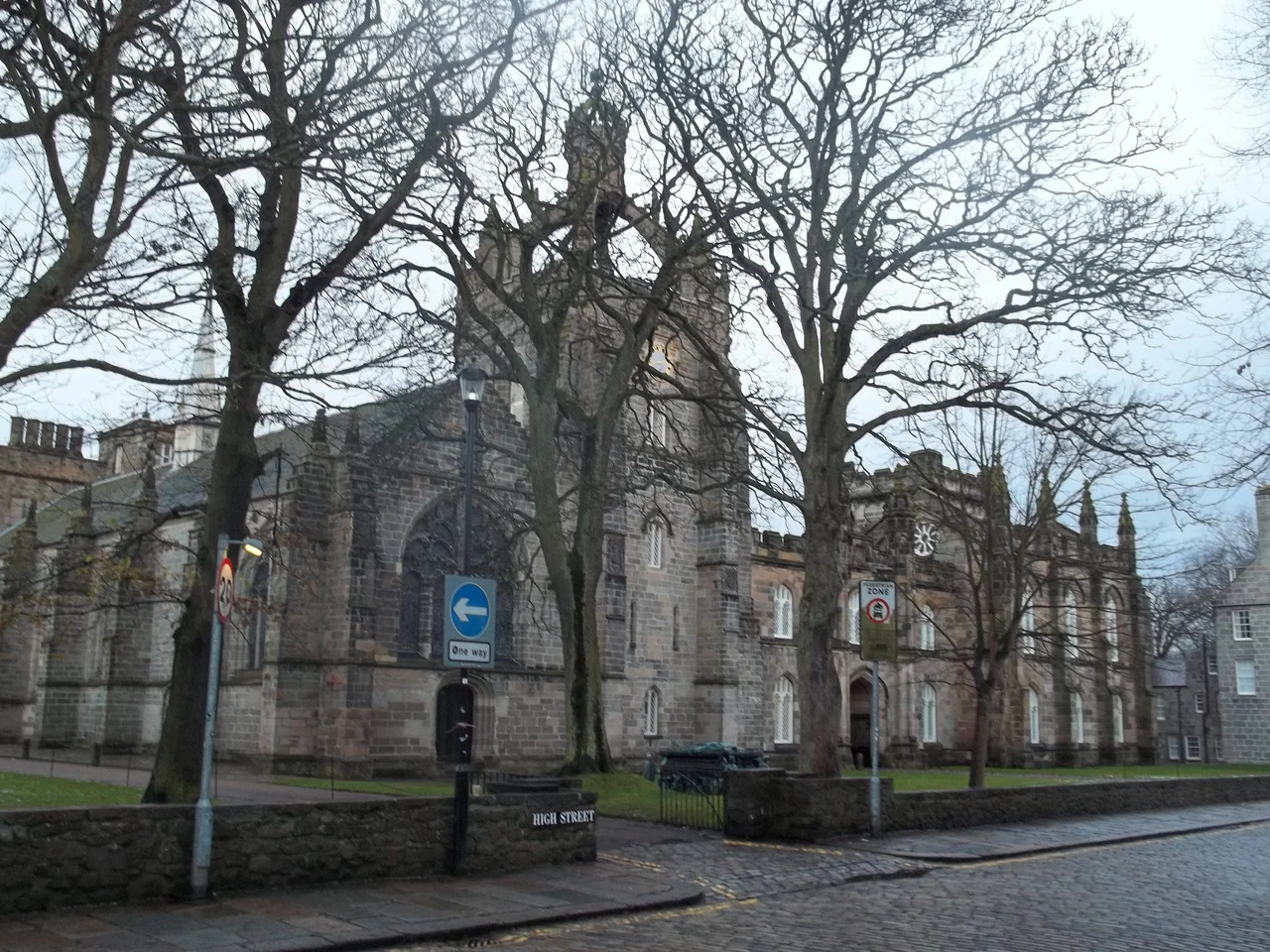

King's College, Aberdeen
The papal bull arrived from Rome on 19 February 1495, signed by Pope Alexander VI - the Borgia pope, in the second year of his scandalous reign. Its name was Primo Erectio Universitatis, and it founded a university at Aberdeen. The man behind the petition was William Elphinstone, recently appointed Bishop of Aberdeen, and his stated purpose was to cure the ignorance he had witnessed within his parish and in the north generally. The phrase sounds dismissive now, but in 1495 the north of Scotland had no university of its own, no easy route to higher learning, no formal training for clergy or lawyers within five days' ride. King James IV backed the petition. The royal charter that followed put Aberdeen on equal footing with Glasgow and St Andrews, Scotland's two existing universities. King's College became the third in Scotland and the fifth in the British Isles. Five and a third centuries later, its crown-topped chapel still rises above the streets of Old Aberdeen as the centrepiece of one of the oldest continuously operating universities in the English-speaking world.
Elphinstone's Vision
Elphinstone had been a professor at the University of Paris before returning to Scotland, and he modelled his new institution explicitly on the continental European tradition rather than the English Oxford-Cambridge model. The first principal was Hector Boece, another former Paris professor, who would later write the Scotorum Historiae - a vast and partly fictional history of Scotland that supplied Shakespeare with most of the material for Macbeth. Construction of the chapel began in 1498 on what was then marshy ground, requiring large oak beams to support the foundations. It was consecrated in 1509 and dedicated to St Mary. By 1514, the university had forty-two members between staff and students. The chapel's most famous feature is its imperial crown - a closed crown spire suggesting imperial status for the Scottish monarchy, of which only two examples survive in Scotland (the other crowns St Giles' in Edinburgh). The original crown was blown down in a storm in 1633; the present one is a faithful recreation that has weathered the centuries since.
Reformation and Cromwell
The Scottish Reformation of 1560 hit King's College harder than its sister institutions. The chapel was Catholic to its bones - its woodcarving, its dedications, its very design - and the new Presbyterian order purged the college of Roman Catholic staff with thorough efficiency. But the buildings survived, and the carved choir stalls and rood screen that date to around 1509 were left in place. They form the most complete surviving medieval church interior in Scotland, a quiet accident of which corners the iconoclasts missed. George Keith, 5th Earl Marischal, who became a moderniser within the college, supported the reforming ideas of Peter Ramus and pushed for curricular change against institutional inertia. The Cromwell Tower went up in the 1650s and 1660s during the period of the Commonwealth - a residential building topped with an ornate turret that housed an early observatory. It was finished only after Charles II had been reinstalled as king, an irony that nobody at the time seems to have remarked on.
The War Memorial
Since 1928, the antechapel of King's College Chapel has served as the University of Aberdeen's war memorial. The walls record the names of 524 students of the university who fell in the First and Second World Wars - young men and a few young women who left lectures and labs and dining halls to die in Flanders, North Africa, the Atlantic, Burma. The university accepts the weight of that record with the kind of quiet pride and quiet sorrow that British academic institutions tend to bring to remembrance. Bishop Elphinstone and Hector Boece, the founder and the first principal, are buried at the foot of the chancel, though Elphinstone also has a larger tomb outside the college. Five centuries of teaching, two world wars of dying, several Reformations, one Cromwell, one stormblown crown - all of it accumulated in a single chapel whose oak beams still hold.
The Old Quadrangle Today
King's College became part of the University of Aberdeen by formal union in 1860, when the two old Aberdeen colleges - King's and Marischal - merged. The historic quadrangle, dominated by the chapel and the Cromwell Tower, remains the heart of the modern Old Aberdeen campus. Elphinstone Hall, built in 1930 in front of the original college, created an effective second quadrangle and is now used for functions, dining, and examinations. New King's - the 1913 expansion - and various later twentieth-century buildings have spread the campus across what was once the medieval town, dominating Old Aberdeen's High Street with university life. The most recent building, the Science Teaching Hub, was completed in 2021 and brought biological sciences, chemistry, geosciences, and medical sciences into a single modern facility. The chapel's crown still tops it all. Approaching Old Aberdeen from the south down College Bounds, that crown remains the first thing you see, exactly as Elphinstone designed it to be.
From the Air
King's College stands at 57.16N, 2.10W in the Old Aberdeen district north of the city centre. From altitude, look for the distinctive crown-topped chapel spire rising above the quadrangle on Old Aberdeen's High Street, with St Machar's Cathedral 400 yards further north and the River Don beyond. Aberdeen International (EGPD) lies 4nm northwest. Best viewed at 1,500-3,000 ft AGL in clear conditions; the imperial crown spire is unmistakable - one of only two surviving in Scotland - and the modern campus sprawls north and east from the original quad. Powis Gates' minaret-style towers are visible just south of the chapel.
Nearby Stories
- Monymusk Priory 3.9 km away
- Deer Abbey 8.6 km away
- Glendronach Distillery 9.8 km away
- Fettercairn Distillery 13 km away
- Dunnottar Castle 16 km away
- Piper Alpha 146 km away
- German submarine U-1274 151 km away
- HMS Nottingham (1913) 192 km away