.jpg)
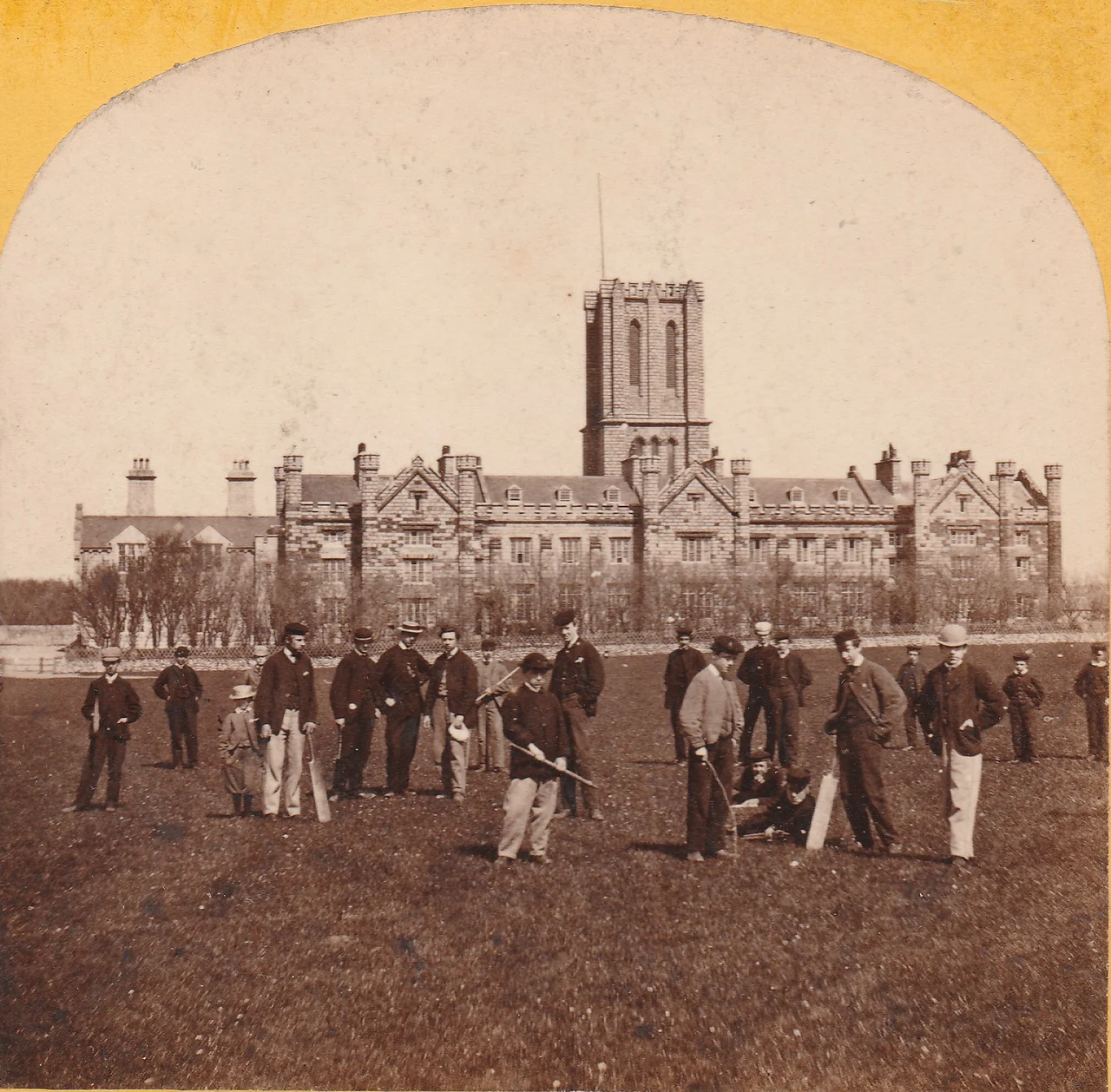
King William's College
Every December, families across Britain sit down at the kitchen table with The Guardian spread out in front of them, pencils sharpened, and brace themselves to fail. The King William's College General Knowledge Paper has been humiliating amateur quizzers since 1904, and the school that sets it sits on the shore of Castletown Bay on the Isle of Man, looking south over a stretch of water that has shaped its character for two centuries. The college was already here, just, when Queen Victoria came to the throne. It was here when the breakwater at Port Erin failed, when the South African War swallowed its Old Boys, and when the steam railway first puffed through Castletown to take pupils home for the holidays.
A Bishop's Promise, Two Centuries Late
In 1668, Isaac Barrow, Bishop of Sodor and Man, set aside the estates of Ballagilley and Hango Hill in trust, intending to found an academical school for the children of the island. He was the uncle of the more famous Isaac Barrow at Cambridge, the mathematician who taught Isaac Newton, and like his nephew he believed that the cure for poverty was reading. The Bishop Barrow Trust waited for the right moment, and that moment did not arrive for 165 years. In 1833 the trust finally funded a school. Forty-six boys walked through the doors that first day. The school was named for King William IV, who, when approached for money, is said to have replied that he had nothing to give but his most valuable possession, his name.
The Quiz That Eats Christmases
Since 1904 the College has set the General Knowledge Paper, and since 1951 The Guardian has printed it. Some 180 questions, ranging in difficulty from obscure to actively cruel. Pupils used to sit it twice: once cold before the Christmas holidays, then again in January after a fortnight of frantic research. The cold sitting often produced scores of two correct answers out of 180. Local Manx families turn it into a kitchen-table sport with prizes presented on Founders' Day, and the current quizmaster, the retired GP Dr Pat Cullen, has been writing it since 1997, checking each question against Google to ensure it cannot be solved by typing it in. The motto printed at the head of the paper is in Latin: 'To know where you can find anything is, after all, the greatest part of erudition.' The quiz is, in its way, a love letter to that idea.
Old King Williams
The school's old boys, who put OKW after their names, fan out into improbable directions. Sir William Henry Bragg, who won the Nobel Prize for Physics in 1915 with his son Lawrence, learned his physics here. Frederic Farrar, who became Dean of Canterbury, used a thinly disguised version of the school as the setting for the Victorian schoolboy novel Eric, or, Little by Little, and one suspects the boys recognised themselves on every page. Three OKWs have won the Victoria Cross. Henry Higgins, who fought bulls in Spain as El Ingles, learned to ride here. T.E. Brown, the Manx poet who wrote in dialect about the fishermen and farmers of the island, was a master at the school. Alfred Cannan, the current Chief Minister of the Isle of Man, was a pupil. The list lengthens. The half-mile open-water swim in Derbyhaven Bay each June, which all non-swimming pupils must compulsorily watch, supplies the school with something rarer than alumni: a shared memory of cold.
The Bay and the Boys in Khaki
The Combined Cadet Force has been part of life here since 1911, and the College carries its military history close. During the First World War, 546 members of the College community served. Forty-five were killed and forty-five wounded from the Officers' Training Corps alone, a casualty rate that says everything about what that war did to boys' schools across the British Isles. In the Second World War, 696 served. The school's Officers' Training Corps was the only contingent in the country to see active service in the Great War, guarding prisoners of war at the camp at Douglas. Major Robert Henry Cain, who won his VC for repeatedly knocking out German tanks at Arnhem in 1944, sat in these classrooms. The CCF still parades on Tynwald Day, the Manx national day, every July.
Looking Down From the Hill
From above, the campus reveals itself as a long stone presence on the shore between Castletown and Derbyhaven, the cricket pitches green even in March, the chapel spire pointing toward the bay. Castletown Bay slides west toward Langness Peninsula, which the school's runners and walkers cross on weekends. On clear days the Mourne Mountains of Northern Ireland rise on the western horizon, exactly as they have for every generation of pupil who has stood on the beach during the swim and waited for it to be over.
From the Air
Located at 54.08 degrees north, 4.64 degrees west, on the shore of Castletown Bay at the south-east corner of the Isle of Man. Best viewed at 2,000 to 3,500 feet on approach from the south, with Langness Peninsula extending into the Irish Sea on the right and Castletown's grey castle to the west. Nearest airport is Ronaldsway (ICAO: EGNS), about three miles to the north-east. Coastal weather can produce sudden visibility changes; the Mourne Mountains in Northern Ireland often appear on the western horizon on clear days.
Nearby Stories
- RAF Jurby Head 14 km away
- German submarine U-246 16 km away
- German submarine U-1051 17 km away
- Kilclief Castle 18 km away
- Ardglass 31 km away
- St Bees Lighthouse 44 km away
- Trwyn Du Lighthouse 54 km away
- Seascale Lifeboat Station 61 km away