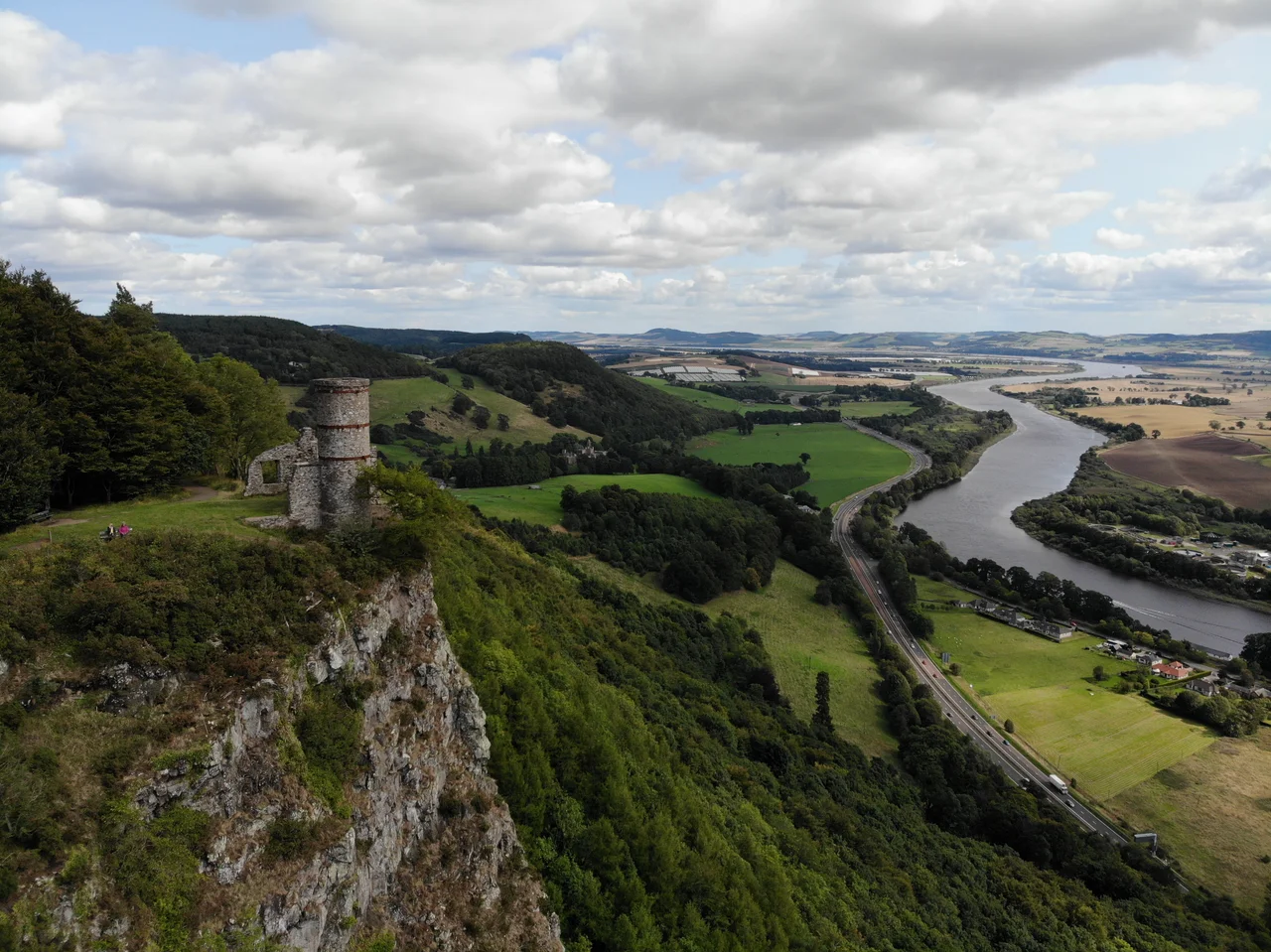

Kinnoull Hill
Jane Austen was fourteen years old when she came here in September 1789. She remembered the view well enough to put it into one of her earliest stories. In Lesley Castle, written for her sister, she describes a mouldering tower on a bold projecting rock two miles from Perth, commanding an extensive view of the town and its delightful environs. The tower is still there, perched on the cliff above the River Tay, and the path to it winds up through one of Scotland's quieter woodland parks. Kinnoull Hill is only 222 metres high - barely a hill in Highland terms - but the way it falls away to the south makes it feel like the edge of something much larger.
The View From the Summit
The south-facing summit looks out over Friarton Bridge, the Tay Coast railway line, and the long ridge of the Sidlaw Hills. Further south, Moncreiffe Hill rises out of the Carse of Gowrie. The summit is divided into two points, and tucked between them is a hollow with the wonderful name of the Windy Gowle, which once - or so the old gazetteers insist - offered an echo of nine distinct reverberations. Whether nine bounces still come back is a question best settled in person. The drop to the south is sudden enough that the trees give way to bare rock, and the path to Kinnoull Tower runs right along the cliff edge.
Wallace, Hay, and a Folly Tower
William Wallace is said to have hidden in a cave on the hill while evading his pursuers. The story may or may not be true, but it has the right shape for Kinnoull, where ledges and overhangs riddle the south face. The folly tower on the summit, the one Jane Austen wrote about, was built in the eighteenth century - in the 1770s or 1780s - by the 9th Earl of Kinnoull, Thomas Hay, who had admired Rhine castles on his Grand Tour and wanted something similar on his Perthshire ridge. He was also instrumental in funding the Perth Bridge over the Tay. In 1793, wild roses gathered from the hill were transplanted into a nursery owned by James Dickson and James Brown that eventually employed around eighty people. The dye-tinted air and the legacy of those rose-hunters still hover faintly over the woodland.
The Woodland Park
Kinnoull Hill Woodland Park is managed jointly by Forestry and Land Scotland and Perth and Kinross Council, with a long-standing Users Group involved in day-to-day decisions. The park has held Green Flag status twice, in 2009 and again in 2010, and the same year it came runner-up in Scotland's Finest Woods Awards. On the western foothills, Branklyn Garden - laid out by Dorothy Renton and her husband John in the twentieth century - is now in the care of the National Trust for Scotland. It is small, dense with alpines and Himalayan species, and shows what Renton called the obsession of a lifetime.
A Hill That Carries Sorrows
Kinnoull Hill has been the scene of private griefs that deserve to be named carefully. In 1793, a twenty-year-old Forfar Athletic player named Jack Syme took his own life on the hill. In January 2002, Daniela Smith - a thirty-one-year-old mother - took her own life and that of her two infant children, who were found on a ledge about a hundred feet below the summit. In 2014, the bodies of two men were found below the hill. These are not curiosities. They are the reasons the path past the lookout carries a Samaritans sign and a phone number, and the reason a hill so beautiful is also tended with quiet, careful watchfulness.
The Name Travels
Kinnoull's name has wandered farther than its 222 metres might suggest. The Kinnoull Campus of De La Salle College in Melbourne is named after the hill. The estate it stands on was built in 1856 by Sir James Palmer and later renamed Kinnoull by Sir Alexander Stewart, a former chairman of BHP who was born near the hill. Closer to home, the Abernyte Brewery makes a beer called Kinnoull Red, named for the colour of the cliff face when the late sun catches it. From the summit at that hour the whole of central Perthshire turns warm, and you understand why a fourteen-year-old visitor in 1789 felt the need to write it down.
From the Air
Kinnoull Hill rises to 222 m (729 ft) at 56.39N, 3.40W, immediately east of Perth on the north bank of the River Tay. Best viewed at 2,500-4,000 ft AGL; the abrupt southern cliff and the small folly tower on the summit are distinctive. Nearest ICAO airport is Perth (EGPT) 4 nm west-north-west; Dundee (EGPN) 16 nm east along the Tay. The hill is a natural waypoint for arrivals into Perth and a useful landmark for visual transit between the Tay valley and Strathmore.
Nearby Stories
- Drummond Castle 0.4 km away
- St Andrews 0.8 km away
- Aberfeldy 2.2 km away
- Yellowcraig 2.7 km away
- Fordell Castle 3 km away
- Battle of Sauchieburn 3.2 km away
- Battle of Dun Nechtain 3.3 km away
- Airlie Castle 13 km away