
Kodak Fortress
The stronghold was barely finished when the men it was built to control came for it. In the summer of 1635, the Polish-Lithuanian Commonwealth raised the Kodak fortress on a bluff above the Dnieper for one purpose: to hold down the fiercely independent Cossacks of the Zaporozhian Sich and keep restless Ukrainian peasants from joining them. Within weeks, the Cossack leader Ivan Sulyma slipped across the river by night, overwhelmed the garrison, and tore the new fort apart. It was an omen. Over the next century Kodak would be rebuilt, besieged, surrendered, and razed again, a border fortress whose story is the story of who would rule this stretch of river.
A Fort to Cage the Frontier
Kodak was built in 1635 by order of Wladyslaw IV Vasa and the Commonwealth's Sejm, its construction overseen by the great crown hetman Stanislaw Koniecpolski. The design fell to Guillaume Le Vasseur de Beauplan, a French military engineer and cartographer whose meticulous maps of Ukraine remain among the finest records of the age. The placement was deliberate. Here the Dnieper broke into its wild rapids, and one of those rapids would take the fortress's name. Whoever held Kodak controlled the river gateway to the Sich downstream, the self-governing Cossack heartland beyond the cataracts. The Commonwealth meant the fort to be a stopper in a bottle, sealing off the frontier. The Cossacks understood exactly what it was, and refused to accept the cage.
Taken, Rebuilt, Taken Again
Sulyma's night raid in 1635 destroyed the first fort and cost him his life; captured by the Poles, he was executed in Warsaw. The Commonwealth rebuilt Kodak larger and stronger by 1639, but the reprieve was temporary. When Bohdan Khmelnytsky launched his great uprising in 1648, the fortress found itself surrounded. The Polish garrison held out through a long siege before surrendering on 1 October 1648. A memorial later raised on the ruins, on the initiative of the celebrated historian Dmytro Yavornytsky in 1910, honors that Cossack triumph, though it misdates the surrender to April. After the 1654 Treaty of Pereyaslav bound the Cossacks to Moscow, Kodak was manned by Cossacks themselves, until Tsar Peter I ordered it razed in 1711 under the terms of the Treaty of the Pruth.
What the Quarry Left Behind
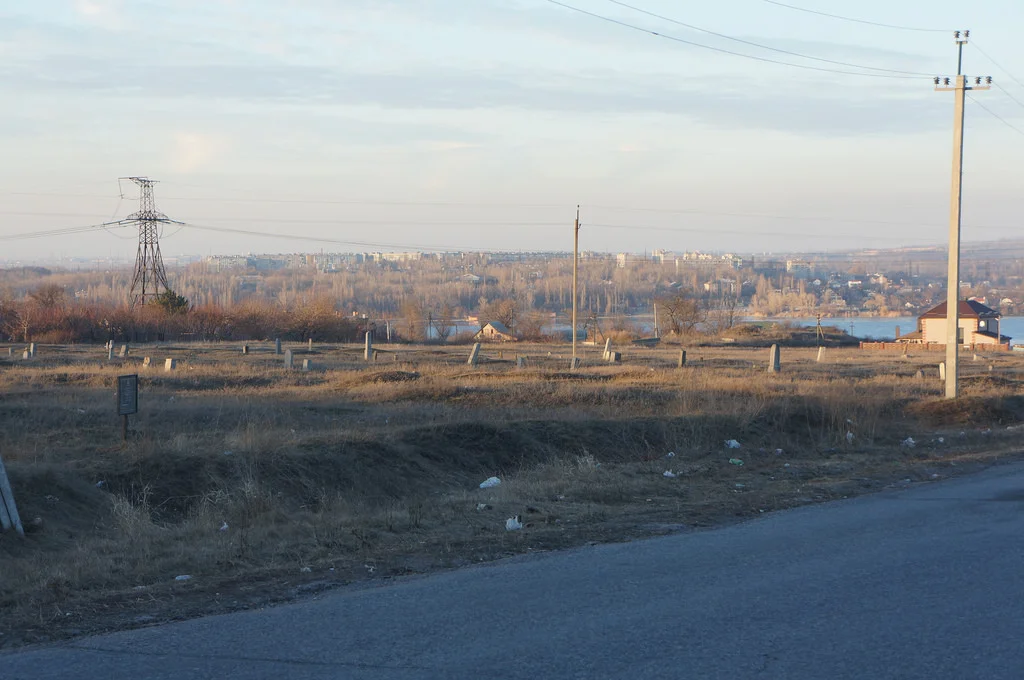
History was not finished humbling Kodak. In the early 1930s the Soviet state opened a stone quarry directly on the fortress site, and industry accomplished what armies had only begun. By the time the quarry closed in 1994, roughly two-thirds of the fortifications had been consumed. A single wall survived. Today the site above the village of Stari Kodaky is a place of ruins and remembrance rather than ramparts, the old Cossack cemetery nearby and the wide Dnieper glinting below. Visitors climb the bluff not for surviving stone but for the ground itself, and for the long view down a river where the fate of a frontier was contested for generations. Kodak endures as an idea more than a fortress, the memory of a line drawn and repeatedly erased.
From the Air
The Kodak fortress site sits at about 48.381 N, 35.137 E on a bluff above the Dnieper near Stari Kodaky, just south of Dnipro. From 1,500 to 2,500 feet AGL the river bend and the elevated ground are the key landmarks; the ruins themselves are modest and easiest to spot against the open bluff. Nearest airport is Dnipro International (UKDD), a short hop north.
Nearby Stories
- Aeroflot Flight 3630 31 km away
- Dnieper Hydroelectric Station 34 km away
- Battle of Zhovti Vody 58 km away
- Battle of the Vorskla River 67 km away
- Battle of Dibrivka 75 km away
- Kryvbas 79 km away
- Borki Train Disaster 120 km away
- Azov Upland 146 km away