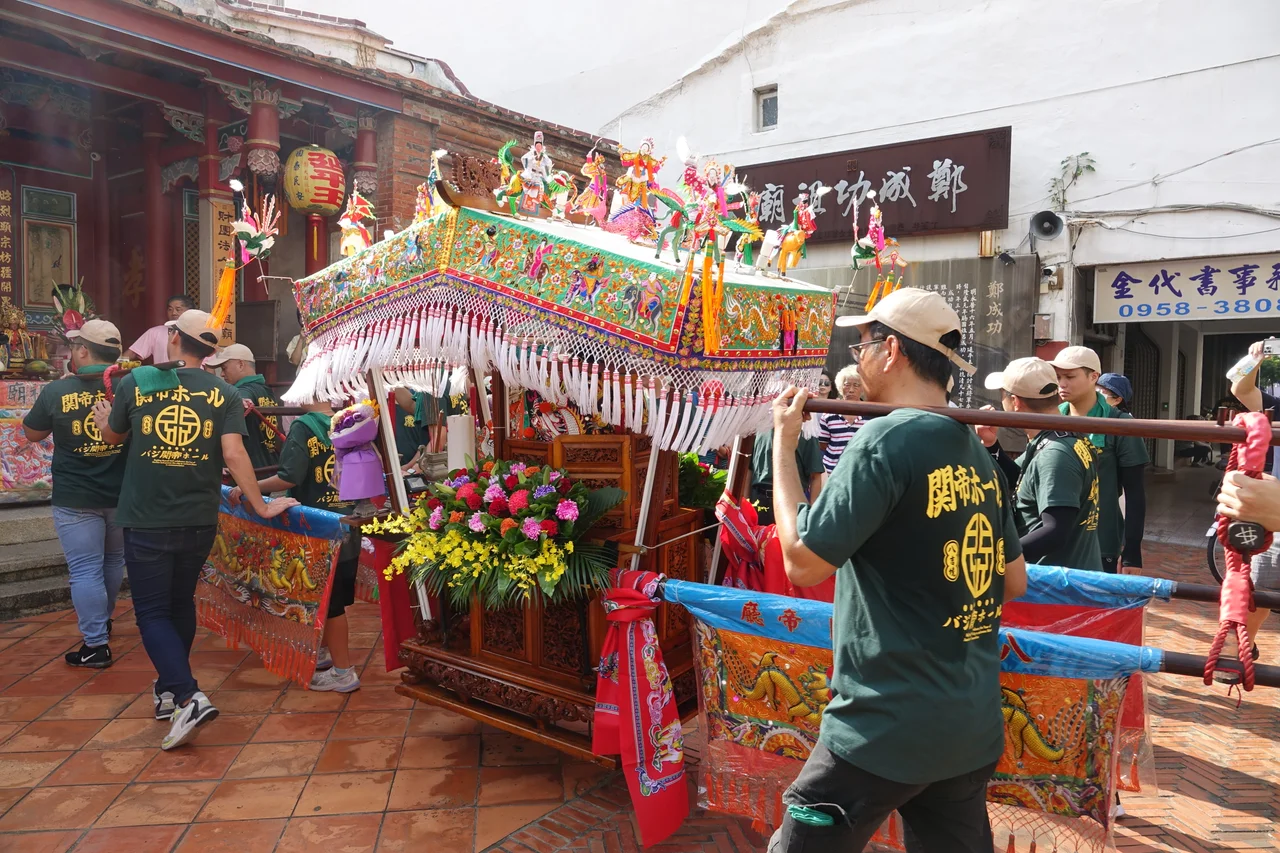

Koxinga Ancestral Shrine
He was born in Japan, raised in China, and died in Taiwan. Zheng Chenggong — known in the West as Koxinga — was the son of a Chinese merchant-pirate and a Japanese woman named Tagawa Matsu, a combination that made him an anomaly in every political category of the seventeenth century. He grew up to become one of the most consequential military figures in East Asian history: the commander who expelled the Dutch East India Company from Taiwan in 1662 after a nine-month siege, establishing the last holdout of the Ming dynasty on an island that the Qing empire would not fully conquer for another two decades. He died the same year he won. His son built him a shrine in 1663, and that shrine still stands.
A Son's Memorial
Zheng Jing — Koxinga's son and successor to the Kingdom of Tungning — built the Koxinga Ancestral Shrine in 1663, the year after his father's death, to serve as a place of family veneration. The original structure was a private shrine: not a public temple, not a state monument, but a family compound where the Zheng clan could honor its founding figure according to the conventions of Chinese ancestral veneration. Spirit tablets representing each generation of ancestors were installed in the central hall alongside a statue of Koxinga himself. In 1771, a famous wooden tablet was added bearing the character inscription 'Three Generations Heritage' — a phrase commemorating the virtue of Koxinga's family across three generations of rule. That tablet's recognition that the Zheng dynasty was already history says something about how quickly things change in Taiwan.
A Name Changed by Conquest
When the Qing dynasty absorbed Taiwan in 1683 and the Kingdom of Tungning came to an end, the shrine's identity had to change. An ancestral hall honoring the founding dynasty of the defeated kingdom was a politically sensitive object. The Qing administration renamed it 'The Cheng's Ancestral Shrine' — using a romanization of the family name rather than the honorific title Koxinga, which carried too much of the defeated order's prestige. Over time, the official designation shifted again, and today the site is known as the Ancestral Shrine of Koxinga. The name revisions track the changes in who has held power over this island, and how each successive authority has chosen to manage the memory of the man who held it before them.
The Well and What Remains
Of the original seventeenth-century shrine, very little survives in its first form. The most tangible connection to the building Zheng Jing constructed is an old well in front of the gate — still present, still visible, sunk into the ground before the entrance as it has been for more than three and a half centuries. It is a quiet kind of relic: not decorative, not inscribed, just a well. The current complex, described as traditional and elegant, reflects the rebuilding and renovation that all old sites in Taiwan have undergone across generations of use. But the compound's essential purpose has not changed. It remains a place dedicated to the memory of a specific man, held in the specific form of Chinese ancestral veneration that his own cultural tradition prescribed.
Mother and Son in Stone
Inside the shrine stands a sculpture that captures something the official historical record often overlooks. The piece depicts the young Koxinga alongside his mother, Tagawa Matsu — the Japanese woman who bore him and who, according to various accounts, died during the Qing conquest of the Chinese port city Xiamen when Koxinga was still fighting. The sculpture makes visible a part of Koxinga's story that his status as a Chinese national hero tends to obscure: that he was half Japanese, that his mother shaped him, and that the loyalty and grief that drove his military campaigns were personal as well as dynastic. A shrine that preserves ancestral memory should perhaps be expected to tell the whole story. This one tries.
From the Air
The Koxinga Ancestral Shrine is located at approximately 22.9926°N, 120.2030°E in the West Central District of Tainan, close to the Grand Matsu Temple and the historic core of the old city. From the air at 1,500–2,500 feet, the West Central District appears as a dense cluster of traditional structures, temples, and older streets set within the broader modern city. The nearest major airport is RCKH (Kaohsiung International), approximately 25 km to the southwest. Tainan Airport (RCNN) is the closer regional option, roughly 5 km to the west. Note that the Koxinga Ancestral Shrine is a separate site from the nearby Koxinga Shrine, which is a larger state-built monument constructed in 1874.
Nearby Stories
- Chung Li-ho Museum 0.7 km away
- Jingzaijiao Tile-paved Salt Fields 8 km away
- Wanchin Basilica of the Immaculate Conception 9.3 km away
- Namasia District 16 km away
- Battle of Penghu 21 km away
- Shoushan (Kaohsiung) 21 km away
- Penghu Air Raids 62 km away
- Daya Bay 512 km away