.jpg)
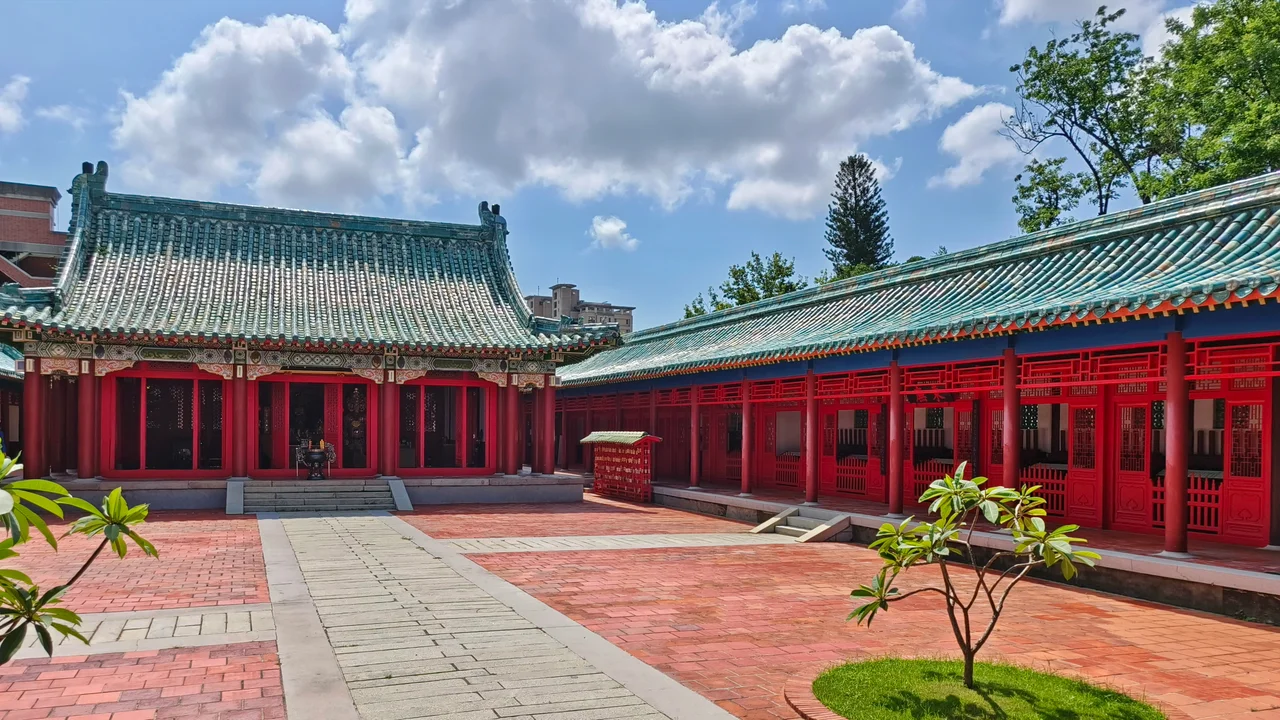
Koxinga Shrine
For nearly two centuries, the people of Tainan worshipped Koxinga in secret. After the Qing dynasty took control of Taiwan in the 1680s, they banned veneration of the man who had driven out the Dutch and established the first Chinese government on the island. His grave was dug up and moved to Fujian in 1699. His temples were shuttered. But the Taiwanese simply renamed him "Prince Zhu" and kept the incense burning. The shrine that stands today on the site of the original 17th-century temple is the product of that stubborn devotion, a place where political identity and religious practice have been entangled for over 350 years.
The Rebel Who Became a God
Koxinga, born Zheng Chenggong in 1624, was the son of a Chinese pirate-turned-admiral and a Japanese mother. A Ming dynasty loyalist, he waged war against the Qing conquest of China and, when that effort stalled, turned his attention to Formosa. In 1661, he besieged Fort Zeelandia with 25,000 troops and 400 warships, forcing the Dutch to surrender after nine months. He established the Kingdom of Tungning, the first Chinese-ruled government on Taiwan. He died the following year at just 37, but his brief reign transformed the island's political trajectory. In death, Koxinga became something larger than a military commander. To the Taiwanese, he represented resistance to foreign domination, and the shrine built in his memory encoded that defiance in wood and stone.
Three Flags, One Temple
Historical records indicate the original temple was built in the 17th century as a Chinese-style ancestral shrine, though some scholars suggest it may have originally honored Wang Ye or other folk heroes. Under the Qing, it survived only through disguise. Then came the Japanese. In 1897, the colonial government converted the shrine into a Shinto worship site and renamed it Kaizan Shrine. The Japanese saw an opportunity: by claiming Koxinga, who had a Japanese mother, as partly their own, they could weaken his association with Chinese identity and legitimize their rule over Taiwan. The conversion was part of a broader assimilation campaign designed to separate Taiwan culturally from mainland China. Yet the Taiwanization of Kaizan Jinja proved difficult to suppress. During festivals, local-style theater and martial arts performances persisted alongside Shinto rituals. Film footage from the 1930s shows a blend of Japanese and Taiwanese customs that neither side fully controlled.
Restoration and Remembrance
After Japan's defeat in 1945 and the Republic of China's assumption of control over Taiwan, the shrine was restored to its Chinese architectural form. In 1961, a major renovation expanded it to a larger scale. Chiang Kai-shek himself visited, recognizing the political value of a site that honored anti-foreign resistance. Today the shrine sits quietly among Tainan's narrow streets, its traditional roofline and courtyard a study in Southern Min architectural style. Every July 14, Koxinga's birthday, a festival draws worshippers who light incense and make offerings to a man who has been, at various turns, a pirate's son, a Ming general, a banned deity, a Shinto spirit, and a national hero. The shrine's persistence through all those identities says something about the particular tenacity of Tainan, a city that has outlasted every power that tried to remake it.
From the Air
Koxinga Shrine is located at 22.9878N, 120.2075E in the West Central District of Tainan, Taiwan. The traditional Chinese temple complex with its distinctive curved roofline is visible in the dense urban fabric of Tainan's old city center. Tainan Airport (RCNN) lies approximately 5nm to the south. Best appreciated from lower altitudes where the courtyard and architectural details become visible against the surrounding neighborhood.
Nearby Stories
- Chung Li-ho Museum 0.7 km away
- Jingzaijiao Tile-paved Salt Fields 8 km away
- Wanchin Basilica of the Immaculate Conception 9.3 km away
- Namasia District 16 km away
- Battle of Penghu 21 km away
- Shoushan (Kaohsiung) 21 km away
- Penghu Air Raids 62 km away
- Daya Bay 512 km away