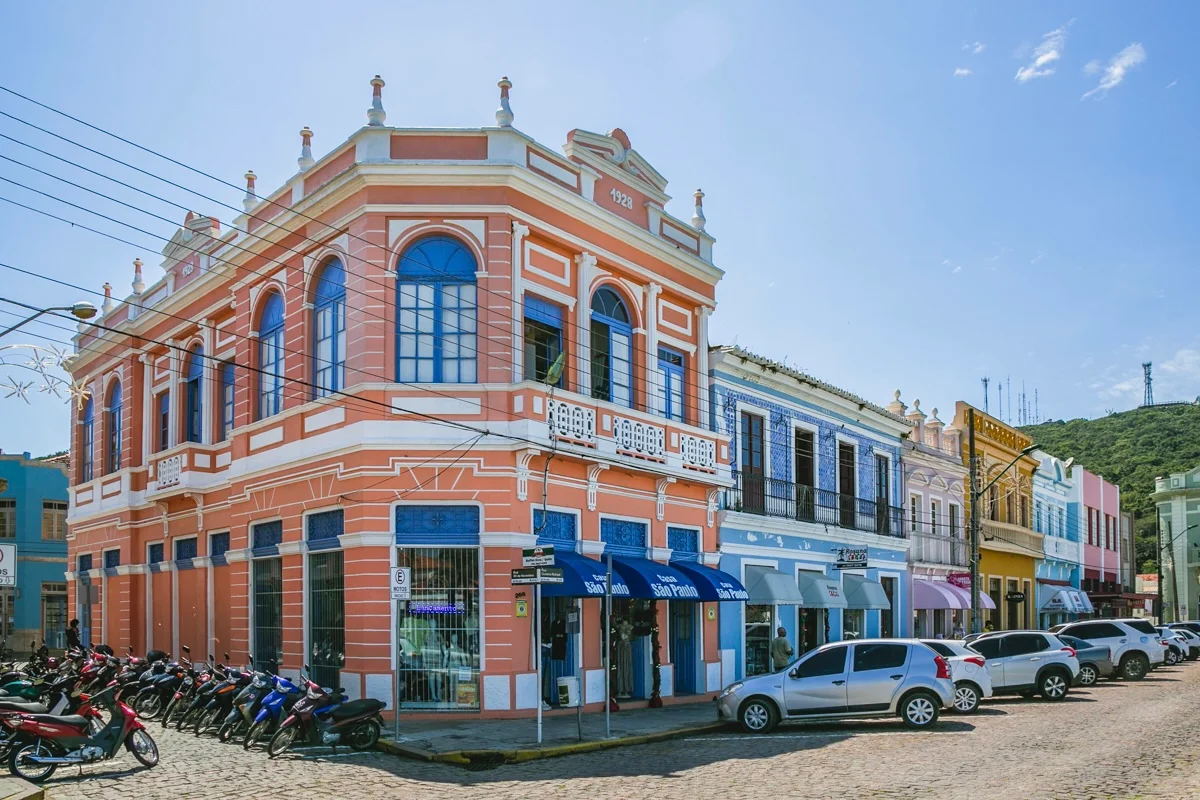

Laguna, Santa Catarina
On a beach here, a wild dolphin will roll on its side and a fisherman will read it as a signal. He casts his net into the shallows, the dolphin herds the fish into the trap, and both walk away fed. No one trained the animals to do this. The arrangement has held since at least 1847, passed down dolphin to dolphin and fisherman to fisherman, on a stretch of coast that has been quietly remarkable for far longer than that. Laguna, on the southern shore of Santa Catarina, is a town of old churches and saltwater history where a heroine was born, a republic flickered into being, and people and dolphins still keep their bargain.
Three Centuries by the Sea
Laguna was founded in 1676 by settlers out of the Captaincy of São Vicente, making it one of the older European footholds on this coast. It earned recognition as a municipality in 1714 and the formal status of city in 1847, accumulating the layered architecture of a long-lived port: colonial houses, a working lighthouse, the bones of an Azorean fishing town. The Azoreans, Portuguese islanders who crossed the Atlantic to settle the southern Brazilian shore, left their dialect, their saints' festivals, and their fishing trades stamped on the place. The sea has always set the rhythm here, and from these same beaches, in winter and spring, southern right whales can still be seen offshore with their calves.
The Capital That Lasted Months
For a brief, charged moment in 1839, this small port was the capital of a country. During the Ragamuffin War, the long rebellion that gripped southern Brazil, revolutionaries pushed north from Rio Grande do Sul and proclaimed the Juliana Republic, declaring Laguna its seat. The new republic was tiny and short-lived, swept aside within the year as imperial forces retook the coast in the campaigns remembered as the capture and recapture of Laguna. The town's flag, a tricolor of yellow, white, and green around a central coat of arms, still nods to that fierce, fleeting independence, when a fishing port briefly imagined itself the heart of a nation.
The Woman Called the Heroine of Two Worlds
It was here, amid that revolution, that Laguna gave history one of its most striking figures. Ana Maria de Jesus Ribeiro was born on August 30, 1821, in the Morrinhos district of Laguna, into a family of Azorean descent. The world came to know her as Anita Garibaldi. She met the Italian revolutionary Giuseppe Garibaldi during the upheaval of 1839 and rode beside him into battle, an expert horsewoman and a fighter who handled firearms as readily as any soldier, often while pregnant. She would carry the republican cause from Brazil to Uruguay to Italy before dying of illness at just 27, earning the name Heroine of Two Worlds. The house where she was born still stands in Laguna as a museum to her life.
Partners in the Surf
For all its history, Laguna's strangest treasure is still playing out at the waterline. The resident pod of bottlenose dolphins works the shallow water off the town in a partnership found in only a handful of places on the planet. The fishermen wade in and wait; the dolphins drive mullet toward the nets and signal the moment to cast with a sudden roll or dive. The fish that scatter from the net become the dolphins' reward. Marine scientists study the behavior as a genuine case of cooperation between wild animals and humans, a tradition older than living memory on this coast, and proof that some of the best things here were never planned, only kept.
From the Air
Laguna sits at 28.48°S, 48.78°W on the southern Santa Catarina coast at near sea level (elevation about 2 m), where coastal lagoons, beaches, and the Atlantic meet the BR-101 highway. From the air it reads as a low-lying historic port wrapped around lagoon waters, with the lighthouse, old town grid, and Mar Grosso beach as visual markers; whales may be visible offshore in winter and spring. The nearest field is Jaguaruna Regional Airport (ICAO SBJA) just down the coast to the south, with Diomício Freitas Airport near Criciúma also nearby and Florianópolis Hercílio Luz International (ICAO SBFL) about 120 km north. Expect coastal stratus, sea breezes, and reduced visibility in onshore flow. A low pass of 2,000-4,000 ft AGL frames the town against its lagoons and the open Atlantic; clear mornings offer the best light over the water.
Nearby Stories
- Criciúma 19 km away
- Morro da Igreja 32 km away
- Ilha dos Lobos 73 km away
- Hercílio Luz Bridge 80 km away
- Torres, Rio Grande do Sul 116 km away
- German Submarine U-513 129 km away
- Ilha da Queimada Grande 477 km away
- Grytviken 2983 km away