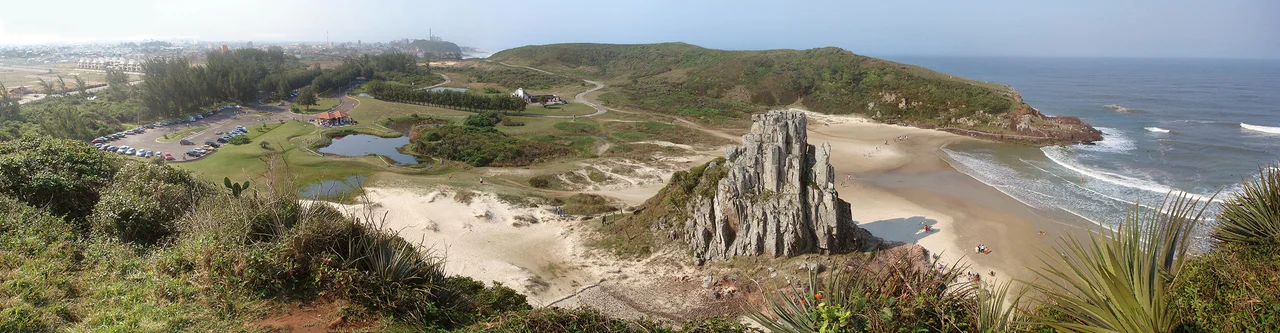

Torres, Rio Grande do Sul
The town is named for what stands at its shore. Along hundreds of kilometers of Rio Grande do Sul coastline, the beach is flat, sandy, unbroken, except at one place, where dark basalt cliffs rear up out of the surf like the ruins of a fortress. The Portuguese called them as torres, the towers, and the name stuck to the town that grew beneath them. This is the only point on the entire coast of the state where rock of volcanic origin meets the Atlantic, and that single accident of geology has shaped everything about the place.
Towers of Ancient Fire
The cliffs of Torres are far older than the town, older than the ocean in front of them. They are built of basalt, hardened lava from the immense eruptions that flooded this part of Gondwana before South America had finished tearing away from Africa, more than 130 million years ago. The rock comes in two layers, a base of rosy Botucatu sandstone, the petrified dunes of an ancient desert, capped by black basalt of the Serra Geral Formation. At Guarita Park, three great headlands stand in a row above the most beautiful beach in town, the Morro do Farol with its lighthouse, the Morro das Furnas, and the Morro da Guarita. Here the Serra Geral highlands, the same range that holds the great canyons inland, make their final stand right at the water's edge.
A Coast of Many Edges
Torres sits in a seam where three worlds meet, the mountains, the coast, and the pampas grasslands. The collision packs an unusual variety of landscapes into a small area: dunes, beaches, rocky shores, wetlands, lagoons, fields, forest, and the sandy coastal scrub the Brazilians call restinga. Many tropical plant species reach their southern limit here; others, suited to the cooler highlands and pampas, reach their northern limit. The coastline is a migratory highway for more than sixty bird species, and dolphins, whales, and sea turtles pass offshore. Just out to sea lies Ilha dos Lobos, the region's one well-guarded marine refuge, a low rock where sea lions rest in winter. The town swells and empties with the calendar. Fewer than forty thousand people live here year-round, but in the December-to-February summer the population is said to climb by hundreds of thousands as vacationers pour in from across the south, and the quiet coastal grid becomes one of the busiest beach resorts in Rio Grande do Sul.
The Oldest Stone in Town
Torres is among the oldest settlements in Rio Grande do Sul, and for most of its history its buildings were humble, mud and branch huts roofed with straw and palm. One structure outlasted the rest. The São Domingos Church, raised between 1819 and 1824, was the first church built along the whole coast between Laguna and Osório, and the town grew up around it. Heritage officials consider it the very starting point of the city. It has not had an easy life: part of a side wall collapsed in 2010, and a restoration that ran to 2017 stripped away much of the original interior. Even diminished, it remains the seed from which Torres grew.
When the Sky Fills With Balloons
Each autumn the cliffs share the skyline with something gentler. The Festival Internacional de Balonismo, born in 1989 out of a local agricultural fair, has grown into the most important hot-air balloon gathering in South America, drawing scores of balloons and crowds in the hundreds of thousands to the coast in early May. The favorable sea winds that lift the balloons are the same ones that draw paragliders and ultralight pilots, and Brazil's Chamber of Deputies has honored the town with the title National Capital of Ballooning. For a few mornings a year, the brightly colored envelopes drift above the dark towers and the wide beach, an improbable, joyful sight against the oldest rock on the coast.
From the Air
Torres lies at roughly 29.34°S, 49.73°W, at the mouth of the Mampituba River marking the Rio Grande do Sul / Santa Catarina border. Its unmistakable landmark from the air is the line of basalt sea cliffs, the only such formation on the state's coast, with the lighthouse-topped Morro do Farol and the headlands of Guarita Park standing right at the shoreline; the small island of Ilha dos Lobos lies just offshore to the south. Each May the Festival Internacional de Balonismo fills the local airspace with hot-air balloons, so expect heavy low-altitude balloon and light-sport traffic in early autumn and coordinate accordingly. Nearest major airports are Porto Alegre / Salgado Filho (SBPA) to the south and Florianópolis / Hercílio Luz (SBFL) up the Santa Catarina coast to the northeast. The town has no airport of its own. Coastal winds are generally favorable but can be gusty along the cliffs.
Nearby Stories
- Criciúma 52 km away
- Canela, Rio Grande do Sul 54 km away
- Laguna, Santa Catarina 72 km away
- São Leopoldo 88 km away
- Serra Gaúcha 95 km away
- Juliana Republic 99 km away
- Killing of João Alberto Silveira Freitas 148 km away
- Battle of the River Plate 497 km away