.jpg)
Killing of João Alberto Silveira Freitas
His friends called him Beto. João Alberto Silveira Freitas was forty years old, a father of four, born in 1980 in the town of Humaitá, the second son of a driver named João Batista. The people who knew him remembered a friendly man, a happy one, a fan of the São José football club. On the night of November 19, 2020, he walked into a Carrefour supermarket in the Passo d'Areia neighborhood of Porto Alegre, on the city's north side. He did not walk out. Two security guards pinned him to the ground and pressed their weight onto his back until he could no longer breathe. It was the day before Black Consciousness Day, the date Brazil sets aside to honor Black resistance and life.
Who He Was
Before he was a name on protest banners, Beto Freitas was a person with an ordinary, complicated life. He had married twice and raised four children. He worked as a service provider. Locals in his part of the city described him as warm and good-humored, the kind of man people were glad to see. When he was buried on November 21 at the São João Municipal Cemetery, his coffin was wrapped in the flag of Esporte Clube São José, the North Zone club he had loved. Mourners met the casket with applause and with a single demand repeated over and over: justice. It is worth holding onto this picture, because what the cameras recorded that night threatened to reduce a whole life to its final four minutes.
Four Minutes
The investigation later established that Freitas had committed no crime that night. An altercation began, and two security guards employed through a contractor named Vector took him to the floor near the exit. One of the guards, twenty-four-year-old Giovane Gaspar da Silva, was a temporary military police officer who lacked the license required for private security work; the other, Magno Braz Borges, was thirty. Witnesses said Freitas asked for help and begged the men to let him breathe. They did not. They held him down with crushing weight on his back, the same method by which Derek Chauvin had killed George Floyd in Minneapolis only six months before. A delivery worker filmed it, and later said the guards tried to make him delete the footage and threatened him. People nearby shouted that the men were killing him. The guards kept others away until Freitas stopped moving.
A Country Forced to Look
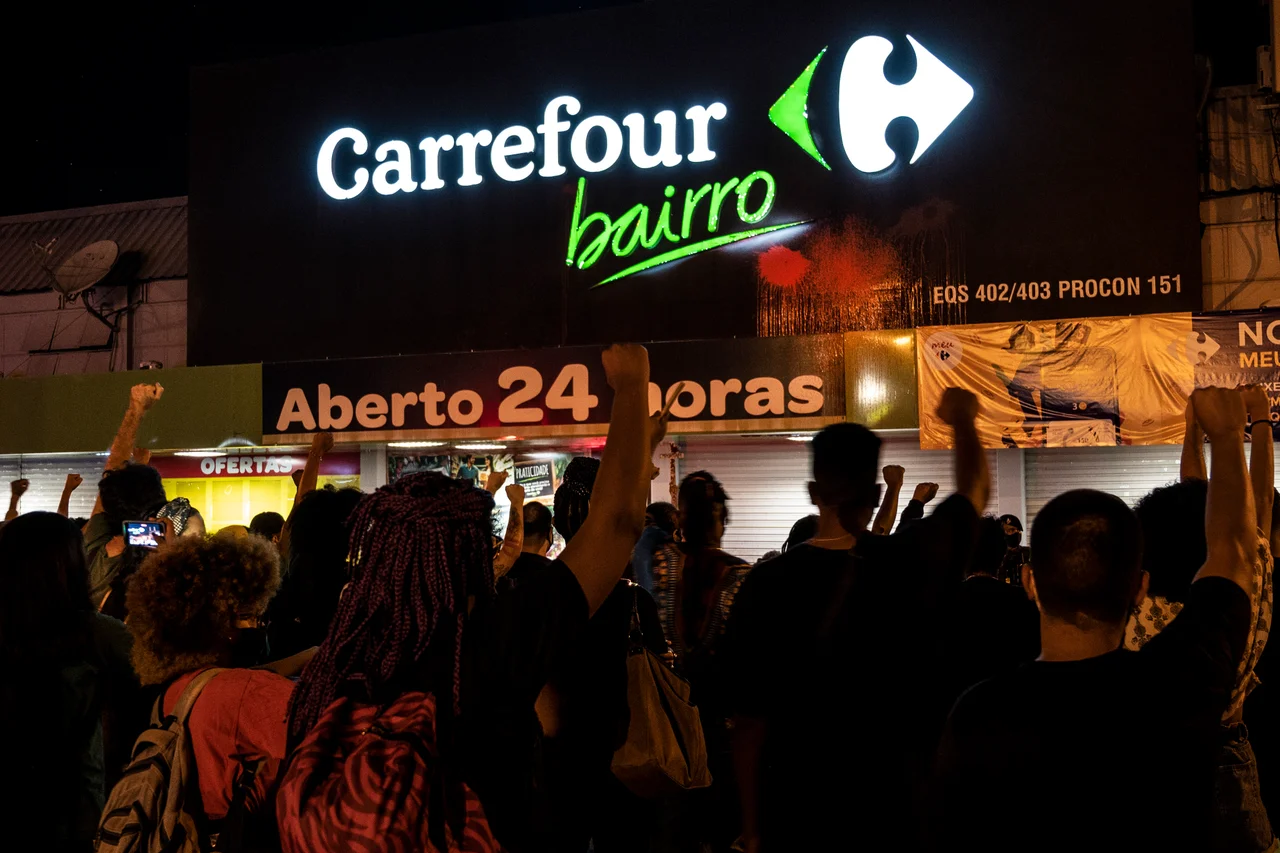
The next morning, Black Consciousness Day, Brazil erupted. In Porto Alegre some 2,500 people gathered outside the very store where Freitas died. Demonstrations spread to São Paulo, Rio de Janeiro, Belo Horizonte, Recife, Salvador, Manaus, and beyond, with the words Black Lives Matter and Stop Killing Us painted on avenues and held up outside Carrefour branches across the country. Artists and athletes joined in; the Formula 1 driver Lewis Hamilton posted an image from the Porto Alegre protest with the caption another black life lost. The United Nations said the killing exposed the dimensions of racism woven into Brazilian society. The reaction was so vast because the grief was not only for one man. It was for a pattern that Black Brazilians had long known and that the country had long preferred not to name.
The Argument Over a Word
Even in death, Freitas became the center of a national argument about whether his country was racist at all. President Jair Bolsonaro offered no condolences and, at a G20 meeting the day after the killing, insisted that racism did not exist in Brazil, while his vice president called the guards merely unprepared. Against them stood justices of the Supreme Federal Court, the presidents of both houses of Congress, and human rights groups, all pointing to the structural racism the case laid bare. The contradiction ran through the legal process too. Police investigators wrote of structural racism in their analysis of the crime, yet none of those charged were accused of the crime of racism itself. Six people were indicted and made to stand trial for aggravated homicide. The word the protesters chanted in the streets never made it onto the formal charge sheet.
What Reparation Cannot Buy
In June 2021, Carrefour reached an agreement worth 115 million reais and, in exchange, was shielded from further lawsuits. The Black Coalition for Rights rejected the framing in plain terms. The reparation of a social trauma, the coalition said, would not come from a financial payment offered in exchange for Black lives, and it objected that other organizations of the Black movement had been left out of the negotiation. Their point was the one Freitas's death had carried into the streets of a dozen cities. A man named Beto, a father of four who liked his football club and was kind to his neighbors, had been killed on the floor of a supermarket, and no settlement could buy back what was taken, nor close the question his death had pried open about who is allowed to live safely in Brazil.
From the Air
The Carrefour store where João Alberto Freitas was killed stands in the Passo d'Areia neighborhood in the north zone of Porto Alegre, near 30.0128 degrees south, 51.1705 degrees west, a few miles inland from Lake Guaíba and well north of the city's historic center. From the air the area reads as dense urban grid and commercial blocks rather than a single landmark; it lies between the centro to the south and the airport district to the north. The nearest field is Salgado Filho International Airport (ICAO SBPA), roughly two to three nautical miles to the north-northeast, with Canoas Air Base (SBCO) a short distance beyond. Because the site sits close to the SBPA approach and departure corridors, this is a location to read about from altitude rather than to seek out as a point of interest; recommended general overview altitude for the north zone is 2,000 to 3,000 feet AGL where permitted. The silver sheet of the Guaíba to the southwest remains the city's primary visual reference.
Nearby Stories
- Itapuã State Park 22 km away
- Nova Petrópolis 37 km away
- Aparados da Serra National Park 77 km away
- Santa Cruz do Sul 77 km away
- Serra Geral National Park 111 km away
- 2009 Brasil de Pelotas Bus Disaster 161 km away
- Passo Fundo 176 km away
- Battle of the River Plate 446 km away