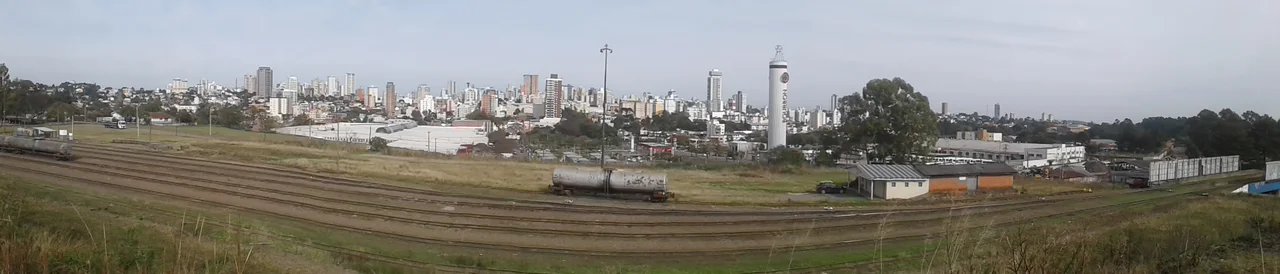

Passo Fundo
It is a strange honor for a city that began as a place to ford a river. Passo Fundo - the name means deep ford - grew up where eighteenth-century muleteers crossed a shallow stream on their long drives between the southern grasslands and São Paulo. Two and a half centuries later, that crossing town carries a title no other city in Brazil holds: National Capital of Literature, granted not by reputation but by federal law. On the median of its main avenue, tunnels of steel frame literary quotations that change every two weeks. In Passo Fundo, books are not just read. They are built into the streets.
Born at a River Crossing
Before the town, there was the passo - the ford. The old road from the coast wound painfully through Viamão and Santo Antônio da Patrulha on its way north, so drovers cut a straighter line across the open pampas, into countryside still largely empty of settlers. Where the shallow stream let mule trains cross on foot, a cluster of houses gathered beside the road. The name of the ford spread to the river, then to the settlement itself. The land had older inhabitants - the Kaingang people, whom the colonizers called Coroados, who lived by hunting and gathering honey and fruit and growing corn and beans. The municipality was formally emancipated by provincial law in January 1857 and established that August, on a plateau that its territory once spanned across more than a hundred future towns.
The City That Made Itself a Library
The literary title was earned, not gifted. It began in 1981, when the University of Passo Fundo and the city created the Jornada Nacional de Literatura, a biennial gathering of writers and readers that swelled into one of the largest literary events in Latin America - a single edition drew more than 27,000 people. That decades-long commitment was crowned on January 2, 2006, when federal Law 11.264 made Passo Fundo the only Brazilian city named National Capital of Literature by act of Congress. The city wears the title in public. Literature tunnels line the central avenue, a monument called the Tree of Letters rises in a plaza, and four separate squares across town are given over to the written word.
Land of Good Folk, and the Gaúcho Soul
Locals call their home A Terra de Gente Boa - the land of good people - and Passo Fundo wears its gaúcho identity as plainly as any city in Rio Grande do Sul. It is not unusual to see riders walking the streets in full pilcha, the traditional dress of the southern cattle country. That spirit found its anthem through Teixeirinha, the folk singer born in nearby Rolante who adopted Passo Fundo as his own. His 1960 song Gaúcho de Passo Fundo became a hit across Brazil and put the city on the national map; he wrote two more odes to it and, in 1978, starred in a film bearing its name. A city of literature, it turns out, is also a city that loves a good song.
A Plateau City of Cold Mornings and Many Names
Passo Fundo sits near the 28th parallel south at 690 meters, high enough that winter brings frost, freezing nights, and the occasional snowfall - a rarity in a country most of the world pictures as tropical. With roughly 204,000 people, it is the tenth-largest city in the state and the third-largest medical center in southern Brazil, a regional hub for the farm country of wheat, soybeans, and corn around it. Its roll of native sons and daughters is long and varied: the World Cup-winning football coach Luiz Felipe Scolari, the supermodel Letícia Birkheuer, and the volleyball-playing Endres brothers all come from here. The city even earned a strange cameo in Hollywood, named in M. Night Shyamalan's 2002 thriller Signs as the source of a home video that captured an alien.
From the Air
Passo Fundo lies at 28.26°S, 52.41°W, on the high plateau of northern Rio Grande do Sul at an elevation near 690 meters. The city has its own field, Lauro Kurtz Airport (ICAO: SBPF), on the BR-285 in the São José district, with regional connections toward Porto Alegre and the São Paulo metro area. For travelers, the nearest large hub is Salgado Filho International (ICAO: SBPA) in Porto Alegre, about 280 km to the south. From the air the city stands out as an urban island amid the vast geometric patchwork of wheat and soybean fields that blanket the plateau, with highways radiating outward like spokes. A viewing altitude of 4,000 to 6,000 feet captures the town within its sea of farmland. Expect crisp, clear air on winter mornings - and the genuine possibility of frost on the ground below.
Nearby Stories
- Antônio Prado historic center 84 km away
- Santo Ângelo 116 km away
- Serra Gaúcha 116 km away
- Bento Gonçalves, Rio Grande do Sul 127 km away
- Ruins of São Miguel das Missões 144 km away
- Battle of Mbororé: The Day the Guaraní Turned the Tide 182 km away
- Jesuit Missions Among the Guaraní: Utopia, Refuge, and Ruin 303 km away
- Blumenau 314 km away