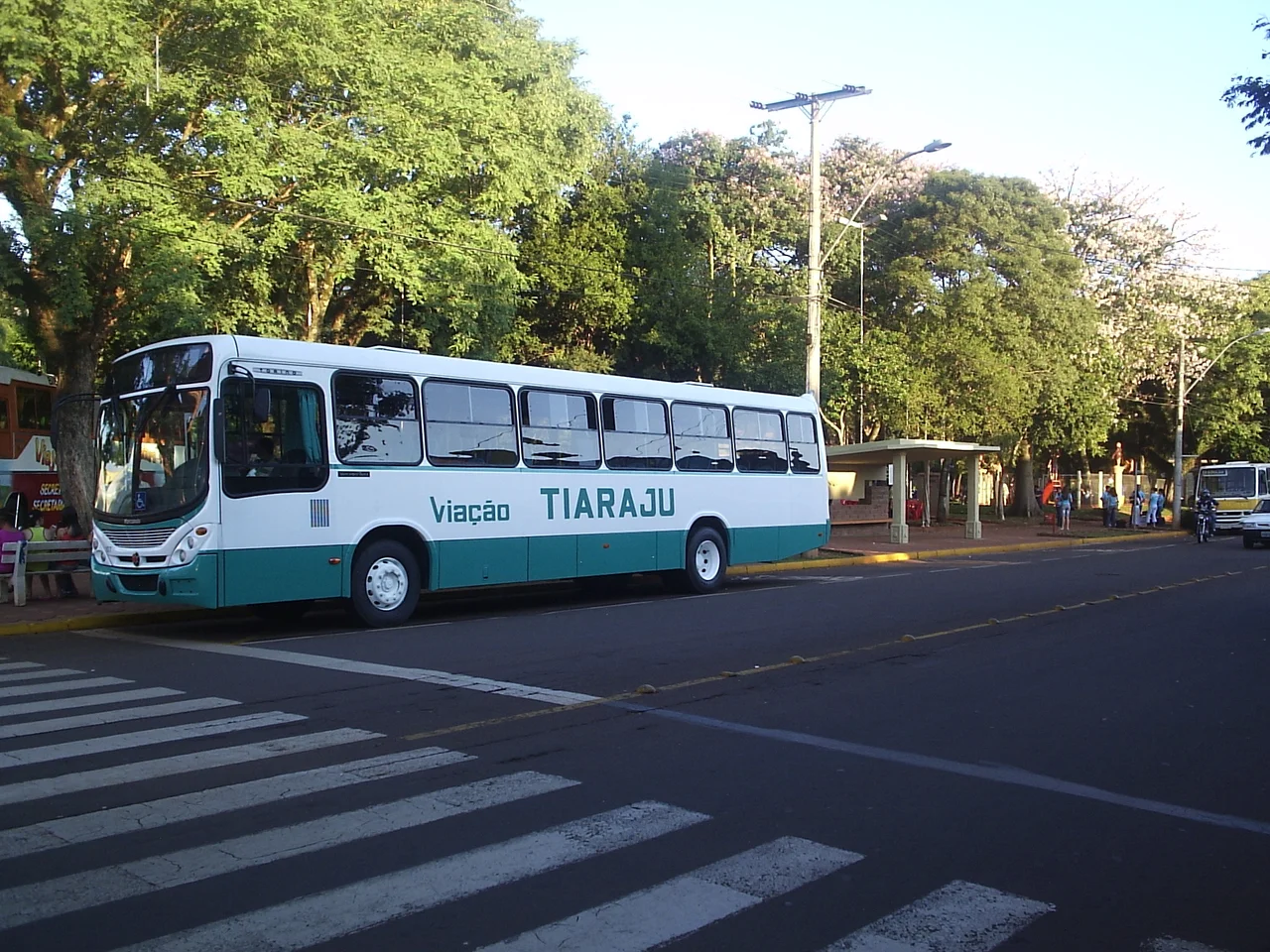

Santo Ângelo
The airport that serves this city of roughly 78,000 people is named for a man who died fighting to keep the land it sits on out of foreign hands. Sepé Tiaraju was the Guaraní leader of the resistance that ended in 1756, and Santo Ângelo, in northwestern Rio Grande do Sul, has not forgotten him. The city grew directly out of the last of the seven Jesuit-Guaraní missions, and that origin still shapes its skyline, its institutions, and its sense of itself.
The Seventh Town
Santo Ângelo Custódio was the last of the Sete Povos das Missões to be established. In 1706 the Belgian Jesuit Diogo de Haze founded the reduction, first near the fork of the Ijuí and Ijuizinho rivers, then in 1707 moving it to the ground that became the city's historic center. Like its six sister towns, it was a Guaraní settlement organized around a great stone church, built by Indigenous labor under priests pursuing a vision of self-sufficient Christian communities at the edge of two empires. The reductions belonged to a contested borderland the Spanish called Misiones Orientales, a frontier where the claims of Spain, Portugal, and the Guaraní themselves collided through the seventeenth and eighteenth centuries.
A General Born on the Frontier
On 25 October 1789, while the missions still echoed in living memory, a child was born here who would help redraw a continent. Carlos María de Alvear came into the world at Santo Ângelo Custódio because his father, the Spanish naval officer Diego de Alvear, was stationed in the region as a commissioner on the very boundary-demarcation expedition meant to settle who owned this land. The boy grew up to become a soldier and statesman of the Río de la Plata, briefly serving as Supreme Director of the United Provinces in 1815 and later commanding troops in the wars that birthed independent Argentina. That a figure of his stature began life in this remote missions town says something about how tangled the frontier's history truly was.
Cathedral and Campus
The missions left their deepest mark on the city's center, where the Angelopolitan Cathedral - the Cathedral of the Guardian Angel - rises as the seat of the Roman Catholic Diocese of Santo Ângelo. Its presence is no accident in a place born from a mission named for a guardian angel. Visitors come above all for that Jesuit inheritance, and many continue a short distance to São Miguel das Missões, where the most spectacular of the seven ruins still stands; those warm sandstone walls were named a UNESCO World Heritage Site in 1984, alongside related mission ruins across the border in Argentina that had been inscribed a year earlier. But Santo Ângelo is no museum piece. It hosts four institutions of higher education, from the regional university URI to the federal institute IFFar, giving the old missions town a young, studying population alongside its history. The city also produced José Goldemberg, born here in 1928, who became one of Brazil's foremost physicists and energy thinkers and helped steer the country's role at the 1992 Earth Summit in Rio.
Soy, Cattle, and the Long Plain
Beyond the city, the land that the Guaraní once farmed now feeds a modern agricultural economy. Soy, corn, and wheat roll across the fields, alongside swine, sheep, and cattle, the staples of Rio Grande do Sul's deep interior. The old railway station downtown carries its own twentieth-century chapter: Luís Carlos Prestes helped plan the legendary Coluna Prestes, the long rebel march across Brazil in the 1920s, from connections to this region, and the station building today guards historical materials of its own. Santo Ângelo lies 443 kilometers from the state capital of Porto Alegre, far enough into the interior to feel like its own world, anchored by a faith and a history that arrived more than three centuries ago.
From the Air
Santo Ângelo lies at 28.30°S, 54.26°W on the high plains of northwestern Rio Grande do Sul, 443 km northwest of Porto Alegre. The city is served directly by Sepé Tiaraju Airport (ICAO SBNM, IATA GEL), named for the Guaraní leader of the 1750s resistance; it offers regional connections and even direct flights toward São Paulo. From the air the surrounding country is a vast patchwork of soy, corn, and wheat, with the cathedral and dense urban grid standing out against the open fields. The spectacular ruins of São Miguel das Missões sit a short hop to the south. The major international gateway is Porto Alegre's Salgado Filho International (ICAO SBPA). Dry winter conditions give the clearest views across the plains.
Nearby Stories
- Ruins of São Miguel das Missões 25 km away
- Battle of Mbororé: The Day the Guaraní Turned the Tide 26 km away
- João Goulart's House 115 km away
- São Borja 124 km away
- Passo Fundo 136 km away
- Jesuit Missions Among the Guaraní: Utopia, Refuge, and Ruin 143 km away
- Santa Cruz do Sul 191 km away
- Blumenau 480 km away