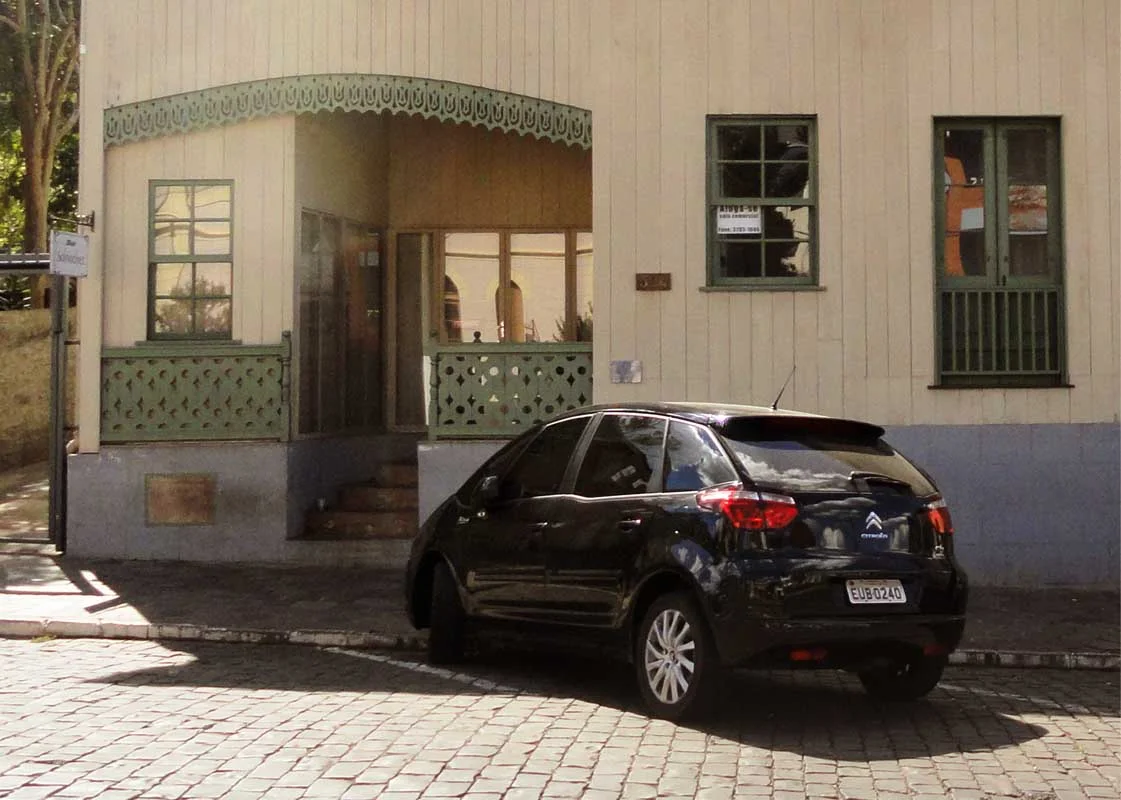

Antônio Prado historic center
Ask a child in Antonio Prado to draw an ideal city, and the city they draw is Antonio Prado. A schoolteacher tried the experiment over two years, and the results were unanimous: timber houses with carved fretwork, the square, the church - the very buildings that an earlier generation had been ashamed of. One child added a wish list to the drawing: a shopping center, intercoms, and listed heritage houses, all together. That a town of roughly six thousand people in the Serra Gaucha could turn its old colonial core into the thing its children most want to keep is a small miracle. It is also, paradoxically, the gift of a road that passed it by.
The Last Colony
The land that became Antonio Prado was opened in 1880, when Polish, Russian, and Swedish immigrants cut a road through virgin forest on their way toward the Upper Uruguay region. That same year a Sao Paulo native named Simao David de Oliveira settled where the Leao River meets the Tigre Stream and built a great wooden shed at a crossing that took his name, Passo do Simao. The colony itself was founded by a project dated May 14, 1886, and it drew some two thousand Italian immigrants into terrain that was rugged, forested, and largely unhelped by the government that had invited them. They were poor. They were on their own. Within a generation they had built a thriving trade center, and in 1899 the colony won its emancipation under State President Borges de Medeiros.
Saved by Being Forgotten
Then a highway changed everything by ignoring the town. In the 1930s the BR-116 - the great artery linking Rio Grande do Sul to the rest of Brazil - was routed past Antonio Prado rather than through it. Cut off from the new flow of commerce, the town slid into decline and stagnation. Storefronts kept their old facades because no one could afford to replace them; timber houses aged in place because there was no boom to tear them down. What looked like misfortune was quietly performing an act of preservation. While Caxias do Sul demolished its colonial core in the rush of progress, Antonio Prado kept its early buildings almost by default - because the future had taken a different exit.
The Architecture of Araucaria
These houses tell a specific story in wood. Most were raised from araucaria, the native pine of southern Brazil prized for its strong, fine timber, in what historian Julio Posenato called the peak phase of Italian colonial architecture. The builders skipped the diagonal braces of older framing, exploiting cheap industrialized nails so that the floor and wall planks themselves locked the structure rigid. Freed by better carpentry, they built spacious houses two and three stories tall and crowned them with eaves, balustrades, balconies, walkways, and lacy fretwork. The effect is at once austere and exuberant. What sets these buildings apart in the Brazilian landscape is not imitation of some Italian village left behind, but invention - regional materials bent to creative solutions, becoming symbols of work, identity, and self-sufficiency.
Forty-Eight Buildings and a Living Tongue
Recognition came in the 1980s, and not without a fight. A working group led by researcher Ana Meira surveyed some thirty German and Italian immigration nuclei across the state and judged Antonio Prado's the largest and best preserved. When the owner of Neni's House - a goldsmith's home from 1910, famous for its fretwork - requested protection, it set off a wave. In 1987 IPHAN, the national heritage institute, listed 48 buildings in the central area, over the objections of residents who feared the rules would cost them. The persuasion took years of patient heritage education. The intangible heritage runs just as deep: Antonio Prado remains one of Brazil's great strongholds of Talian, the northern-Italian dialect spoken here since 1875 and recognized in 2014 as a national cultural reference. Among residents over thirty, roughly nine in ten still speak it.
From the Air
Antonio Prado's historic center lies at about 28.86 degrees south, 51.28 degrees west, at roughly 650 meters elevation in the northern Serra Gaucha. From the air, look for the compact town set in rugged, forested highland terrain north of Caxias do Sul, organized around a rectangular central square with the Sacred Heart church and City Hall. The nearest airport is Hugo Cantergiani Regional Airport at Caxias do Sul (ICAO: SBCX, IATA: CXJ), about 35 km south; Salgado Filho International at Porto Alegre (ICAO: SBPA, IATA: POA) is the major hub, roughly 130 km away. The dissected highland landscape and frequent low cloud reward clear-weather flying.
Nearby Stories
- Nova Petrópolis 22 km away
- Cambará do Sul 49 km away
- Aparados da Serra National Park 51 km away
- Passo Fundo 83 km away
- Santa Cruz do Sul 94 km away
- Serra do Rio do Rastro 109 km away
- São Joaquim National Park 168 km away
- Paleontological Sites of Santa Maria 223 km away