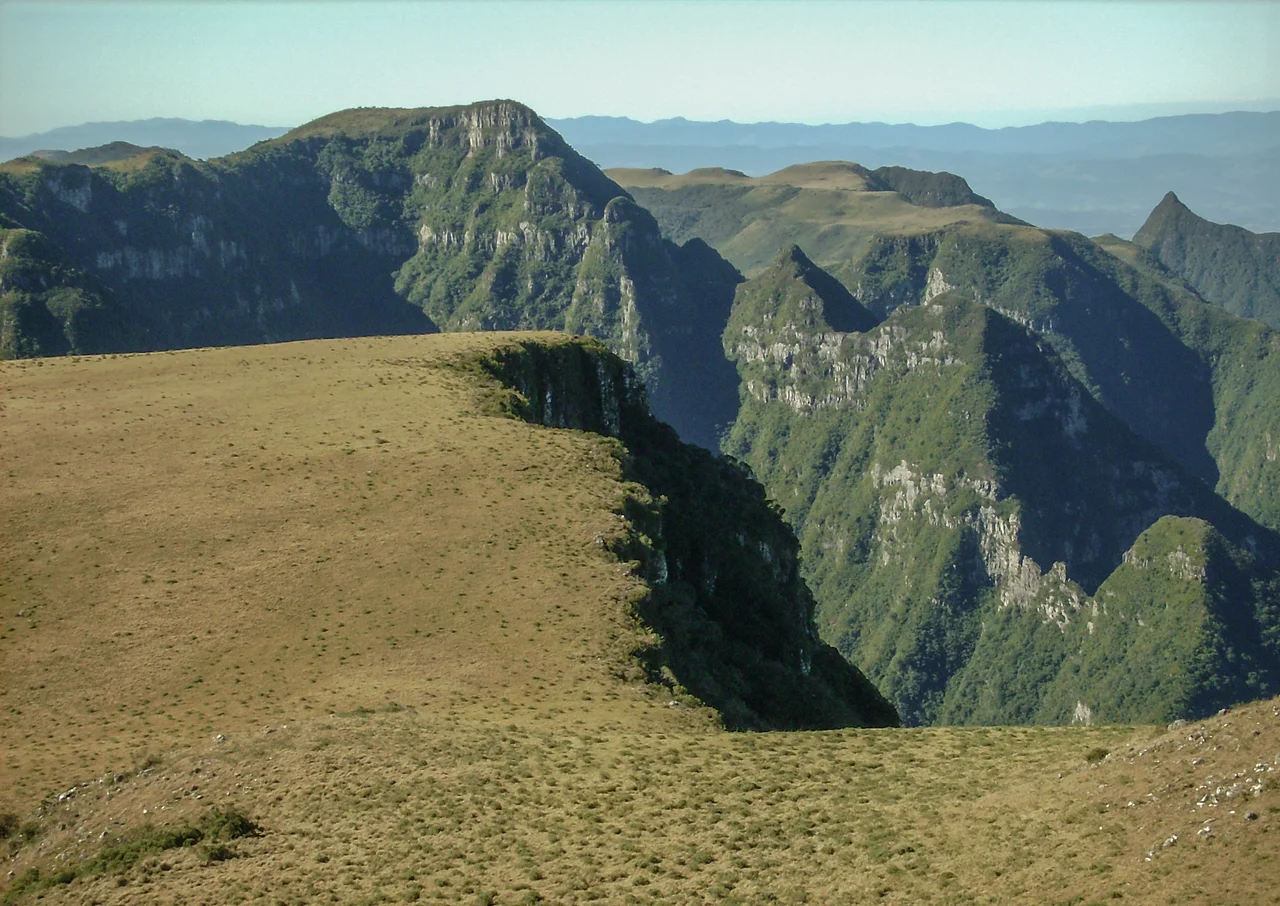

São Joaquim National Park
Snow in Brazil sounds like a contradiction, but it falls here most winters. São Joaquim National Park spreads across the highest country in Santa Catarina, a rumpled landscape of canyons, cloud forest, and open alpine meadow where the temperature can sit at the freezing point and the morning grass comes up silver with ice. This is one of the few corners of a tropical nation where winter behaves like winter, and the park protects not only the cold but the ancient forest that thrives in it, a stand of trees that looks like nothing else on Earth.
The Candelabra Forest
The reason this park exists stands rooted across its slopes: the Paraná pine, Araucaria angustifolia, a tree shaped like a green candelabrum or an umbrella turned inside out. When São Joaquim was set aside by decree on July 6, 1961, the goal was to save exceptional remnants of these araucaria forests, which logging had stripped from much of southern Brazil. The species is now threatened, and walking beneath the survivors here, their branches splayed flat at the crown and bare along the trunk, is to stand among living relics of a forest that once blanketed the highlands. Frost rimes their needles in winter; the trees endure it, as they have for a far longer span than any logging boom.
Where the Rivers Are Born
Covering some 48,300 hectares across the municipalities of Urubici, Orleans, Grão Pará, and Bom Jardim da Serra, the park is rugged almost everywhere: deep canyons, large caves, and forested slopes folded one into the next. From this high ground the water of half a state begins its journey. The park holds the headwaters of the Canoas, Tubarão, and Pelotas rivers, the principal river basins of Santa Catarina, gathering rain and snowmelt off the plateau and sending it down toward the lowlands. To stand in São Joaquim is to stand at a source, the place where rivers that shape distant valleys are still just trickles in the alpine grass.
Life at the Edge of the Cold
The chill keeps the wildlife sparse, but what lives here is remarkable. The park shelters threatened species that have vanished elsewhere, among them the maned wolf, a tall, fox-red predator on improbably long legs that stalks the highland meadows. Pumas move through the forest, and overhead fly two rare birds: the red-spectacled amazon, a parrot tied closely to the araucaria seeds it depends on, and the Chaco eagle, a raptor of the open country. Administered by the Chico Mendes Institute for Biodiversity Conservation and ranked as an IUCN category II national park, São Joaquim guards the araucaria forest, the cloud forest, and the alpine grassland together, a layered refuge for animals that need the cold.
A Brazil Few Expect
Established initially to protect trees, the park has become a destination for people chasing an unfamiliar version of their own country. Climbers come for the alpinism on its rugged terrain; in winter, the snow season from June to August draws crowds hoping to see a tropical land turn white. The Bridal Veil cascade spills down a cliff face, freezing at its edges when the cold is deep. Adjoining the park since 1980 is the smaller Serra Furada State Park, extending the protected highland a little further. Together they preserve a paradox worth the trip: a slice of Brazil where the air bites, the rivers begin, and a forest of candelabra pines stands quietly through the frost.
From the Air
São Joaquim National Park centers near 28.18°S, 49.52°W in the Santa Catarina highlands, with terrain altitudes climbing from around 300 m up toward 1,800 m MSL near the highest peaks (Morro da Igreja, at 1,822 m, lies just to the north). The landscape is a maze of canyons and forested ridges, frequently wrapped in cloud, with frost and winter snow common at elevation. Distinctive aerial markers include the flat-crowned araucaria forests, deep escarpment canyons, and the Bridal Veil cascade. Nearest fields are Jaguaruna Regional Airport (ICAO SBJA) on the coast to the southeast and Diomício Freitas Airport near Criciúma; Florianópolis Hercílio Luz International (ICAO SBFL) lies to the northeast. Maintain generous terrain clearance and expect orographic cloud, turbulence, and possible icing in cold, moist air. Clear days after a winter front give the best views of snow-dusted highland and the candelabra canopy from a safe altitude.
Nearby Stories
- Laguna, Santa Catarina 8.5 km away
- Criciúma 23 km away
- Juliana Republic 30 km away
- Florianópolis 48 km away
- Cambará do Sul 67 km away
- Hercílio Luz Bridge 91 km away
- Serra Geral National Park 103 km away
- Vila Velha State Park 302 km away