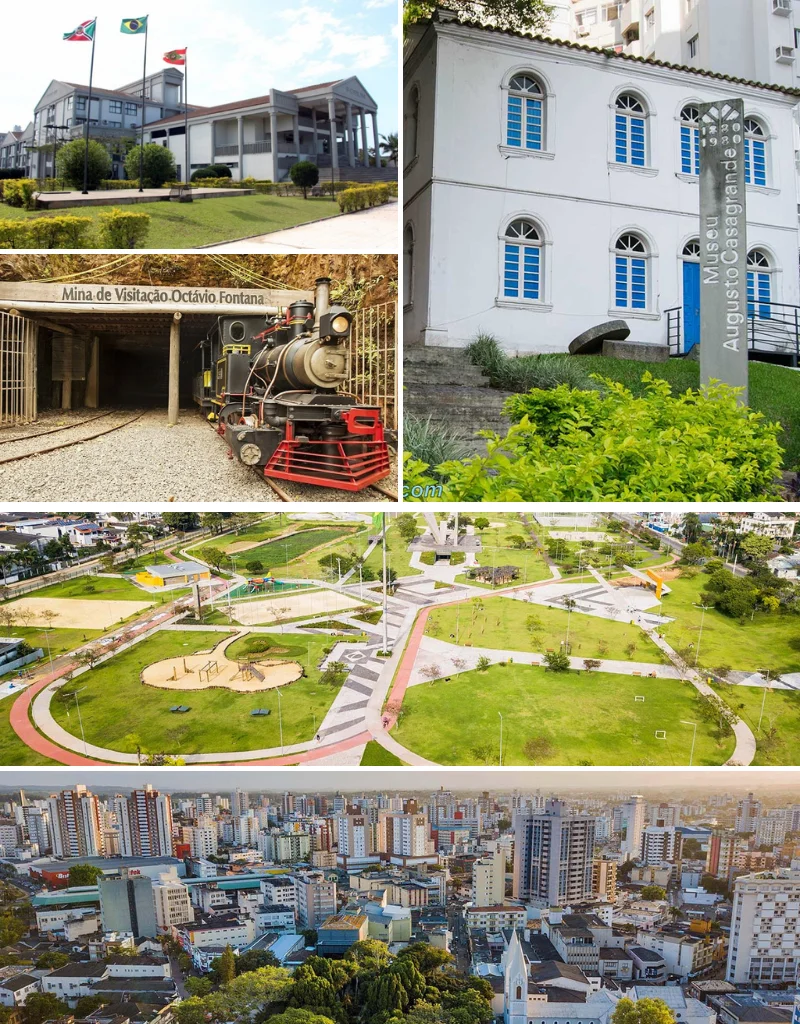

Criciúma
Look at the colors of the local football club and you read the city's biography. Black, yellow, and white: coal, the mineral riches of the earth, and the ceramic that coal helped fire. Criciúma sits about 180 kilometers south of Florianópolis, inland from the Atlantic, on a plateau where Santa Catarina's farmland meets the foothills of the highlands. Beneath it lies one of the largest coal reserves in Brazil. For more than a century, the people who came here from across the world dug into that subsoil, and the city that rose above the shafts wears their labor in its very team colors.
Many Tongues, One Town
Criciúma was founded on January 6, 1880, by Italian immigrants who cleared the forest and planted the first homesteads. They did not stay the only newcomers for long. Poles arrived, then Germans, Portuguese, and Arab families, each wave settling its own quarter, raising its own church, keeping its own kitchen. That layered arrival still defines the place. Every year the city holds a Festival of Ethnicities, descended from a parish quermesse once staged beside the Cathedral of São José, where the descendants of those first colonists trade food and music and remind one another where they came from. The surrounding towns tell the same story in miniature: Nova Veneza named for an Italian lagoon city, Içara famous for its honey, Siderópolis and Urussanga and Orleans ringing the center in a metropolitan belt of roughly 600,000 people across the wider Carboniferous region.
The Wealth Below
Coal made Criciúma, and coal nearly unmade the men who mined it. For generations, workers descended into the dark to bring up the fuel that powered Brazil's southern industry, breathing dust that no team color could romanticize. The Octávio Fontana visitation mine now lets visitors walk a stretch of that buried history, tracing how a farming colony became the self-styled Brazilian capital of coal. The seams did more than fill rail cars. The same earth that yielded coal yielded the clay and minerals for ceramic tile, and Criciúma turned itself into one of the largest centers of flooring and home-materials manufacturing in the world, second only to a handful of rivals anywhere on the planet.
Tigers and the Modern City
The mining identity hardened into civic pride on the football pitch. Criciúma Esporte Clube, the Tigre, plays in the national leagues and stunned the country by winning the Copa do Brasil in 1991, a national title carried home by a club from the coal country. Today the city of roughly 215,000 has grown past its industrial roots without erasing them. It anchors the south of Santa Catarina with hospitals, a federal institute and a clutch of universities, shopping malls, and the headquarters of Angeloni, one of Brazil's largest supermarket chains. The forge, the loom, and the kiln still run, but the city around them now sells software and schooling as readily as tile.
A Storm Out of Nowhere
In late March 2004, something arrived off the coast that the textbooks said should not exist. A tropical cyclone spun out of the South Atlantic and came ashore over this corner of Santa Catarina, a basin where such storms were essentially unknown in the modern record. It battered roofs and trees and left the region shaken, the first hurricane-strength system anyone here had reckoned with. For a city used to measuring its luck in coal and tile, the storm was a reminder that the Atlantic, only two dozen kilometers away at Rincão beach, sets terms of its own.
From the Air
Criciúma lies at 28.68°S, 49.37°W on an inland plateau roughly 24 km from the Atlantic coast, sitting near 40-50 m elevation with the Santa Catarina highlands rising to the west. The nearest field is Diomício Freitas Airport in neighboring Forquilhinha; Humberto Ghizzo Bortoluzzi Regional Airport at Jaguaruna (ICAO SBJA) serves the broader southern region just up the coast, and Florianópolis Hercílio Luz International (ICAO SBFL) lies about 180 km north. From the air, look for the dense urban grid set back from the beaches, with the mining-scarred terrain and tile factories spreading inland. Coastal stratus and afternoon convection are common; the surrounding highlands can generate rapid weather changes. A viewing altitude of 3,000-5,000 ft AGL frames the city against the rise toward the serra.
Nearby Stories
- Juliana Republic 9.9 km away
- Serra Geral National Park 16 km away
- Serra do Rio do Rastro 17 km away
- Laguna, Santa Catarina 30 km away
- Cambará do Sul 41 km away
- Ilha dos Lobos 47 km away
- Passo Fundo 244 km away
- Grytviken 2982 km away