
Nova Petrópolis
The smell gives it away before the architecture does. Streuselkuchen cooling on a windowsill, sausages and sauerkraut from a kitchen down the lane, the particular sweetness of a German bakery on a Brazilian hillside. This is Nova Petrópolis, a small town in the Serra Gaúcha highlands of Rio Grande do Sul where the half-timbered houses and the food on the table both came from somewhere far away. German immigrants founded it in the 19th century, many from Saxony and Pomerania, and more than a century and a half later their descendants have kept the place looking and tasting like the homeland their ancestors left behind.
A Piece of Saxony in the Highlands
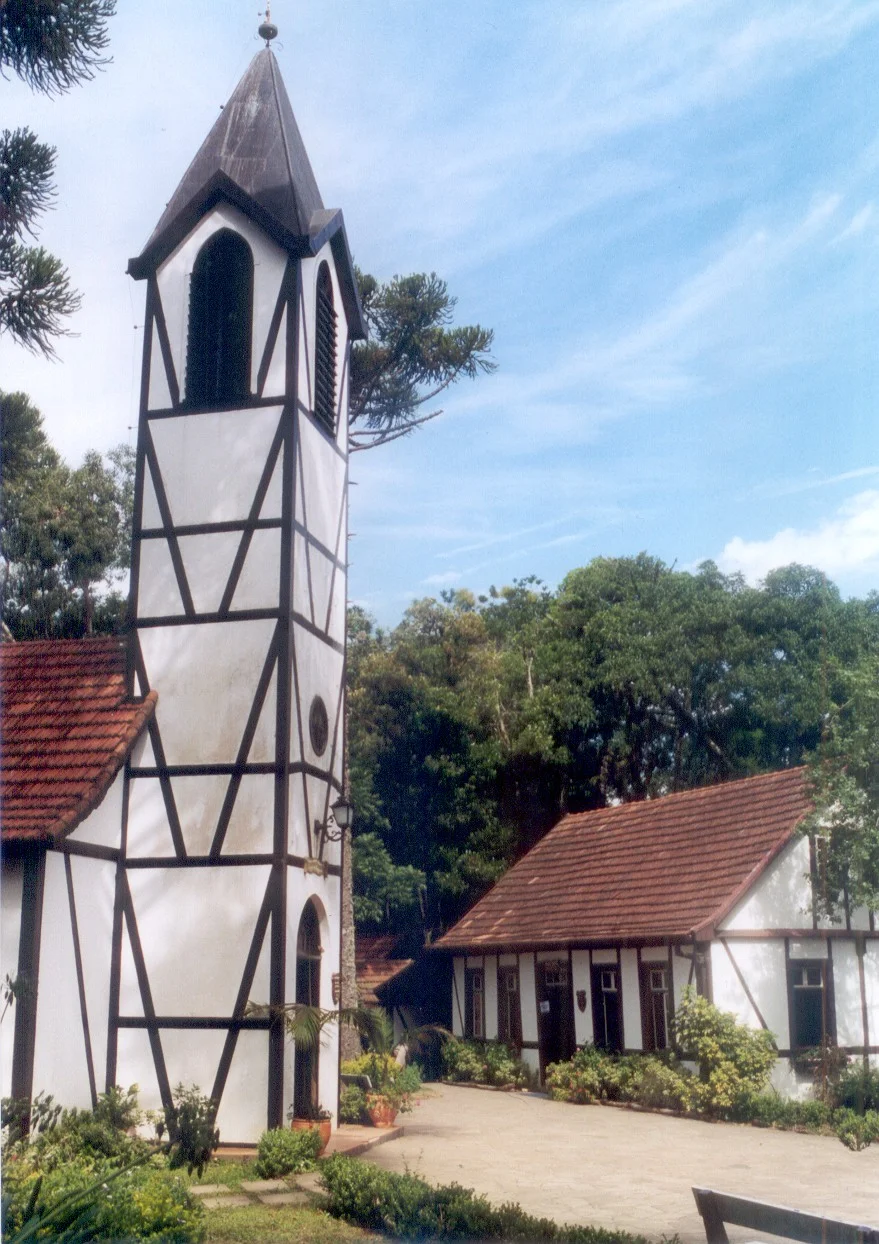
Nova Petrópolis sits roughly halfway between Caxias do Sul and Porto Alegre, on the high green country that drew European settlers in the 1800s. The immigrants who built it came mainly from Saxony and Pomerania, regions of a Germany that no longer exists in quite the same form, and they reproduced what they knew: the half-timbered enxaimel houses with their exposed wooden frames, the cooking, the tidy plazas. The result is a town that feels transplanted rather than merely influenced. Brazilians know the broader area as the Região das Hortênsias, the Hydrangea Region, and Nova Petrópolis earned its own nickname as the Jardim da Serra Gaúcha, the garden of the highlands. In spring the hydrangeas line the roadsides in drifts of blue.
The Village That Remembers
At the entrance to town stands the Parque Aldeia do Imigrante, the Immigrant Village, a living museum built to rescue and preserve the story of German immigration. Set in a green park, it gathers the buildings and tools and daily objects of the settlers into one place, blending cultural heritage with the natural landscape that surrounds it. It is the kind of institution a community builds when it decides its own history is worth keeping rather than letting fade, and it tells the harder truths of immigration alongside the picturesque ones: the crossing, the clearing of forest, the slow construction of a new home from scratch. The descendants of those settlers run it now, custodians of a memory that is also their own. Walking its paths, you move from a settler's cabin to a working mill to a schoolhouse, the ordinary architecture of a community that had to build everything itself, and the park keeps the trades and tools alongside the buildings so the daily labor is not lost either.
Flowers, a Labyrinth, and a Covered Street
The center of town life is the Praça da República, known to nearly everyone as the Praça das Flores, the Flower Square. Its gardens are immaculate, and around them cluster the things that make Nova Petrópolis itself: a green hedge labyrinth that visitors lose themselves in, a monument to cooperativism, and the covered Rua Coberta where people gather out of the weather. The town is small enough that most of its sights sit within walking distance of one another, a place meant to be explored on foot at the unhurried pace its gardens encourage. It is also a node on the Rota Romântica, the Romantic Route that strings together the German and Italian heritage towns of the Serra Gaúcha.
Reaching the Garden
Getting here is part of the journey. From Porto Alegre, about 98 kilometers away, the BR-116 highway climbs into the highlands, widening to four lanes as far as Ivoti before narrowing and beginning its serpentine ascent, skirting mountainsides through a succession of curves that demand a careful hand on the wheel. Buses run from Porto Alegre and Caxias do Sul. The nearest airport sits 35 kilometers off at Caxias do Sul, with flights from Campinas, Rio de Janeiro, and São Paulo, though many travelers arrive instead through Porto Alegre's larger international gateway. However you come, the road delivers you into a town that decided, generations ago, that it would stay German even as it became thoroughly Brazilian, and somehow managed to be both.
From the Air
Nova Petrópolis lies at 29.38°S, 51.11°W in the Serra Gaúcha highlands, roughly midway between Caxias do Sul to the north and Porto Alegre to the south, at an elevation of about 600 meters. From the air it reads as a compact town set among forested ridges and patchwork farmland, threaded by the winding BR-116 as it climbs from the lowlands. A viewing altitude of 3,000–5,000 ft AGL captures the town against its green highland setting. The nearest airport with scheduled service is Hugo Cantergiani Regional Airport (SBCX) at Caxias do Sul, about 35 km north; Porto Alegre's Salgado Filho International (SBPA) lies roughly 95 km south. The surrounding terrain is hilly and the highway notably sinuous, useful visual references for low-level navigation; expect valley fog on cool mornings.
Nearby Stories
- National Monument to the Immigrant 1.5 km away
- São Leopoldo 5.9 km away
- Cambará do Sul 49 km away
- Aparados da Serra National Park 58 km away
- Santa Cruz do Sul 72 km away
- Passo Fundo 124 km away
- Paleontological Sites of Santa Maria 207 km away
- Battle of the River Plate 501 km away