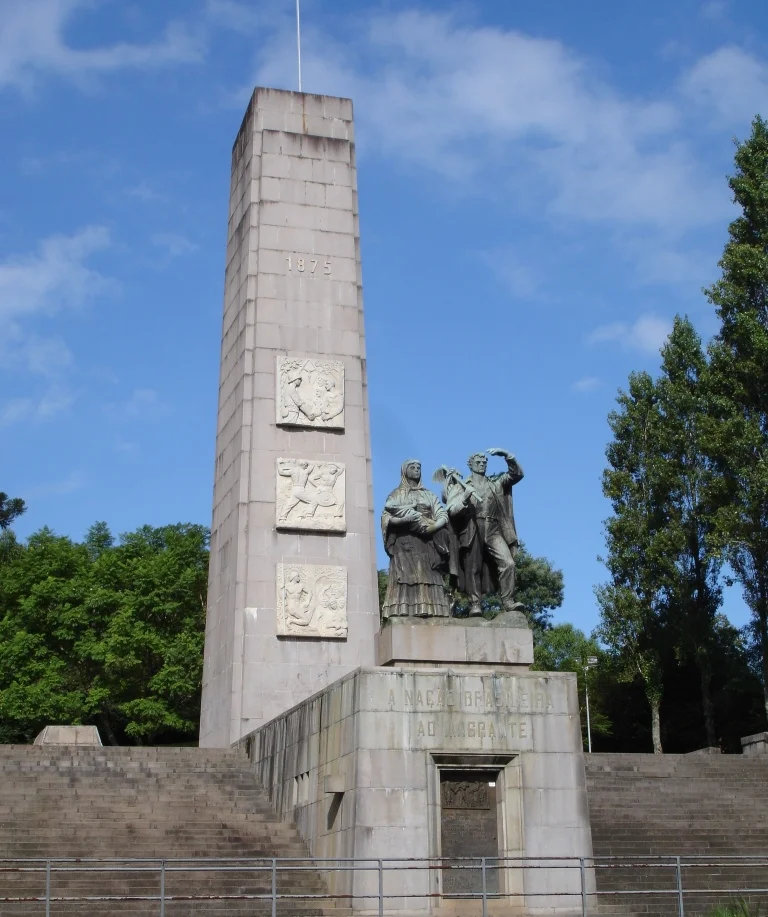

National Monument to the Immigrant
A farmer, his wife, and a child in her arms stand cast in bronze at the entrance to Caxias do Sul, where the BR-116 highway brings travelers into the city. About 4.5 meters tall and weighing nearly three tons, the figures gaze outward with the particular expression of people who have arrived somewhere and decided to stay. The sculptor Antonio Caringi called his winning design Nova Patria - new homeland. It is a fitting name for a work that started out honoring one group of newcomers and ended up honoring them all.
A Sculptor of the Pampas
Antonio Caringi was born in Pelotas in 1905 and came of age studying his craft far from home. In 1928 he entered the Academy of Fine Arts in Munich, the only Brazilian then studying sculpture there, and he returned to Rio Grande do Sul with European technique and a stubbornly local imagination. They called him the sculptor of the pampas, because he kept choosing subjects rooted in the history and culture of his home state. When a community commission in Caxias held a contest for a monument to the region's Italian immigrants, Caringi entered and won. The bronze casting fell to the Abramo Eberle metalworks - the same Caxias industrial dynasty whose Art Deco buildings still stand downtown - while local craftsmen Silvio Toigo and Jose Zambon shaped the stone.
From Italian to National
The monument's meaning shifted before it was even finished. Its cornerstone was laid in 1950 by President Eurico Gaspar Dutra, and as construction proceeded, a 1953 law redefined the project: it would no longer honor only the Italians, but every ethnic group that had helped settle and build Brazil. What began as a regional tribute became a national one. President Getulio Vargas - the same leader whose earlier government had once tried to suppress immigrant culture - inaugurated the completed work on February 28, 1954. The reversal carries its own quiet irony. The state that had spent the late 1930s policing the Italian language now unveiled a bronze altar to the immigrant family.
The Crypt Beneath
Behind the bronze couple rises an obelisk worked in bas-relief, its panels telling the story in symbols: land claimed, land cultivated, civil and military forces joined under divine protection, and the date 1875 - the year Caxias was founded. Below the sculpture lies something more intimate. A crypt was built into the base, and its bronze door shows Luiz Antonio Feijo Junior welcoming the immigrants, framed by verses from the poet Cassiano Ricardo. The space now houses the Immigrant Museum, so that visitors descend, quite literally, beneath the figures to reach the human stories they represent - the poverty left behind, the forest cleared, the new homeland made.
The People in the Bronze
It helps to remember who the farming couple stands for. Beginning in 1875, Italian immigrants arrived in the Serra Gaucha with little, sent to settle rugged highland forest that the government had promised to help clear and largely did not. They felled the trees, planted the vines, and built the towns more or less alone. The monument honors that labor without sentimentality: a couple, a child, a future being carried forward in someone's arms. By widening the tribute in 1953 to embrace every group that helped build Brazil, the law turned a single immigrant story into a shared one. The bronze family at the city gate is no longer only Italian, nor only of Caxias - it is a stand-in for everyone who crossed an ocean toward an uncertain home and stayed to make it theirs.
From the Air
The monument stands at roughly 29.17 degrees south, 51.16 degrees west, at the northern entrance to Caxias do Sul along the BR-116 highway, at about 800 meters elevation. From the air it reads as a tall pale obelisk and plaza set beside the highway corridor, best picked out at lower altitudes. The nearest airport is Hugo Cantergiani Regional Airport at Caxias do Sul (ICAO: SBCX, IATA: CXJ); Salgado Filho International at Porto Alegre (ICAO: SBPA, IATA: POA) lies about 89 km south. Expect highland fog on cool mornings; clear afternoons offer the best view of the city gateway.
Nearby Stories
- Nova Petrópolis 4.5 km away
- Cambará do Sul 47 km away
- Santa Cruz do Sul 83 km away
- Passo Fundo 95 km away
- Serra do Rio do Rastro 115 km away
- Criciúma 175 km away
- Paleontological Sites of Santa Maria 216 km away
- Battle of the River Plate 539 km away