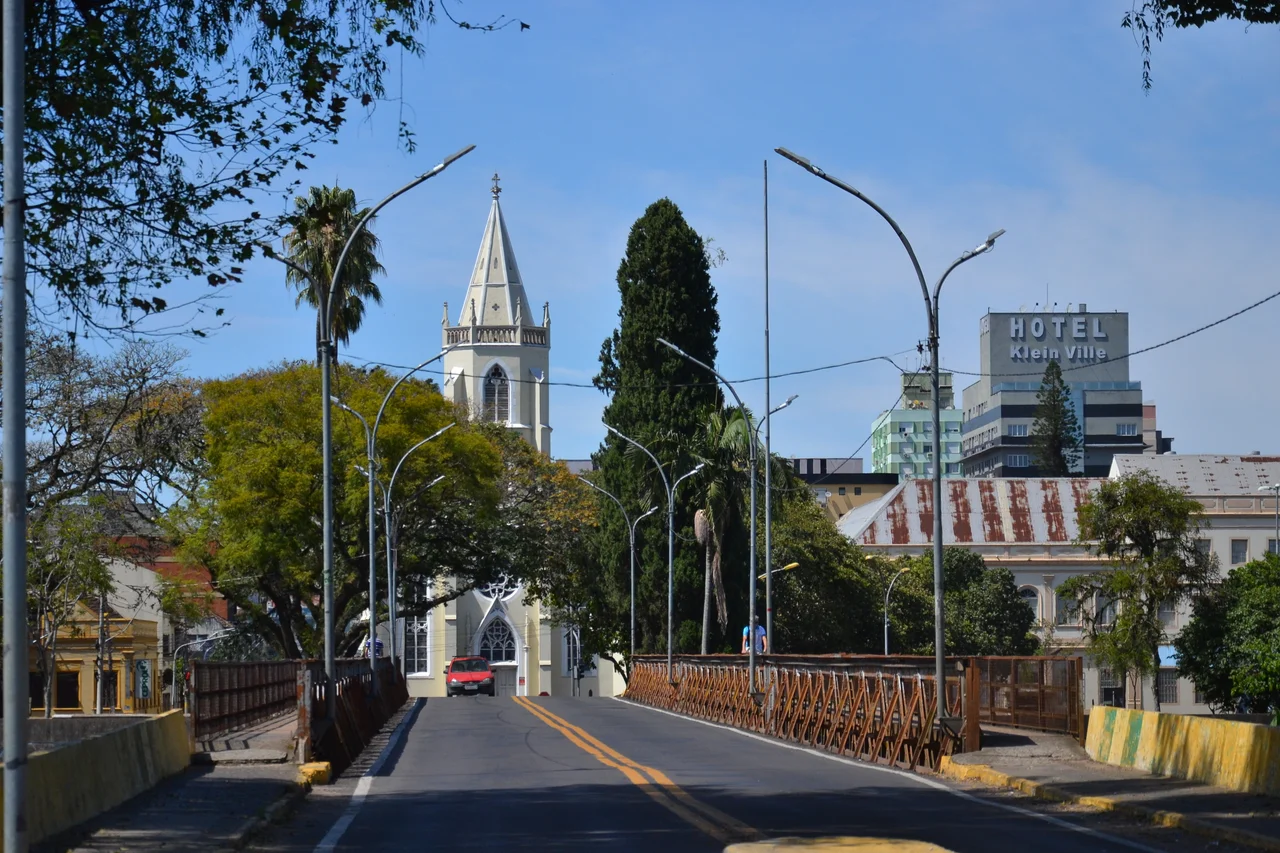

São Leopoldo
On July 25, 1824, thirty-nine people climbed out of boats on the bank of the Rio dos Sinos, roughly thirty kilometers from the provincial capital, and unpacked their lives in a place none of them had ever seen. They were farmers and artisans from the Rhineland, the Moselle valley, and the German states to the north, recruited by the young Brazilian empire to settle a thinly populated frontier. São Leopoldo is what grew from that landing. It is remembered, simply, as the cradle of German immigration in Brazil - the first official colony of a movement that would reshape the whole south.
The First Landing
Brazil in 1824 was a brand-new empire looking for hands to work its southern lands, and it found them in a Europe of crowded farms and uncertain futures. São Leopoldo was the first city the imperial government formally designated to begin its German immigration plan, which makes that July landing a genuine starting line rather than just an early date. The newcomers settled the land that became the Feitoria district and lived, at first, off subsistence farming. Word traveled back across the Atlantic, and the trickle became a stream. By 2006 the city counted roughly 210,000 people, a thriving industrial center grown from those first thirty-nine arrivals.
A Dialect That Crossed an Ocean
The settlers brought more than tools and seeds. They brought their language, and unlike most immigrant tongues it never fully faded. Riograndenser Hunsrückisch German - a Brazilian branch of the Moselle Franconian spoken in southwest Germany's Hunsrück hills - put down roots and held. It survives much as Pennsylvania Dutch does in North America, and for the same reason: a community that stayed close, kept its speech, and passed it down. Today some two to three million people understand it, not only across Rio Grande do Sul but in neighboring Brazilian states and over the borders into Argentina, Paraguay, and Uruguay. A dialect of one small German region became a living language of South America.
A Language Granted Protection
For most of two centuries Hunsrückisch lived in kitchens and fields, an everyday speech with no official standing. That changed in 2012, when the state chamber of deputies of Rio Grande do Sul voted unanimously to recognize the dialect as an official intangible cultural heritage to be preserved. The vote acknowledged what the families of São Leopoldo had quietly proven for nearly two hundred years - that the language was not a relic but a heritage worth defending. Across the state the German tongue is enjoying a revival, taught and spoken again with new pride, no longer something to hide behind closed doors.
On the Romantic Route
São Leopoldo is the gateway to one of Brazil's most distinctive landscapes of memory. The city anchors one end of the Rota Romântica, the Romantic Route, a scenic road threading thirteen towns from the capital up toward the Serra Gaúcha - a chain of communities where German-style architecture, festivals, and food carry the old country into the present. The city is also home to Unisinos University, one of the largest private universities in the south, a sign of how far this frontier colony has come. Two centuries on, the place where Brazil's German story began still wears its origins openly, in its streets, its schools, and the words its people still speak.
From the Air
São Leopoldo sits at 29.76°S, 51.15°W, in the Sinos River valley about 30 km north of Porto Alegre and part of its greater metropolitan region. The nearest major airport is Salgado Filho International (ICAO: SBPA) in Porto Alegre, roughly 25 km to the south. From the air the city reads as a dense urban patch along the meandering Rio dos Sinos, with the rising green folds of the Serra Gaúcha visible to the north and northwest - the country the Rota Romântica climbs into. A viewing altitude of 3,000 to 4,000 feet shows the river valley and the transition from the flat coastal lowland to the highlands beyond. The subtropical climate runs from near-freezing winter mornings to summer afternoons above 40°C; visibility is generally best in the drier summer months.
Nearby Stories
- Iberê Camargo Foundation 9.3 km away
- Nova Petrópolis 18 km away
- Aparados da Serra National Park 64 km away
- Santa Cruz do Sul 73 km away
- Cambará do Sul 95 km away
- Passo Fundo 158 km away
- 2009 Brasil de Pelotas Bus Disaster 177 km away
- Battle of the River Plate 464 km away